Auction Catalogue




 Create new list
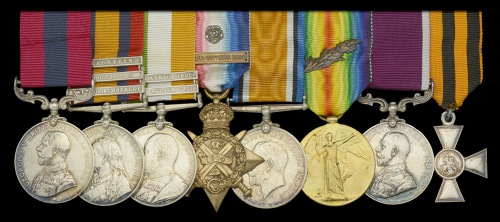
The superb ‘Le Cateau, 26 August 1914’ D.C.M. group of eight awarded to Regimental Sergeant Major A. G. Palmer, 56th Field Company, Royal Engineers, a veteran of the Boer War, who went on to distinguish himself fighting in an impromptu infantry capacity alongside Lieutenant C. G. Martin, R.E.
Martin was awarded the D.S.O. for this action, and this episode was recorded in Deeds That Thrill The Empire alongside his Victoria Cross winning exploits at Spanbroek Molen, 12 March 1915. Palmer is mentioned in Martin’s diary extracts for August 1914, which were later retold by Martin in a series of letters written to his wife in 1916
Distinguished Conduct Medal, G.V.R. (823 C.S. Mjr: A. G. Palmer. 56/Coy. R.E.); Queen’s South Africa 1899-1902, 3 clasps, Relief of Kimberley, Paardeberg, Driefontein (823 2/Cpl: A. G. Palmer. R.E.); King’s South Africa 1901-02, 2 clasps, South Africa 1901, South Africa 1902 (823 2nd Cpl A. G. Palmer. R.E.); 1914 Star, with clasp (823 C. S. Mjr. A. G. Palmer. R.E.); British War and Victory Medals, with M.I.D. oak leaves (823 T.W.O. A. G. Palmer. R.E.); Army L.S. & G.C., G.V.R., 1st issue (823 C.S. Mjr: A. G. Palmer. R.E.); Russia, Empire, Cross of the Order of St. George, Fourth Class, silver, the reverse officially numbered ‘127151’, mounted for display, light contact marks to Boer War awards and top lugs neatly removed from both, otherwise generally good very fine (8) £3,000-£4,000
D.C.M. London Gazette 6 November 1914:
‘For gallantry and coolness at Le Cateau on 26th August, in assisting Lieutenant C.G. Martin, Royal Engineers, in the defence of a Post from which Infantry had been driven.’
M.I.D. London Gazette 19 October 1914 and 15 June 1916.
Russia, Cross of St George, 4th Class, London Gazette 22 August 1915.
Albert George Palmer was born in Hastings, Sussex. He was a Harness Maker by trade, and also served with the Hampshire Isle of Wight Artillery prior to attesting for the Royal Engineers at Parkhurst, Isle of Wight in February 1897. Palmer served with the 38th Field Company, Royal Engineers during the Second Boer War, and with the 56th Field Company, R.E. on the Western Front from 18 August 1914.
Palmer distinguished himself serving beside Lieutenant Cyril Gordon Martin at Le Cateau, 26 August 1914. Martin was awarded the D.S.O. for this action, and both his and Palmer’s decorations were amongst some of the earliest gazetted for the Great War. Martin later went on to be awarded the Victoria Cross whilst serving with the 56th Field Company, and Deeds That Thrill The Empire gives the following for both actions:
‘At 7.30 on the morning of 10 March, 1915, the Battle of Neuve Chapelle began with perhaps the most terrific artillery preparation in the history of modern warfare, and by the evening of that day the village was ours, and on a front of three miles we had advanced more than a mile. But our ultimate objective - the driving of a great wedge into the enemy's line by the capture of the ridge south of Aubers - still remained to be accomplished; and it was to this task, which was to prove, unfortunately, beyond the capacity of our troops, that the two following days were devoted. Simultaneously a number of movements were undertaken all along the British front, with the object of preventing any sudden massing of reinforcements, and it was during one of these attacks - that upon the German position at Spanbroek Molen - that a young officer of the 56th Field Coy. Royal Engineers, Lieut. Cyril Gordon Martin, performed the gallant action that gained him the Victoria Cross. Lieut. Martin had already won the Distinguished Service Order by his gallantry in the first weeks of the war, during the Retreat from Mons, when, at the head of his platoon, he had captured a German trench and held it until reinforcements arrived. On this occasion he was twice wounded, and invalided home for some months; indeed, he had only recently returned to the front. Early in the action at Spanbroek Molen, Lieut. Martin was again wounded; but he made light of his hurt, and volunteered to lead a little party of six bombers against a section of the enemy's trenches. So effectively did they discharge their deadly missiles that the Germans were quickly driven out in rout and confusion, when the Lieutenant and his men proceeded to transfer the parapet of the trench and to strengthen their position with sandbags, in readiness for the inevitable counter - attack. This was not long in coming, but, inspired by the splendid example of their leader, the little band of heroes drove their assailants back, and though the attack was again and again renewed in apparently overwhelming numbers, they succeeded in holding the enemy at bay for two and a half hours, when orders arrived for them to abandon the captured post and retire. By their gallant defence they had rendered most valuable service by holding up German reinforcements, who were unable to advance until this section of their trenches had been retaken."
The early actions and movements of Palmer’s 56th Field Company during the Great War are described in detail by Lieutenant C.G. Martin in letters that were written by him to his wife in 1916. The letters were based on his diary extracts from the time, and were subsequently published in The Royal Engineers Journal of June 1981:
August 16th. Sunday. We left Bulford at 2am for Amsbury Station and arrived at Southampton Docks at Ipm. The ship was on the London - Bordeaux trip and we shared it with a Company of the ASC. We had to sling our horses aboard but the pontoon wagons would not go through the holds and so had to be unloaded. We finished loading at 6pm. The ship left the docks and anchored off the isle of Wight till it got dark. We were lucky as the ship had just been stocked up for its run from London to Spain and so we had a good dinner and each Officer a cabin to himself.
August 17th. Monday. Crossed to France that night and woke up at 5am and recognised Havre. As soon as we entered the Seine and I knew that we were making for Rouen. We were a fast ship and soon passed half a dozen slower transports, there was much shouting, cheering and singing of Tipperary. All the villages were decorated with flags and people on the banks were shouting Vive les Angiais. At about noon we reached Rouen and berthed above the Transporter Bridge about 4pm. Unloading the horses was difficult as the gangways were very steep and narrow. Temporary horse lines were made on the quay by attaching ropes to the lamp posts. We then started unloading the pontoon wagons, the first got jammed in the small hatch and by the time we had cleared it we realised we could not complete the unloading that evening. So we had to have another night on board with a comfortable bed and another good dinner. I had to do duty on the horse lines from 11pm to 1am on the quay.
August 18th. Tuesday. We got everything off the ship by 11am and marched to a rest camp about 2 miles South of Rouen near the Race Course. Having got comfortable in the rest camp by about 2pm we were warned that our train left Rouen at 5am next morning, so turned
in early as the parade next morning was at 1.30am.
August 19th. Wednesday. Marched from the camp at Rouen at 3am and moved to the Gare du Nord station and entrained. A long journey through Amiens to Sasseignes where we detrained at about 6pm. Marched about 2 miles to our billets. This was our first experience of billets - the men were in empty houses sleeping on straw. The Officers slept in an empty house but had meals with a family, we had a good meal and drank many healths before we got to bed.
August 20th. Thursday. Left Sasseignes at 6am and matched to billets at Harmics. It was a very hot day and after we had settled down in our billets we had a grand bathe in a little stream nearby. Before I left England I bought a small bivouac tent, 6ft by 6ft and very light, and when I could I pitched it near our billets and found it much more comfortable than a dirty French bed one had to share with undesirable companions. No one knew where we were going or what our job was going to be or where the Germans were located.
August 21st. Friday. We continued marching North and just after midday we marched through Mauberge. We passed some of the forts just like those around Chatham. The French were digging new trenches and putting up barbed wire entanglements around them. Some of the barbed wire was 70 yards wide which surprised me as we had always been taught that 20 yards was enough for defences. Mauberge was full of French troops, a dirty looking lot, mostly reservists. We marched on about 5 miles to Feignes where we got a fine billet in a school but just as we had settled down to supper we were ordered to move on a further 7 miles to Goesgnies Chausse. I was acting as guide to the Company (56) and it was a pitch black night. I was very frightened that I would lose my way, however we got there safely. We found a large farm, half in France and half in Belgium, and tied our horses to the trees in the orchard. Here we got our first news of the Germans, that they were advancing towards Mons. (16 miles).
August 22nd. Saturday. Continued our march towards Mons and before we had gone a mile I was ordered to take my Section to Givry to help the Royal Irish to entrench. When I got there I found Holt, one of our Subalterns, already at work but I had orders for him to join the Company at Mons. I then looked at the proposed work and thought it was wrongly sited being on the front slope instead of the back slope. I had a bit of an argument with Major Daniel, (Royal Irish), and got him to agree with me, so we resited the whole line. At about 2pm I was ordered back to Mons and heard of the German advance. I marched back and found the Company bivouacked at Myon. I pitched my tent and it began to pour with rain, so the tent became the Officers Mess and Hopkins, Nation and I had supper in it.
August 23rd. Sunday. At 8am I was ordered to take my Section to Mons and await orders. At 8.30 I was told to move to Symphorien to help the Royal Scots dig in but on arrival was told I was not wanted so hurried back to Mons. On arrival I was ordered to destroy the bridge at Obourg 2 miles away. I rode off telling the Section to follow. On arriving at Obourg at 11am I found the 4th Middlesex holding the railway station on this side of the canal and bridge. There was a good deal of firing and I saw a German cavalryman shot on the other side of the bridge. The tow path was on the other side of the canal so the only way to get below the bridge was to cross the bridge.During a lull in the firing I dashed across the bridge and got under it and saw that it would take a long time to fix the charges. I dashed back over the bridge and found my tool cart had come up and was under cover about 50 yards away and the explosives were being unpacked. I found a ladder and with five men and all the stuff dashed across the bridge and got under it. By now a few shells were arriving and heavy rifle fire, mostly from our side. We found that the ladder was too short and that without a quantity of planks and
uprights it was impossible to fix any charges to the underside of the bridge. At this moment the firing above us showed that the Germans were very close so I decided to get back. I semaphored the Middlesex for covering fire and dashed over. As we got back to the tool cart we saw the Middlesex retiring from the station. I told the men to pack up and return to Mons and as I turned I saw the Germans swarm over the bridge. I jumped on my horse and only just got away and soon caught up with my Section. We rejoined what was left of the Company. I was lucky not to have a single casualty. Holt on a bridge nearby was caught under it with his whole Section and was killed. Day was in the same box and was captured. The Company was then sent to the right flank at Nouvelles and spent the rest of the day and the night digging trenches. At 4am the retreat commenced.
August 24th. Monday. We left Nouvelles at 6am after having taken shelter in a village from a German battery which shelled us with shrapnel. After taking a short cut which proved to be a very long one, we got on to the Bavai road. The road was packed with refugees and their carts and troops without units. We reached Bavai at about 3pm where the stragglers were collected into units. The Sappers marched all day with their tool carts. We got to our halting place at Amfroipret about 2 miles SE of Bavai at 4pm and spent the night there. Great difficulty in getting supplies, but Nation and our QM managed to find enough to keep us going.
August 25th. Tuesday. Left Amfroipret at about 4am and the men had their breakfast before leaving, but the cooks had put salt in the tea instead of sugar, the men were awfully sick and started grousing. I told them not to blame the Officers for it and if they did not shut up they would have to march at attention all the way, some 35 miles and that stopped them. We marched solidly all day going through Le Quesnuy and on to Solesmes arriving at 7pm hoping to stop there; but were ordered to march on another 5 miles in the dark to Caudry. I was sent on to get our billets while the men had a drink in a pub which cheered them up. I got hold of the Mayor and got about 60 small houses. It was around 11pm so they were all in bed. We had to wake them all up and explain in my poor French that they had to have four soldiers each billeted on them. All the men were settled in by midnight. I was Duty Officer and had just got to sleep when I was
woken up with orders that the Company was to parade at 3am for trench digging.
August 26th. Wednesday. Up at 3am but hardly any of the men paraded. We had to go round the houses and pull them out of bed as they were all so tired. The QMS managed to find a bakery so it was bread and bully beef for breakfast. We moved off to the rendezvous the Staff had given us but they did not turn up until 8am and with them some German shells, so no digging was done and we were sent to the village square to await orders.
The Le Cateau position ran due East to Caudry and from there it bent South West. The Royal Irish occupied the North of the village.
A report came in that a Battery of Gunners had been held up by wire and had no wire cutters. I was sent with some cyclists to help them. I met a Battery and asked for information but they knew of no wire, so returned to the village and found the square empty. I collected all the Sappers I could find, about 15 including the CSM [Palmer] and cooks and Officers servants and reported to the Royal Irish HQ. They wanted ammunition taken up to the Regiment. We found their men lining the edge of the village behind a small bank with a field of fire of about 100 yards. Standing up I could see over a mile to the village of Bethancourt. We distributed the ammunition and my men joined the firing line. Quite a lot of bullets were coming over but our line being on the reverse slope we were quite safe.
The Officer in charge of the Infantry was very nervous and kept saying we ought to retire. I said you can't, your CO has just sent you up ammunition. I then told him that I would go into one of the houses just behind us and direct the fire of his men. Got up to an attic window and had a wonderful view. I saw a firing line of sorts about a mile away and behind that some dismounted Cavalry and what looked like two Companies of Infantry in close formation. It was obvious that we would soon be attacked so I thought that the more noise we made with our rifles the longer it would be delayed. I passed the word to the men below me to pass the following order along the line-All men to put their sights at 1000yds, Aim straight in front, Load magazines and fire five rounds rapid whenever I blew my whistle. The scheme worked well, the Germans took what cover they could find or withdrew a bit. The morale of our men rose and it was hard to make them wait for the next whistle. We kept up this type of firing with several gaps till about one o'clock when the Germans started shelling us. Suddenly as I was pointing out a target the whole house shook and I found myself on the floor rather dazed. The bed, and the back wall of the room, had disappeared with all my kit on it. Just under the window out of which I was looking was a round hole about one foot in diameter and I am sure that the shell must have passed between my legs which were about 2 feet apart. It took me a minute or two to collect myself and get out of the house. I opened the front door and found that all the infantry had cleared off and my Sappers wondering what was left of me. I told them to go on firing as hard as they could to pretend that we were still a large force. I lay down next to my Sergeant Major [Palmer] who was rather large, he felt awfully unhappy because a machine gun was firing about 3 inches above him and he could not move. The man on my right lifted his foot for a second and had the heel of his boot taken right off. The Infantry reported that I was dead and that the Germans had captured the village. The Infantry mounted a counter attack and found us instead of the Germans holding the village. We stayed till about 3pm and then had an order to retire and slipped away with only one Sapper wounded. I had lost my hat but luckily picked up a soldiers hat lying in the road that fitted me perfectly. We marched in pouring rain and darkness until we reached Le Catelet; there was no sign of my forage cart which contained all my kit, equipment and my tent.’
Palmer advanced to Temporary Regimental Sergeant Major (entitled to Silver War Badge, and he discharged due to ‘Sickness’, 31 October 1918). The medal group of Brigadier C. G. Martin, V.C., C.B.E., D.S.O. is held by the Royal Engineers Museum.
Share This Page