Auction Catalogue




 Create new list
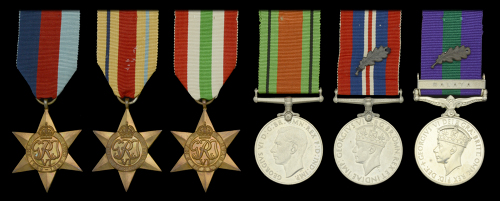
Six: Lieutenant-Colonel J. A. Cameron, Royal Engineers, who ended his long and distinguished career with a ‘Mention’ for services in the Malaya Emergency
1939-45 Star; Africa Star; Italy Star; Defence and War Medals 1939-45, with M.I.D. oak leaf; General Service 1918-62, 1 clasp, Malaya, G.VI.R., with M.I.D. oak leaf (Lt. Col. J. A. Cameron. R.E.) good very fine (6) £160-£200
This lot is to be sold as part of a special collection, Medals from the Collection of Lieutenant-Colonel Edward De Santis.

View
Collection
John Ancrum Cameron was born in Kensington, London on 27 August 1903, the son of Major Sir Maurice Cameron, K.C.M.G., R.E., who served as Surveyor General of the Straits Settlements and was a Crown Agent for the Colonies. Educated at Wellington College and the R.M.A. Woolwich, young John was commissioned as a Second Lieutenant in the Royal Engineers in August 1924. Two years later, on being promoted to Lieutenant, he received orders to join Queen Victoria’s Own Madras Sappers and Miners in India, where, in due course, he was assigned to 10 Field Company, at Razmak on the North West Frontier. And it was there, in May 1930, that he first witnessed active service, when a force of 4,000 Tochi Wazirs attacked Datta Khel but were driven off by the Razmak Column. He was awarded the India General Service Medal with ‘North West Fronter 1930-31’ clasp.
By the outbreak of the Second War, Cameron was serving at Bangalore as an Acting Major in command of 14 Field Company, Madras Sappers and Miners, and in February 1942 he was posted as O.C. 12 Field Company to the 4th Indian Division. The latter assignment led to his deployment to North Africa, where his company carried out extensive demolitions in Benghazi and then withdrew eastwards to Gazala. Then, following a brief sojourn in Cyprus, Cameron and his company returned to the fray in November 1942, when they were assigned to a flying column whose mission was to clear minefields, in addition to round up prisoners, guns and equipment left behind by the retreating Italians.
But it was in the British attack on the Mareth Line in March 1943 that Cameron and his company particularly distinguished themselves, constructing two causeways in a wadi which came under heavy fire:
‘From front and rear over the heads of the sappers, tracer rounds, mortars and sheets of machine-gun fire streamed. Then the field guns joined in. Between the walls of exploding shells the engineers grappled with their task. The area around the Wadi Zig-Zaou was transformed into a block of dust and fumes, shot with flames rising into the luminous sky.’ Nonetheless, as also observed in the historical records of the 4th Indian Division, ‘Cameron and Subedar Sampangiraj of 12 Field Company supervised the tasks as calmly as though on exercises.’
Next in action in the attack on Wadi Akarit on 6 April 1943, his company were tasked with making gaps in the minefields, an unenvious assignment enacted under further fire. It was in this action that his C.O., Lieutenant-Colonel Blundell, was killed, and Cameron was appointed an Acting Lieutenant-Colonel and C.R.E. of the Division. And he was likewise employed in the final victorious push to Tunis in May 1943, in addition to being specially selected to command the subsequent Victory Parade in the presence of King George VI. On that memorable occasion, Cameron shook hands with the King and presented one of his VCOs, Subedar Narinder Singh, to His Majesty. The King, looking pleased with the Sapper and Miners, pronounced them “A good lot” at which time Cameron took a pace to the rear and ordered, “Sappers and Miners, three cheers for His Majesty the King-Emperor.”
Cameron remained employed as the Division’s C.R.E. throughout the Italy campaign, in which it participated in the battles of Monte Cassino and in later operations against the Gothic Line. Then, in September 1944, the Division was ordered to Greece, where Cameron remained actively employed until returning to India in early 1945.
Having then served as an Assistant Commandant of the Madras Sappers and Miners at Bangalore, he was ordered to Malaya, where he was appointed Assistant Director of Works in May 1949. And he was again Mentioned in Despatches ‘in recognition of gallant and distinguished services’ there in the period 1 July to 31 December 1950’ (London Gazette 27 April 1951, refers).
Cameron clearly liked Malaya, for on taking his retirement in July 1952, he opted to stay on as a Security Officer at Pahang. Additionally, between 1953 and 1957, he served as the Commanding Officer of the Pahang and Selangor Home Guard and was involved in combating Communist guerrillas. He finally returned to the U.K. in the mid-1960s. Following his death in Hereford in August 1996, one obituarist described him as ‘mildly eccentric, but his radiating smile, extraordinary memory and profound humanity endeared him to all.’ He was ‘also a practical joker with a marvellous and mischievous sense of humour.’
Note: Second War M.I.D. unconfirmed.
Share This Page