Auction Catalogue




 Create new list
Three: Private G. Bateman, Royal West Surrey Regiment, who was taken Prisoner of War at the Battle of Gheluvelt, 31 October 1914, and spent the rest of the Great War in captivity
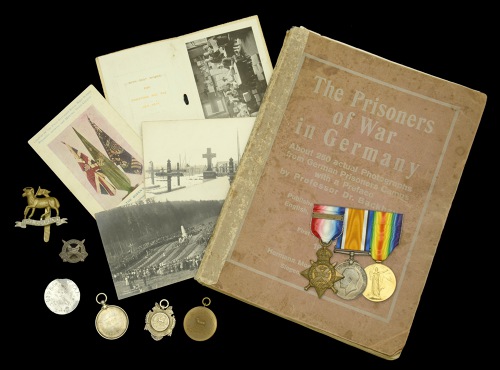
1914 Star, with clasp (L-8195 Pte. G. Bateman. 1/The Queen’s R.); British War and Victory Medals (L-8195 Pte. G. Bateman. The Queen’s R.) all in named card boxes of issue, the last two with outer envelopes addressed to ‘Mr. G. Bateman, 7 St. Ann’s Gardens, Kentish Town, London, NW.’, extremely fine (3) £200-£240
George Bateman was born in Marylebone, London, in 1885, and attested for the Royal West Surrey Regiment at Guildford on 25 October 1904, whilst currently serving in the Regiment’s 3rd (Militia) Battalion. Posted to the 2nd Battalion on 13 February 1905, he transferred to the 1st Battalion on 25 November of that year, for service in India. Returning home on 21 February 1910, he transferred to the Army Reserve on 24 October 1913.
Recalled to the Colours following the outbreak of the Great War, he served with the 1st Battalion during the Great War on the Western Front from 12 August 1914. He was taken Prisoner of War at the Battle of Gheluvelt on 31 October 1914, during which battle the Battalion was virtually wiped out, suffering 9 officers and 624 other ranks either killed, wounded, or missing. However, their sacrifice was not in vain, for despite their heavy losses they prevented the enemy from taking Ypres and being able to advance on the channel ports. As Field Marshal Sir John French said: ‘31 October and 1 November will remain forever memorable in the history of our country, for, during those two days, no more than one thin and straggling line of tired-out British soldiers stood between the Empire and its practical ruin as an independent first-class Power.’
Bateman was one of those reported missing during the defence of Gheluvelt. Having been taken Prisoner of War, he spent the remainder of the War in captivity, including at Hähnofersand Lager P.O.W. camp. He was repatriated on 31 December 1918, and was discharged on 31 March 1920, after 15 years and 159 days’ service, of which 4 years and 62 days were spent in captivity.
Sold with the recipient’s identity tag; cap badge; ‘Old Contemptibles’ lapel badge; a Queen’s Regiment ‘Prisoner of War Welcome Home Medal’, bronze; and two Regimental prize medals, both silver, these last three in cases of issue; a copy of ‘The Prisoner of War in Germany’, a booklet containing approximately 250 photographs from German Prison Camps, the inside page inscribed ‘Cpl G. Bateman 8195, “Queen’s” Regiment, Hähnofersand Lager, Germany, 26.5.1917’; various other ephemera; and copied service papers and a large quantity of copied research.
Share This Page