Auction Catalogue




 Create new list
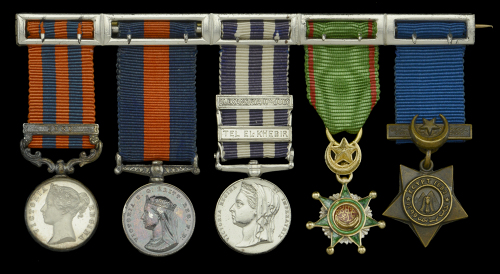
The mounted group of five miniature dress medals attributed to Admiral the Lord Alcester, Royal Navy
India General Service 1854-95, 1 clasp, Pegu, the planchet housed in glazed lunettes,the reverse lunette missing; New Zealand 1845-66, reverse undated; Egypt and Sudan 1882-89, dated reverse, 2 clasps, Tel-El-Khebir [sic], Alexandria 11th July, mounted in this order; Ottoman Empire, Order of Osmanieh, silver, gold, and enamel; Khedive’s Star, dated 1882, mounted as worn from a quintuple twin-pronged top silver riband buckle, with gold retaining pin, good very fine (5) £300-£400
Frederick Beauchamp Paget Seymour, 1st Baron Alcester, a scion of the Dukes of Somerset, was born on 12 April 1821 into a notable naval and military family; his father, Colonel Sir Horace Seymour served as aide-de-camp to Lord Uxbridge, and had carried the wounded Uxbridge from the battlefield of Waterloo; whilst his grandfather, Vice-Admiral Lord Hugh Seymour, had captained H.M.S. Leviathan at the Glorious First of June, being awarded a Naval Gold Medal. He entered the Royal Navy in 1834, and had a meteoric rise, being advanced Commander on 5 June 1847, whilst just 26. He served during the Anglo-Burmese War in 1852-53, and subsequently as Commander-in-Chief of the Australia Station from March 1860 to July 1862, commanding the Naval Brigade in New Zealand 1860-61, for which services he was appointed a Companion of the Order of the Bath. Advanced K.C.B. in June 1877, and G.C.B. in May 1881, from 1880 to 1883 he was Commander-in-Chief, Mediterranean Fleet, and was advanced Admiral in May 1882.
Seymour commanded the Fleet at the bombardment of Alexandria on 11 July 1882, and in the subsequent operations. For his services during the Egyptian campaign he was created Baron Alcester, of Alcester in the County of Warwick, and was also voted a gratuity of £25,000 by parliament, as well as being given the Freedom of the City of London. Appointed Second Naval Lord in 1883, Lord Alcester retired in 1885, and died, heirless, on 30 March 1895, upon which his peerage became extinct.
Share This Page