Auction Catalogue




 Create new list
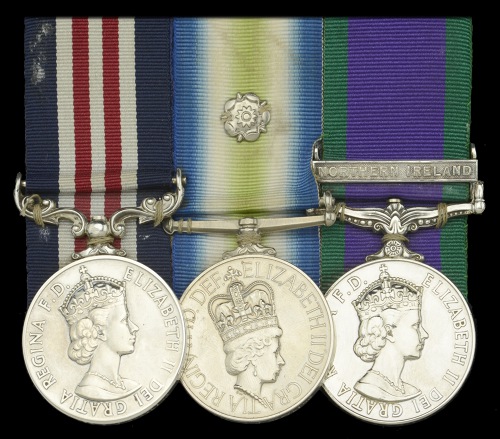
The important Falklands War ‘Battle of Goose Green’ M.M. group of three awarded to Corporal B. J. ‘Baz’ Grayling, 11 Platoon, ‘D’ Company, 2nd Battalion, The Parachute Regiment, for the epic frontal assault on the Argentine held Coronation Point; which the nineteen year old carried out alongside his best friend ‘Gaz’ Bingley. Their Company commander Major Phil Neame stated, ‘The assault led to four casualties. One of those killed was Corporal Bingley who was very brave.
He’d gone to ground not really knowing quite where these machine-guns were and found himself virtually overlooking the position. He and Grayling just went in and did an immediate assault and the two of them took the five-strong position between them.
But Bingley was killed in the process and Grayling slightly injured. It was that sort of immediate get up and go and flair that really got us out of a very sticky situation.’
Lance-Corporal ‘Bill’ Bentley M.M., 2 Para medic, later retrieved Bingley’s body from the battlefield, ‘It was a moving moment for everyone. Gaz was the first of our dead to be recovered. The story of his last few minutes of life had already reached us through Baz Grayling. They had been making a frontal charge on an Argie machine-gun post. Grayling was hit at close range in his water bottle; it exploded shattering his hip. As Grayling collapsed, still firing, they silenced the Argie MG. But as fate would have it the last few rounds squeezed off by the Argie gunner ripped through Gaz Bingley’s head, killing him instantly. Both Bingley and Grayling were awarded the Military Medal for their heroic effort.’
Military Medal, E.II.R., 2nd issue (24521305 Pte B J Grayling Para); South Atlantic 1982, with rosette (24521305 Pte B J Grayling Para) with official corrections; General Service 1962-2007, 1 clasp, Northern Ireland (24521305 Pte B J Grayling MM Para) mounted as originally worn, very fine (lot) £50,000-£70,000
M.M. London Gazette 8 October 1982:
‘In the dark early hours of Friday 28 May 1982, the 2nd Battalion The Parachute Regiment launched a night attack on an enemy bunker system in the area of the Goose Green settlement on the Island of East Falkland.
Private Grayling and Lance Corporal Bingley were members of a machine gun team when two enemy machine gun posts opened up on the Company’s right flank. The enemy’s heavy rate of fire threatened to stop the advance.
Private Grayling and Lance Corporal Bingley moved to a position where they thought they could put down suppressive fire. Instead, they found themselves within ten metres of the enemy. With a total disregard for their own safety they immediately attacked and destroyed the enemy machine gun position. Lance Corporal Bingley was killed and Private Grayling continued and successfully pressed home the assault.
Their heroic action ensured that the company could continue its advance. For his part in this attack in which his conduct, bearing and determination were of a very high order indeed.’
Corporal G. D. ‘Gaz’ Bingley, listed above, was awarded a posthumous M.M. for his gallantry at Goose Green (this medal group appearing at public auction in 2018)
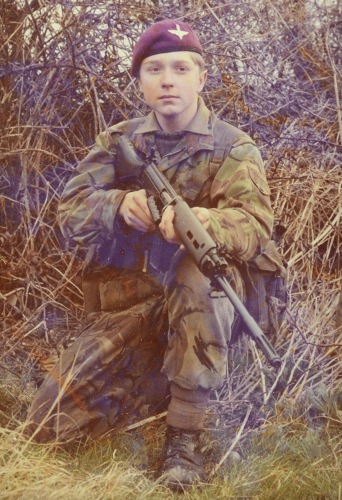
Barry James Grayling was born in January 1963, and resided in Felixstowe, Suffolk. He joined the British Army in May 1979, and subsequently attended selection for the Parachute Regiment. Having completing his recruit training and initial jumps training, Grayling gained his wings and was assigned to 2 Para. After a very brief posting to Germany, Grayling served in Kenya, 13 November - 18 December 1981.
Grayling embarked for the South Atlantic on Operation Corporate on 26 April 1982, upon the successful completion of which he returned to the U.K. and then served in Belize, April - October 1983. Grayling served a tour of operations in Northern Ireland, 5 November 1984 - 19 March 1985, with other postings including to the U.S.A., Belize, Cyprus and Canada. He was discharged, 8 January 1990, having served 10 years and 230 days with the Colours.
Britain’s Elite Airborne Infantry - With 2 Para in the Falklands
Grayling was a member of 11 Platoon, ‘D’ Company, under the command of Major Phil Neame. His Platoon Leader, and best friend, being Lance-Corporal ‘Gaz’ Bingley. 2 Para were due for a proposed tour of Belize, the latter being cancelled as the situation in the South Atlantic unfolded.
Lieutenant-Colonel Christopher Keeble, D.S.O., who assumed command of 2 Para at the Battle of Goose Green following the death of Colonel ‘H’ Jones V.C, gives an insight into the ethos of the men of the Battalion as they embarked for a 21 day voyage of training and preparations for war whilst afloat:
‘I was enormously attracted to the Parachute Regiment because of this wonderful feeling of comradeship. We all have to go through a traumatic selection process, which weeds out a great number of people. We are united in our hardship, by what we have done. It is a very good way of preparing for the actual trauma of war. Soldiers do not fight for Queen and country, or even for Maggie - they fight for each other. But they need to know that their comrades would do the same. Selection produces that mutual trust. That's how it is in 2 Para. We had spent our practice-training fusing the individuals together. The fire of war merely tempered that process. We would never have given up. We would have fought to the last man rather than not achieve the mission.’
Little wonder, then, that the Parachute Regiment has been actively deployed for almost every year of its existence and its men have been decorated out of all proportion to their number; their accolades including two Victoria Crosses each for Arnhem, and in more recent years, Afghanistan. Most pertinently though, and perhaps, unsurprisingly, both V.C.s awarded for the Falklands War also went to men from the Parachute Regiment; one being to Sergeant Ian Mckay, 3 Para, for Mount Longdon. The other, awarded to Lieutenant-Colonel H. Jones, O.C. 2 Para, was for Goose Green and it is hard to find a better example of the Parachute Regiment’s aforementioned qualities than in 2 Para’s celebrated and epic battle on 28 and 29 May 1982 on the cold, boggy and treeless terrain of the isthmus of the Darwin and Goose Green settlements. Indeed, a signal, sent to 2 Para after the battle from the Chief of the General Staff stated that the Battalion had ‘executed a feat of arms and gallantry probably unsurpassed in the glorious history of the British Army PD it will certainly rate with the other great examples of courage by the Parachute Regiment such as the Normandy Landings and Arnhem’.
The main body of the Battalion embarked in the requisitioned North Sea ferry, the MV Norland, from Portsmouth on 26 April 1982. Major Phil Neame, Officer Commanding D Company, 2 Para, describes the changing atmosphere among the members of the battalion during their 21 day journey to the South Atlantic:
‘There was a lot of training and sorting out of stores and so on. But no one took the exercise seriously, it all looked likely that we would go for a nice South Atlantic cruise, a big show of arms and maybe even go ashore, but no one really thought that we were going to shed blood at that stage - they were all hoping we would, but didn’t really believe it was going to happen.
I suppose it all started to change when the Belgrano was sunk. That of course got everyone chauvinistic and excited; then a couple of days later the Sheffield was sunk. It was at this point that the ship became rather more quiet than it had been, everyone wrapped up in their own thoughts, but probably not until then had it dawned really that this could be a rather bloody business and that we might not all be coming back.’ (Major Phil Neame’s personal account of the action at Goose Green published in Above All, Courage by Max Arthur, refers.)
Although late to depart from the U.K., the men of 2 Para were among the very first of the Task Force to be put ashore, landing on ‘Blue Beach’ in Bonner’s Bay, San Carlos Water, on the dark, early morning of 21 May, whence they were ordered, laden down with extremely heavy bergens, to move up to the top of the dominating feature of the area, Sussex Mountain, to ensure no Argentine force had any chance of disrupting the landings, ‘D’ Company at the rear:
‘As we moved off we ended up at the rear of the battalion snake going up Sussex mountain. I suppose everyone was carrying about 80 lbs but the guys with the mortars must have been carrying around 120 lbs and of course were holding us up at the back. With Argentine air strikes expected at daybreak this was a little trying. Knowing our rear was by then secure, I overtook them, but we were still left struggling up the mountain when the first strikes came in’ (Ibid)
Fortunately for 2 Para, the Argentinian aircraft were focussed mostly on the large number of ships in the bay, some of which were hit, to devastating effect. The battalion could only stare as successive Mirage or Skyhawk attacks went in, while in the Command Post work had to continue regardless of feelings of vulnerability. The 2 Para position was quite unique in that most of the enemy aircraft had to pass over the battalion before getting to the ships. Their grandstand on Sussex mountain allowed the Machine-Gun Platoon to produce a barrage of bullets which resulted in a claim of at least three hits. Similar stories were repeated often in the rifle companies. Soon the combination of inactivity and frustration at the carnage being wreaked below began to take effect. Above all, there was no clear direction given to the proceedings, and as yet no decision had been made for a breakout. The constant wind did little to boost spirits either - at this stage, for 2 Para, the major cause of casualties was the effect of cold and wet on the feet. Trench foot put numbers of men out of action.
The Fight Back - 2 Para Unleashed
Under pressure to strike back after the air attacks in the bay, Command HQ finally ordered 2 Para to break out of their entrenched but impotent position on Sussex Mountain and raid the Argentine Garrison holding Goose Green - a settlement situated 15 miles south of Sussex Mountain on an isthmus connecting the Northern and Southern parts of East Falkland. Despite Goose Green not seeming to have much strategic value, it was a valid fear that later in the campaign Argentine forces might use its airfield and troops to deliver strikes on the British troops closing in on Stanley. In addition, and probably more significantly, the British government now badly needed a ground offensive victory for political and propaganda purposes.
A period of agonising frustration now followed in which, on two separate occasions, 2 Para were primed to raid Goose Green only to have the operation aborted. On the first occasion, 12 Platoon had even gone ahead and secured Canterra House, a dwelling approximately half way between Sussex Mountain and the start of the Goose Green isthmus. Linking up with the remainder of ‘D’ Company, chosen as the advance guard for the raid, they had then set off for their immediate objective, Camilla Creek House, before hearing that the operation had been shelved. 12 Platoon returned to Canterra House and the rest of D Company, including Grayling, trudged back over the 7 or so miles of trackless moorland, arriving back, late into the night, at Sussex Mountain wet, tired and miserable. A lack of air support due to SAS prioritisation had been the cause of the cancellation and Colonel H Jones was furious, exclaiming ‘I’ve waited twenty years for this, and now some f------ marine’s cancelled it’. He showed little sympathy, however, for the men of D Company, such were his high expectations, telling them to ‘stop whinging and get on with it’. The following morning a second planned operation was also cancelled, this time due to bad weather, and so 12 Platoon, by now tired and hungry themselves, ‘tabbed’ back from Canterra House to rejoin 2 Para in the trenches on Sussex Mountain.
Goose Green and ‘The Red Machine’
Finally, on 26 May, to his great relief, Jones was informed by Brigadier Julian Thompson, O/C 3 Commando Brigade, that the mission was back on. This time it was not to be just a raid however; the orders now were for 2 Para to actually capture Goose Green and its garrison of close to 1100 well-armed troops who were in prepared positions, protected by minefields. And so, just after dusk on 26 May having already lost the equivalent of a platoon of men to the ravages of frostbite and exposure, the paratroopers of 2 Para Battalion (approximately 450 men), once again led by ‘D’ Company, moved off the mountain and navigated, in pitch darkness, the 8 mile trek through the marshy and rock strewn terrain towards the unoccupied Camilla Creek House, in the environs of which the entire battalion, bar those on patrols, spent the following day resting and preparing their equipment. The men, now in light fighting order, were carrying their weapons, including ammunition, two water bottles and food for forty-eight hours. The 2 inch mortars were left behind since H.M.S. Arrow would be on hand to provide starshell illumination but at the last moment ‘H’ agreed to bring two 81mm mortars. Radio equipment, three Milan missile firing posts and 17 missiles were also taken.
Then, in a rather shameful turn of events, the Signals Platoon, tuning into the 10am BBC World Service, realised their mission had been compromised; the news reader announcing to the world: ‘A parachute battalion is poised and ready to assault Darwin and Goose Green’. Their incredulous Colonel raged incandescently, fulminating that he would sue the Corporation and the government in due course. The culprit was never found but political expediency from within Thatcher’s war cabinet was always suspected. Nonetheless, working with very little fire support and limited information about his target, ‘H’ gave the orders for the attack to his company commanders and battalion specialists late on 27 May, shortly after which the various companies moved into their start line positions at the top of the isthmus, highly motivated for a fight.
It was known that the Argentine defences comprised of at least three rifle companies, in addition to some Air Force personnel. Mixed intelligence gathered from previous patrols in the area did little to clarify the situation. It was, however, known that there was a system of at least 16 trenches near Darwin Hill, with more in and around Boca House and Darwin itself.
What resulted was a six-phase, night/day action, with the ground and numbers both in favour of the defenders. This did not deter the ‘Red Machine’. 2 Para were tasked with covering 14km, capturing Goose Green and its garrison, all within 14 hours. Grayling’s 11 Platoon was commanded by the nineteen year old Second Lieutenant Chris Waddington, known by the nickname ‘Boy Wonder’. The latter was the same age as Grayling. The 24 year old ‘Gaz’ Bingley being the Platoon Leader.
Grayling’s ‘D’ Company started as the reserve for the attack, moving through the night with the firefights growing in noise as the day broke. It would be at Coronation Point after daybreak that ‘D’ Company would come to the fore. As often occurs in the heat of battle, the original plan for Major Neame’s men had to be adapted. They had followed ‘C’ Company as directed to their start line. However, in the darkness and with ‘.... this enormous gaggle of bodies’ it soon became clear they had overshot the mark, finding themselves not only in front of the RV, but ahead of Colonel ‘H’ Jones.
Major Neame’s account offers further detail of his Company’s action:
‘The last thing I wanted was to end up ahead of ‘A’ and ‘B’ Companies and get caught up in their crossfire. So we trod a very careful path back to a known start point, found the track and sat down to wait for our battle to start.
Fortunately ‘A’ and ‘B’ Companies were still ahead of us, but what I hadn’t taken into account was that we had got ahead of H’s Tactical H.Q. He came stomping down the track, found us and took this as a most immense personal affront that his reserve company was actually closer to the battle than he was. Suitably chastened we just sat where we were and watched him go stomping further down the track only to find himself caught in crossfire further down. By this time both ‘A’ and ‘B’ Companies had put in an attack of sorts. H. came stomping back and having been shot at, identified one position where he thought the fire came from and directed me to go and destroy it. My only difficulty was that I couldn’t really see where this position was and he didn’t really know where it was on the map. So we called up a fire mission from the ship that was offshore, hoping it was one of the pre-targeted objectives. They gave us about two rounds and then the gun jammed on the ship, so that was a great start! We were already underway so it just became an advance to contact and hope for the best.’
Coronation Point - a Fatal Charge, but Saved by a Water Bottle
Grayling’s company found themselves thrust up against a trench system held by the Argentine Lieutenant Manresa’s Company:
‘By then we were ahead of the other two companies. We dimly saw a position on the skyline ahead of us which offered no opposition at all. So we just went straight into a frontal assault which was the first time I’d been in action in my life. It all seemed to be going well, when suddenly two machine-guns opened up on us from the right.... By now we were suddenly caught flat-footed. There was already one platoon clearing the position in front of us, the platoon on my right was completely pinned down by two machine-guns and the difficulty was getting any troops available to manoeuvre around and actually assault this position....
My other force available was my third platoon and any direction they were likely to attack from would mean assaulting straight in towards the direction I thought ‘B’ Company was. After... sucking of teeth and wondering what the hell to do, I saw Chris Waddington [11 Platoon Commander] had already started bringing his platoon across so that they could assault. I was still concerned that they’d be shooting up ‘B’ Company in the process, but there was no option.
By this time H. was yelling to find out what the hell was holding us up. So I told Chris to go in and assault and in he went. I got a few expletives from John Crosland about the number of rounds that were coming his way and I answered with expletives about the number of rounds that were coming my way and we just got on with it.
The assault led to four casualties. One of those killed was Corporal Bingley who was very brave.
He’d gone to ground not really knowing quite where these machine-guns were and found himself virtually overlooking the position. He and Grayling just went in and did an immediate assault and the two of them took the five-strong position between them.
But Bingley was killed in the process and Grayling slightly injured. It was that sort of immediate get up and go and flair that really got us out of a very sticky situation.’ (Ibid)
Bingley and Grayling’s frontal assault on the position is further described by the 2 Para medic Lance-Corporal ‘Bill’ Bentley (who was also awarded an M.M. for his gallantry during the Falklands conflict) in Goose Green, A Battle Fought to be Won, by M. Adkin:
‘As daylight approached, we started to search for those of ‘D’ Coy still missing. Padre Cooper called me over, he had found Gaz Bingley. Gaz had been shot through the head. I helped the Padre carry Gaz back to the RAP in a poncho. I will never forget that short walk, his head kept banging against my knee... It was a moving moment for everyone. Gaz was the first of our dead to be recovered. The story of his last few minutes of life had already reached us through Baz Grayling. They had been making a frontal charge on an Argie machine-gun post. Grayling was hit at close range in his water bottle; it exploded shattering his hip. As Grayling collapsed, still firing, they silenced the Argie MG. But as fate would have it the last few rounds squeezed off by the Argie gunner ripped through Gaz Bingley’s head, killing him instantly. Both Bingley and Grayling were awarded the Military Medal for their heroic effort.’
Grayling returned to the UK:
A war veteran at 19 - that’s Barry Grayling, who has been settling in for a few days’ relaxation at his parents’ home in Philip Avenue [Felixstowe] after his return from the Falklands... Barry, who flew into RAF Brize Norton earlier last week, was able to reveal his life was probably saved by his water bottle, which deflected bullets fired by the Argentines.... He arrived to a rapturous welcome... Barry was reluctant to talk in detail of his war experiences - but said he had difficulty in adjusting to the warmth of summertime Britain after the zero temperatures of the South Atlantic...’ (Newspaper cutting included with the lot refers)
Grayling later added in another newspaper interview:
‘It was hard and tiring. My company kept attacking positions and pushing forward until we got to the airfield... I lost some very good friends out there. I am just glad the job is over and glad to be home.’
Grayling was invested with his M.M. at Buckingham Palace, 25 November 1982, and a reception was held in his honour by the Mayor of Felixstowe.
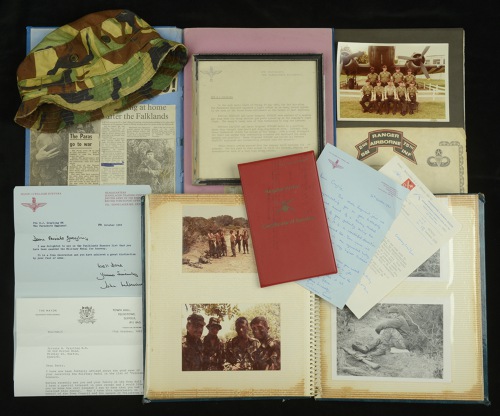
Sold with the following archive of related items and documents: Recipient’s Identity Disc; Short brimmed Jungle Bush Hat, ‘Grayling’ written in marker pen inside; Regular Army Certificate of Service; typed copy of M.M. citation, this glazed and framed; a number of letters of congratulation written to the recipient on the occasion of the award of his M.M., these including from Brigadier M. J. A. Wilson, O.B.E., M.C., Headquarters 5 Infantry Brigade, Colonel G. D. Farrell, M.B.E., Regimental H.Q., The Parachute Regiment, Major J. S. Williams, D.C.M., Para, Major (Q.M.) F. J. Miller, 29 Commando Regiment Royal Artillery, and Mr T. L. Savage, The Mayor Felixstowe; an annotated scrap book compiled by the recipient, replete with photographs from service career, including with ‘Gaz’ Bingley, and labelled ‘Kenya 1981’; another scrap book replete with contemporary newspaper cuttings relating to the recipient’s investiture and 2 Para throughout the Falklands War; pair of framed and glazed photographs of recipient in uniform; copies of Goose Green, A Battle is Fought to be Won, by M. Adkin and 2 Para Falklands, The Battalion At War, by Major-General J. Frost.
Share This Page