Auction Catalogue




 Create new list
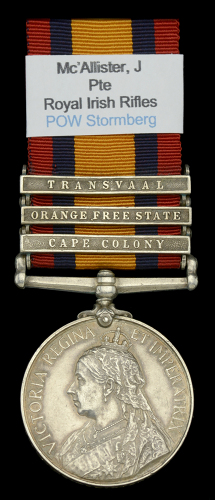
Queen’s South Africa 1899-1902, 3 clasps, Cape Colony, Orange Free State, Transvaal (3031 Pte. J. McAllister, R. Irish Rifles) top clasp slightly bent, good very fine £100-£140
John McAllister, from Newry, Co. Armagh, attested at Belfast into the Royal Irish Rifles, aged 18 years and 6 months, on 16 February 1892. He served in Malta and the East Indies before transferring to the Army Reserve in March 1899. Recalled for service during the Boer War, he served in South Africa from 14 November 1899 and was taken prisoner the following month, on 10 December 1899, at the Battle of Stomberg.
Arthur Conan Doyle, in ‘The Great Boer War’, wrote: ‘The force with which General Gatacre advanced consisted of the 2nd Northumberland Fusiliers, 960 strong, with one Maxim; the 2nd Irish Rifles, 840 strong, with one Maxim, and 250 Mounted Infantry. There were two batteries of Field Artillery, the 74th and 77th. The total force was well under 3,000 men.’
After the failed assault, Conan Doyle concludes: ‘It is a sad subject to discuss, but it is the one instance in a campaign containing many reverses which amounts to demoralisation among the troops engaged. The Guards marching with the steadiness of Hyde Park off the field of Magersfontein, or the men of Nicholson's Nek chafing because they were not led in a last hopeless charge, are, even in defeat, object lessons of military virtue. But here fatigue and sleeplessness had taken all fire and spirit out of the men. They dropped asleep by the roadside and had to be prodded up by their exhausted officers. Many were taken prisoners in their slumber by the enemy who gleaned behind them. Units broke into small straggling bodies, and it was a sorry and bedraggled force which about ten o'clock came wandering into Molteno. The place of honour in the rear was kept throughout by the Irish Rifles, who preserved some military formation to the end. Our losses in killed and wounded were not severe - Military honour would have been less sore had they been more so. Twenty-six killed, sixty-eight wounded - that is all. But between the men on the hillside and the somnambulists of the column, six hundred, about equally divided between the Irish Rifles and the Northumberland Fusiliers, had been left as prisoners. Two guns, too, had been lost in the hurried retreat.’
‘Our Regiments in South Africa 1899-1902’, by John Stirling, further notes 'No one could blame the Rifles; had they shirked the attack their losses would have been very much less serious. As it turned out, these were approximately 12 men killed, 8 officers, including Colonel Eager, who afterwards died, and 45 men wounded, and 3 officers and over 200 men taken prisoners. It is said that Colonel Eager reached a higher point than any one else in the assault and there was shot down. The evidence given before various courts of inquiry, an abstract of which is printed in the proceedings of the War Commission, shows that the companies who had been foremost in the assault were partially stopped in their progress by the fire of the British artillery, and that these companies were not properly notified of the general's decision to retire.’
McAllister’s release from prison at Waterval was reported in The Times on 10 July 1900, after which he rejoined his regiment. He is additionally entitled to a King’s South Africa Medal with two clasps. Returning Home on 11 September 1902, he was discharged on 15 February 1904.
Sold with copied medal roll extracts.
Share This Page