Auction Catalogue




 Create new list
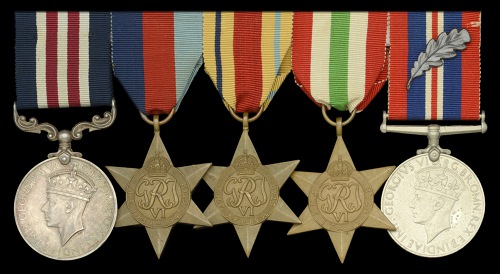
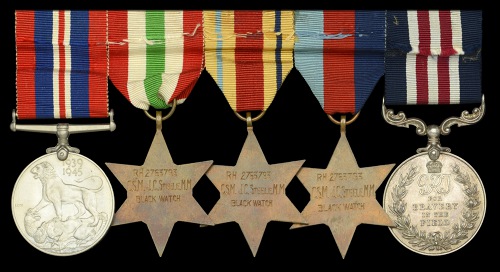
The outstanding and deeply poignant Second War M.M. group of five awarded to Company Sergeant-Major J. C. ‘Jumbo’ Steele, Black Watch, attached to the Special Operations Executive’s ‘Ministry of Economic Warfare’ in the Middle East, who was murdered in Sachsenhausen concentration camp in April 1945.
A hardy Rhodesian, he had served under S.O.E.’s swashbuckling, gold ear-ringed and ‘truly Elizabethan’ Lieutenant-Commander Mike Cumberlege, D.S.O., and participated in some notable clandestine operations to Crete and Greece: on one occasion he had his hair parted by a bullet from a Messerschmitt 110, which attacked his caique and killed two of his comrades.
Subsequently selected for Operation ‘Locksmith’ in March 1943 – an attempt to mine and block the Corinth Canal (for which he was additionally recommended for the award of a D.C.M.) – he, Cumberlege and two comrades were captured and taken to the Averoff prison in Athens, and thence – via Gestapo H.Q. in Vienna – to Mauthausen concentration camp, a protracted journey in which they endured torture and terrible suffering.
Finally, in early 1945, after a year of being subjected to the horrors of the notorious Zellenbau block in Sachsenhausen, they were murdered by a shot to the back of the neck
Military Medal, G.VI.R. (R/2763793 Pte. J. C. Steele. Black Watch) one digit of number over-struck; 1939-45 Star; Africa Star; Italy Star; War Medal 1939-45, the campaign awards all officially engraved ‘RH 2763793 C.S.M. J. C. Steele. M.M. Black Watch’, mounted for display, minor edge bruise to MM and light contact marks, good very fine and better (5) £20,000-£30,000
M.M. London Gazette 15 October 1942:
‘In recognition of gallant and distinguished services in the Middle East.’
The original Recommendation states: ‘This N.C.O. has been in ships since before the fall of Crete. During the Greek evacuation he served in the Dolphin with Lieutenant Cumberlege and assisted in the evacuation. Together with Cumberlege he assisted in the embarkation of about 400 British troops. During the Cretan evacuation, he assisted in the embarkation of troops, helped to blow up the ammunition store on Suda island and brought away the Ag Miaoulis after the Dolphin was abandoned and blown up. During the voyage across he shot down a Messerschmidt 110 which attacked the ship, during which engagement the Ag Miaoulis had two killed out of a crew of five. Since then, he has taken part in every expedition to Crete, having stayed two weeks on the island with Lieutenant Cumberlege and organising the embarkation of British and Greek stragglers. This N.C.O. has at all times shown the greatest courage and determination and is thoroughly worthy of a decoration.
It is requested that, should the award be made, there should be no publicity for security reasons.’
On 4 July 1943, Steele was also recommended for an immediate award of the D.C.M. for gallantry during Operation Locksmith:
‘C.S.M. Steele, in company with Lieutenant Cumberlege, R.N.R., a wireless operator and one other was landed on 14 April 1943 by submarine on the mainland near Poros. With the party were loaded also a number of specially constructed magnetic mines and strong explosive charges, all camouflaged to look like oil drums. The intention was to mine the Corinth Canal with the object of tearing out the bottom of a ship of over 5,000 tons (a ship of less tonnage would not activate these specially constructed mines), and thus block the canal.
On 25 January the party’s hideout was betrayed by a Greek fisherman and quickly, by night, they had to move to a new hideout, laboriously carrying in several journeys the two tons of mines and explosives, etc. with which they were burdened.
On 4 February, a meeting was at last arranged with a Greek collaborator from Athens, whose organisation was to supply a caique whose passage through the canal was already established as a habitual affair. A rendezvous was made for the caique to pick up the mines and counter-mines.
It was not, however, until p.m. on 2 March (nearly a month later) that the caique arrived off Poros. Straight away four mines with 30lbs. of explosives, each with four counter-mines with 80lbs. of explosives, were loaded.
Next morning the caique sailed with Lieutenant Cumberlege and C.S.M. Steele on board and arrived off the Sipori Islands at dusk without having encountered enemy patrols.
At dawn on 4 March the work of attaching the counter-mines on the ship’s bottom started under difficult conditions, Cumberlege and Steele carrying it out.
At 0900 hours, when the mines were on the deck and Cumberlege and Steele were still in the water fixing the counter-mines on to the bottom of the ship, a German control caique with a crew of seven appeared. Immediately Cumberlege and Steele were hauled aboard and hid in the confined space of a false bulkhead. The crew successfully hid their movements by standing up between them and the German caique. The ship was searched from stem to stern. The camouflage of the mines withstood scrutiny, and within half an hour the ship was cleared.
Work on the mines and counter-mines was continued and completed by nightfall. At dawn on 5 March, the caique proceeded towards the Canal entrance, and Cumberlege and Steele were disembarked, as neither could speak Greek, and, not only were all the members of the crew registered, but they were known to the guards.
The mines were successfully laid on 5 March by the simple method of cutting two retaining wires at the right moment.
Cumberlege and Steele returned to Poros where fresh mines, either to repeat the operation if necessary, or for blocking the Levkas Channel, were delivered to them by submarine.
Unfortunately, no ship of 5,000 tons has since cleared the Canal, and as three months was about the limit within which the mines might reasonably be expected to work, there is only slender hope that Cumberlege’s and Steele’s great efforts will succeed. At any rate, failure will in no way be their fault, and will certainly be a ‘glorious failure’.
Soon after the operation, the parent organization of those who provided the caique was cleaned up by the Axis, as a result of betrayal on political grounds, and the presence of Cumberlege’s party in the Poros area was confirmed, although their task was fortunately kept secret.
We were able to warn Steele and Cumberlege, and, although they moved their hideout twice, eventually moving to the island of Hydra, they refused to leave the area till they knew the result of the canal operation, and whether it should be repeated. Their W./T. operator and another man were captured on 9 April. Cumberlege and Steele succeeded, after wounding a German N.C.O., in escaping. They were, nevertheless, captured towards the end of April and are now almost certainly in Averoff Prison in Athens.’
The recommendation ended with the usual statement about no publicity should the award be approved. But as confirmed by an added ink inscription, no such award was forthcoming.
M.I.D. London Gazette 30 December 1941:
‘For distinguished services in the Middle East, during the period February 1941 to July 1941.’
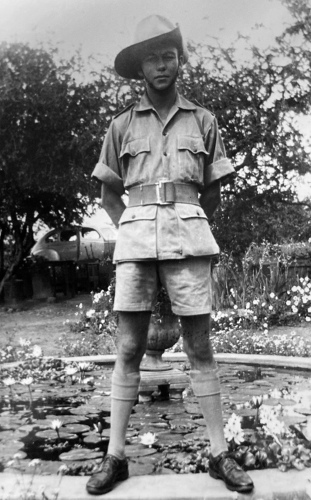
James Cook ‘Jumbo’ Steele was born in Melsetter in Southern Rhodesia on 29 October 1919, where his father was manager of the local hotel. Educated at Prince Edward School in Salisbury, where he was a keen scout, he was working as a grader on the tobacco auction floors on his enlistment in the 1st Service Battalion of the Rhodesian Military Forces on 5 September 1939, the same day that he married Patricia Denis. Subsequently posted to No. 2 Training Centre, he was one of 42 recruits to be assigned to the 2nd Battalion, Black Watch, in April 1940, which unit he joined in Egypt in the following month. Embarked for Somaliland that summer, the battalion first saw action against the Italians at Barkassan in mid-August, prior to returning to Egypt and being re-assigned to Crete. Here, then, the commencement of Steele’s clandestine career, for it was in Crete that he was enlisted by the colourful Mike Cumberlege, an early recruit to S.O.E.’s ‘Ministry of Economic Warfare’ in the Middle East.
The Special Operations Executive (S.O.E.) - Opening Shots
The circumstances behind his enlistment were later described by Lieutenant-Colonel Nevill Blair, himself a casualty in Crete:
‘The name of the Rhodesian Steele reminded me of the renowned and be-ear-ringed Mike Cumberlege in Heraklion’s Venetian harbour. He made an urgent request for a mechanic to put the engine of his caique in order for he had an urgent assignment in the Aegean which it was imperative not to miss. I telephoned Lieutenant-Colonel Adrian Hamilton, and Steele in due course reported to the harbour. He stayed with Cumberlege until the end of the war and presumably disappeared with him in April 1945, having gained the M.M. and promotion to Warrant Officer Class II. It was to Cumberlege and Steele in their caique that in the months that followed the evacuation, many of those left behind in Crete owed their deliverance.’
The caique in question – christened Dolphin II – was quickly put to good use in the evacuation of troops from Greece, gallant work undertaken at the behest of S.O.E.’s ‘Ministry of Economic Warfare’, which in turn operated under the overall auspices of ‘G.H.Q. Raiding Forces’.
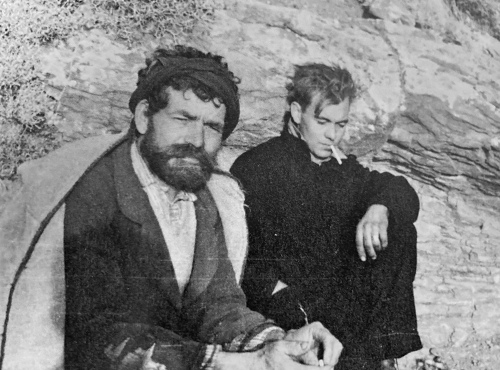
Another clandestine operative, Captain Nicholas Hammond, described Steele as ‘an independent youngster who had run away from home as a boy and who was eager for adventure.’ He added that he was ‘a first-class shot with any weapon’, an attribute that came into good use when their caique was attacked off Crete 10 days after the commencement of the German airborne assault in May 1941. On that occasion, Cumberlege’s party included his cousin, Cleland, a Major in the gunners with clandestine connections in Cairo, the whole embarked in a purloined caique after the loss of Dolphin II.
Target Corinth Canal 1940-1944, by Platon Alexiades, takes up the story:
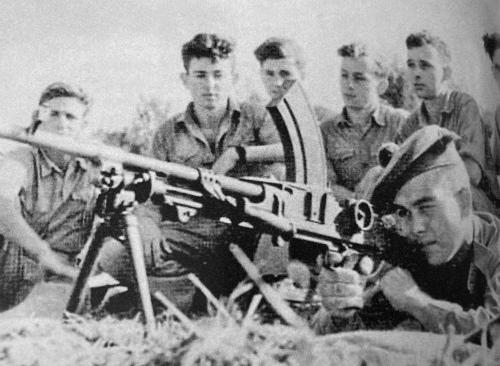
‘Athanassios Miaoulis was now vulnerable as a southbound caique could only be taken for an enemy vessel. At about 0900 hours on 31 May it was set upon by a Messerschmitt 110 fighter-bomber, which swooped down to the attack. The aircraft strafed the caique which was helpless as her low speed prevented her from taking avoiding action. Major Cleland Cumberlege was killed outright; Able Seaman Saunders was mortally wounded and Mike Cumberlege was hit by a fragment in the elbow joint. Despite the pain he remained in command. A Greek crew member and Private Steele were slightly wounded; the latter had his skull grazed by a bullet. The Rhodesian private did not lose his composure and fired away with a machine gun. He managed to hit the aircraft as it was coming for a second run. The bomber pulled away and disappeared in the distance with one engine smoking. Saunders was given morphine but died soon afterwards.’
Notwithstanding such loss and damage, the Athanassios Miaoulis limped into Mersa Matruh three days later, from whence Mike Cumberlege, Hammond and Steele took passage to Alexandria in a three-masted brig. The former then made known his plans for future operations off occupied Crete and, with M.I.9 and Naval Intelligence approval, set about rescuing British and Allied stragglers still trapped on the island.
Here, then, the background to Steele being Mentioned in Despatches and awarded the M.M. In fact, Steele quickly settled in as a member of Cumberlege’s crew, the whole operating as part of an S.O.E. inspired para-naval force. And a flurry of covert operations ensued, commencing with return trips to occupied Crete in the period October to December 1941, where the embarkation of further evading Allied troops aside, S.O.E. operatives were also landed and collected, and intelligence gathered for future operations. By this stage, Cumberlege had command of two vessels, the Hedgehog, a motor caique of about 60 tons, and the Escampador, a 20 ft. sailing vessel. During these clandestine voyages Steele on one occasion spent an eventful fortnight ashore with Cumberlege, in which the latter had a victorious fist fight with a German. Such close encounters aside, vital mapping work was undertaken, particularly on the deserted south coast of Crete, between Cape Litinon and Tsoutsouros Bay, where potential landing grounds and hide-outs were recorded. Official records also reveal that Steele skippered a captured caique back to Alexandria in November 1942.
For their gallantry Steele was awarded the M.M. and Cumberlege the D.S.O., but their activities were interrupted when the latter fell ill with paratyphoid in early 1942. He was invalided home and did not recover until the summer of 1942. Steele, too, was admitted to hospital in January 1942, but was discharged to an appointment in Naval Intelligence at Alexandria at the end of the month and advanced to Sergeant. Having then been embarked for South Africa in April 1942, he went A.W.O.L. and was declared a deserter, possibly in an attempt to visit family back in Rhodesia. Be that as it may, he was re-attested in the Middle East Force in June 1942, when he joined the 1st Special Service Regiment, Holding Squadron, and was attached to G.H.Q. Meanwhile, his old boss was plotting his next daring mission.
Operation Locksmith
Back in the U.K., following his recovery from paratyphoid, Cumberlege presented S.O.E. at Baker Street with a plan to mine the Corinth Canal, a plan discussed at the highest levels of Naval Intelligence. And in recommending a team of five men, he listed Steele as one of his preferred candidates, for he was ‘a highly competent engineer and handyman in general’.
In the event, his final team comprised Steele, Sergeant Thomas Handley, a qualified radio operator, and Jan Kotrba, a Czech soldier. Higher authority, however, ordained that Antonios Fakaros, a Greek petty officer, be dropped from the team at a late hour. The loss of a Greek speaker was a major setback, but the operation went ahead, nonetheless. Nor, as it transpired, was their equipment entirely up to scratch.
Cumberlege was emplaned for Cairo in November 1943, where he was re-united with Steele and his fellow operatives. And on the operation getting a final ‘green light’, the four men were embarked in the Royal Hellenic Navy’s submarine Papanicolis at Beirut on Thursday 7 January 1943. Having then reached the Hydra Channel without incident, the team disembarked in canoes and paddled ashore to a pre-arranged landing spot in Boufi Cove on the Peloponnese coast, bringing with them ten mines and spares, six .303 Vickers machine-guns, 2,000 rounds of ammunition, three sets of personal gear and 250lbs. of special stores.
Over the coming weeks, team ‘Locksmith’ hid their equipment in a ravine and built a small hut, where one of their radio sets was hidden. Inevitably their arrival was noticed by local shepherds and fishermen, Cumberlege signalling Cairo to say the sooner he could rendezvous with a fellow operative, Major Tsigantes, the better. As it transpired, the latter had been shot dead by the Germans in Athens, and it was a week or two before a meeting could be arranged with a fellow resistant, Warrant Officer Spyros Kotsis. And that memorable occasion took place at a pre-arranged spot known as the ‘Devil’s bridge’ on the 20 January 1943, when Cumberlege was accompanied by Steele. The team was now regularly on the move, awaiting the arrival of a caique to take them to the Corinth canal, but that intention was subject to ongoing delays. All the while, ‘Locksmith’ risked discovery, a reminder of their perilous position being heightened by reports of the Gestapo regularly raiding resistance groups known to them.
At length, however, a caique was secured at Piraeus, renamed the Aghia Varvara, and arrived off Boufi Cove on 3 March 1943. She was skippered by her owner, Kiriakoulis Sideris, with Lieutenant Fotios Manolopoulos in operational command and an engineer, Michael Morakeas. Papers for the passage through the Corinth Canal had also been obtained and team ‘Locksmith’ loaded the caique with four mines with 30lbs. of explosives and five counter-mines with 80lbs. of explosives. But it was just Cumberlege and Steele who joined the Greek crew on her departure for the canal at 0800 hours on the 4th. Both men quickly set to work in disguising the mines as petrol cans, in addition to drilling holes in the hull to suspend the counter-mines. And Cumberlege was engaged in just such work when a German patrol boat suddenly hove into view. Remarkably, he managed to swing himself back on board without being noticed and, with Steele, hid behind a false bulkhead as the Germans boarded and searched the caique. The ‘petrol cans’ held true and, equipped with the correct paperwork, the Aghia Varvara was permitted to proceed on her way.
When about seven miles from the entrance of the Corinth canal, Cumberlege and Steele were dropped off at Katakali, and the three Greeks were left to complete the mission. The two Brits could not pass effectively as Greeks, especially since an Italian guard would be embarked for the crossing of the canal. It was hoped he could be distracted by the Greeks as the four counter mines - now lashed to the bottom of the caique – were dropped by cutting attached ropes, and then the four actual mines tipped over the stern. For security reasons of his own, Lieutenant Manolopoulos decided to ditch three of the four actual mines before entering the canal, which almost certainly led to the failure of the operation. Nor did Cumberlege ever learn of that decision, for the Aghia Varvara proceeded directly back to Piraeus. Instead, when it was clear the attack had failed, he concluded that the mines’ detonators must have been defective.
Capture and Torture
Cumberlege and Steele arrived back at their original hideout at Ermioni, near Boufi Cove, on 11 March, after a 40-mile overland trek, following which the activities of team ‘Locksmith’ fell quiet. Tragically, not quiet enough, for the Abwehr station in Athens was rapidly homing in on their radio transmissions to Cairo. And that radio direction finding reached its climax at the end of the month, when Italian Secret Police landed near the ‘Locksmith’ team. Someone had clearly talked. The net was closing.
Then, on 8 April, a party of eight Germans came ashore just 700 metres from Boufi Cove. The game was up, Cumberlege and Sergeant Handley being discovered 50 yards from their stone hut hideout. The former shot and severely wounded one of the Germans, an act that saw the rest of them run off in panic. Cumberlege then quickly grabbed a machine-gun from their hut and headed off with Handley in the direction of the village of Damala, where Steele and Kotrba were hiding out. Fatally, however, they left behind their transmitter and codebooks.
At Damala, where they had a second transmitter, team ‘Locksmith’ received a message – supposedly from Cairo – in which they were informed a submarine would be sent to meet them off Fourkari at 2130 hours on the 29th or 30th April. It was in fact a false message sent by the Abwehr in Athens, who made use of the team’s captured codebooks. And the deception had tragic consequences, all four members of ‘Locksmith’ falling into enemy hands on the 30th, when canoeing to what they believed to be a submarine. It being a dark, moonless night, it was too late to react when they realised it was an enemy patrol boat.
Of subsequent events, Target Corinth Canal 1940-1945 states:
‘The Locksmith men were brought to Averoff jail in Athens. If Hitler’s Kommandobefehl was to be followed to the letter, the commandos should have been handed over to the Sicherheitsdienst and on no account kept under military guard as ordinary prisoners of war but treated as common criminals. From information later acquired, it was known that Obersleutnant Hoffmeister, head of the Abwehr Group III in Athens, had resorted to ‘unlawful’ means to extract information from the four men. What form of torture that took, and what information he got, we do not know. Once the interrogation was terminated, they should have been liquidated to conform with German policy at this time but this was not done, possibly since their names had been released to the Greek Red Cross. This was either done through an administrative error or perhaps it was done deliberately by a member of the Abwehr, some of them being quite opposed to the methods used by the Nazis.’
Cumberlege was even able to send a message to his wife via the Greek Red Cross and Geneva, dated on 11 May 1943, but thereafter, he and his fellow operatives rapidly disappeared from view. And an indication of the terrible journey that lay ahead occurred on the day after Cumberlege had written to his wife: the four men were transferred to Gestapo H.Q. in Vienna and thence to Mauthausen concentration camp in upper Austria.
There, they endured several months of severe cruelty and suffering, Cumberlege being forced by further torture to sign a statement confirming the ‘Locksmith’ team were saboteurs, even though they had been captured in uniform. Then in January 1944, Gestapo Head Office in Prinz Albrecht Strasse, Berlin, issued ‘protective custody’ warrants in their names, Steele’s being signed off by Dr. Ernst Kaltenbrunner at 1400 hours on the 23rd. The warrants stated that they endangered the existence and security of the people and the state, and that they had been proven guilty of ‘activities to the detriment of the German Reich’. Appended to each was a statement to say the recipients should not be informed of the issuance of the warrants.
Instead, a few days later, they were transferred to the infamous Zellenbau block at Sachsenhausen concentration camp. Incarcerated in solitary confinement cells barely larger than one or two metres in any direction, they were fed - starved - on a diet of pig’s food and limited to just 15 minutes a day for exercise. And that shocking ordeal lasted for another year, overseen by a lethal cast of S.S. guards.
Sachsenhausen – Cold Blooded Murder
In his book, The Extraordinary Life of Mike Cumberlege SOE, Robin Knight describes the situation at Sachsenhausen thus:
‘Cumberlege and his party had been transferred to Sachsenhausen in January 1944 after a gruelling eight-month interlude in the notorious Mauthausen extermination camp in Austria, where Cumberlege was tortured ‘severely’ to get him to admit he had been on a sabotage mission. All four have remained in solitary confinement in the Zellenbau ever since – treated as common criminals, denied P.O.W. status, not allowed to write or receive letters, permitted no Red Cross parcels, given no ‘privileges’ (such as books or cigarettes), forced to wear standard camp ‘uniform’ of rough blue-striped dirty grey serge, round cap and clogs, and fed a starvation diet of wurzels (a root crop cooked in water that is normally fed to pigs). Even by the abysmal standards of the Zellenbau, they rate as the lowest of the low, treated in this harsh way to justify, in S.S. minds, keeping them alive at all following Hitler’s infamous order issued in October 1942 that every Allied commando captured by German forces was to be killed on the spot, whether in uniform or not.
By Christmas 1944, the only remaining value of the Locksmith party to the Nazis seems to be for last-ditch surrender or negotiation purposes as the Allied net closes in on Hitler, the Third Reich and Berlin ... A variety of guards, mostly men unfit for military service, rule every prisoner’s life. Some hate Sachsenhausen and sneak favours, like cigarettes, to the prisoners, but many others revel in the sheer brutality and corruption of the Zellenbau. Chief among the persecutors during the 1943-45 period is the head guard, the swarthy and unreliable Kurt Eccarius – ‘a dour-looking drunkard of 35 who seldom smiled’ as one prisoner puts it after the war. Franz Ettlinger is a good-looking sadist, bully, sycophant, thief, drunkard’ aged twenty-seven. Josef Drexl, aged fifty, is ‘an uncouth Bavarian peasant’. Five S.S. corporals, all in their twenties, report to Eccarius – Lux, a sadist who tortures prisoners for self-gratification, Hartman, Meyer, Schmidt, and Beck. Each of these thugs is egged on by Camp Adjutant and Chief Executive Officer of the Zellenbau, Heinrich Wessel, ‘one of the most brutal of men’. He is in the habit of visiting the block for the pleasure of witnessing torture sessions, executions, and the stringing-up of prisoners on the poles in the exercise yard.’
Not all the staff were brutal Nazis, some of them being prisoners who had been deemed trustworthy and made orderlies. One such was Paul Schröter and it was he who was to provide key evidence in respect of team ‘Locksmith’s fate, as did further evidence gathered from a variety of prisoners who had shared in the horrors of the Zellenbau block. The latter included several persistent escapers, such as Group Captain ‘Wings’ Day and Squadron Leader ‘Jimmy’ James, together with commando legends such as Lieutenant-Colonel ‘Mad Jack’ Churchill. On being interviewed by an S.O.E. officer after the war Churchill stated that he had once seen Steele by mistake when the door opposite his cell was opened. Such was the determination of the guards to isolate Steel and his comrades.
Over time, however, they established means of clandestine communication, either by tapping out Morse code on pipes in their cells, or leaving messages stuck to the underside of closet sinks. Cumberlege was thus able to make assorted statements and write another message for his wife, all of which were hidden by the likes of Churchill and Day and then delivered on their liberation.
Returning to the likely fate of team ‘Locksmith’, nothing by way of concrete evidence survives. Statements taken after the war – from fellow prisoners and captured German personnel – were of a confusing and contradictory nature. But one witness stood out and that was the aforementioned orderly, Paul Schröter, who was thrice interviewed by S.O.E.’s Vera Atkins in the period July-August 1946. Robin Knight’s biography takes up the story:
‘Schröter stated clearly, for instance, that Mike [Cumberlege] and his team ‘were all transported by ambulance to the Industriehof and executed in the usual way’. He gave a date ‘on or about April 10th [1945]’ but admitted to a poor memory for dates and stated that he was not an eyewitness. The Industriehof, he explained, was the industrial-style execution area of the camp where bodies were disposed of en masse by cremation, having first been machine gunned in a sandpit or killed in other ways, including gassing. In the case of the Locksmith party, Schröter believed they had been executed next to the sandpit in the so-called neck-shooting barrack … Schröter said he was ‘quite sure’ that the camp adjutant and ‘chief executive’ of the Zellenbau, Heinrich Wessel – ‘one of the most brutal of men’ – attended the executions. As proof of their deaths, the prison garb of the men was handed back to the cell orderlies who later sent the clothes to the main camp stores. Schröter added: ‘All papers, letters, etc. belonging to the prisoners was afterwards taken by me and the camp boiler room attendant to the boiler house and burned.’
Of the ‘neck-shooting barrack’, Robin Knight’s biography adds:
‘A structure of particular significance was the genickschussbarake or neck-shooting barrack. Victims were told by the S.S. that they were being taken to a medical examination. Inside the building was a large room where prisoners were made to undress. They were then taken individually to an adjacent, smaller room and greeted by an S.S. guard dressed as a doctor and checked to see if they had any gold fillings. Those that did were marked with an X. Led to a third room that resembled a bathroom with shower heads in the ceiling, the victim was ordered to stand against a measuring pole fixed to the wall. A sliding, porthole-like door behind the prisoner’s neck was then opened and another S.S. guard pulled the trigger. According to Nikolaus Wachsmann in his book KL ‘judging by the gaping holes in the victims’ skulls, the S.S. used special dumdum bullets’. A gramophone played cheerful music in the first waiting room to disguise the sound of the shot. Once the body slumped to the floor, orderlies from the crematorium dragged the corpse to a makeshift morgue where they ripped out any gold teeth before throwing the corpse into an oven. Back in the execution room, other orderlies hosed down the blood-stained execution site … ’
Cumberlege was posthumously gazetted for the award of a Bar to his D.S.O. after the war, but in spite of the fact that Steele was recommended for the award of a D.C.M. no further recognition was afforded to him. He is commemorated on the Athens memorial, in addition to a special memorial stone on the site of Sachsenhausen concentration camp and, back in modern day Zimbabwe, at Marondera, formerly Marandellas.
Sold with his original M.I.D. certificate, in the name of ‘Private J. C. Steele, The Black Watch (Royal Highland Regiment)’, dated 30 December 1941, together with copies of The Remarkable Life of Mike Cumberlege SOE, by Robin Knight, Target Corinth Canal 1940-1945, by Platon Alexiades and Courage Endured by Alan Harris, and a file of related research and copy photographs.
Share This Page