Auction Catalogue




 Create new list
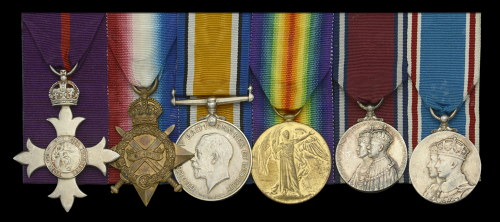
An interesting Great War ‘Palestine’ M.B.E. group of six awarded to Captain J. C. Watson, Royal Air Force, late Royal Fusiliers and Royal Flying Corps, a pilot in 14 Squadron who on one occasion flew a secret mission to Hedjaz to liaise with Lawrence of Arabia, and who was later knighted for his services as Solicitor General for Scotland in Ramsay MacDonald’s Labour Government in 1929-31
The Most Excellent Order of the British Empire, M.B.E., (Military) Member’s 1st type breast badge, silver, hallmarks for London 1919; 1914-15 Star (2 Lieut. J. C. Watson, R. Fus.); British War and Victory Medals (Capt. J. C. Watson, R.A.F.); Jubilee 1935; Coronation 1937, these last two privately engraved ‘Sir J. C. Watson, M.B.E.’, mounted court-style for display, very fine or better (6) £400-£500
M.B.E. London Gazette 31 December 1918.
John Charles Watson was born in Paisley, Renfrewshire on 9 July 1883, where his father was the editor of the Paisley Daily Express. Educated locally at the John Neilson Institution and the University of Glasgow, he was admitted to the Faculty of Advocates in 1909. Subsequently, with the help of his connections to the Liberal Party, Watson built-up a substantial legal practice and undertook a good deal of parliamentary work. The outbreak of war having intervened in August 1914, he obtained a commission in the Royal Fusiliers, in which he joined the Mediterranean Expeditionary Force in December 1915, shortly before the evacuation of Gallipoli. Subsequently attached to the Egyptian Expeditionary Force, in which he onetime acted as Deputy Judge Advocate-General, he transferred to the Royal Flying Corps and served in Palestine Brigade’s H.Q. and No. 14 Squadron in 1916-18.
Watson was consequently employed in support of T. E. Lawrence’s Arab revolt. In fact, the close working relationship established between No. 14 Squadron, the secretive ‘X’ Flight and Lawrence’s irregulars proved crucial, for, in the great man’s own words, ‘It was the R.A.F. which had converted the Turkish retreat into rout, which had abolished their telephone and telegraph connections, had blocked their lorry columns, and scattered their infantry units.’ Watson’s flying services, moreover, ‘included a secret expedition to Hedjaz which co-operated with Colonel Lawrence and the Arab Army’ (the recipient’s obituary notice in the Glasgow Herald refers).
Mentioned in despatches and awarded the M.B.E., Watson resumed his legal career on being demobilised in late 1919 and rose to prominence as an advocate over the coming decade. In July 1928, in a case that received the support of Sir Arthur Conan Doyle, he acted as one of Oscar Slater’s counsel in a successful appeal against the latter’s conviction for murder back in 1909. In April 1929 he was appointed a King’s Counsel and, two months later, in Ramsay MacDonald’s second Labour Government, he became Solicitor General for Scotland. Knighted in the Dissolution Honours of November 1931, he subsequently took up post as Sheriff of Caithness, Orkney and Shetland. He died in February 1944.
Share This Page