Auction Catalogue




 Create new list
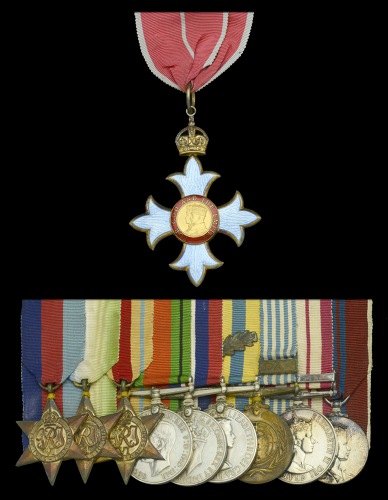
The post-war C.B.E. group of ten awarded to Captain A. F. P. ‘Popski’ Lewis, C.B.E., Royal Navy, who won a ‘mention’ for Korea and served as ‘Captain of the Fleet’ at the time of the Suez crisis and Operation ‘Musketeer’
The Most Excellent Order of the British Empire, C.B.E. (Military) 2nd type neck badge, silver-gilt and enamels; 1939-45 Star; Atlantic Star; Africa Star; Defence and War Medals 1939-45; Korea 1950-53, with M.I.D. oak leaf (Capt. A. F. P. Lewis R.N.); U.N. Korea; Naval General Service 1915-62, 1 clasp, Near East (Capt. A. F. P. Lewis. R.N.); Coronation 1953, unnamed as issued, the last nine mounted court-style as worn, good very fine (10) £1,400-£1,800
Alan Hall Collection, June 2000.
C.B.E. London Gazette 1 January 1959.
Arthur Francis Patrick Lewis entered the Royal Navy as a Cadet at Dartmouth in May 1927 and was appointed a Midshipman in the battleship Iron Duke in the following year. On passing his examinations for the rank of Sub Lieutenant in May 1930, he was awarded the Robert Roxburgh Prize, following which he specialised in gunnery. A spate of seagoing appointments ensued, and by the outbreak of hostilities in September 1939 he was serving in the cruiser Neptune, flagship of Vice-Admiral D. H. D’Olyon, C.B. Following his promotion to Lieutenant-Commander in February 1940, Lewis departed Neptune to take up an appointment on the staff of the gunnery school at Drake, but he returned to sea in the battleship Malaya in January 1942. Two years later, he was appointed an instructor at the gunnery school at Pembroke, following which he was advanced to Commander and joined the staff of Mercury II.
In the immediate post-war era, Lewis served on the staff of Vice-Admiral Sir Harold Walker, Flag Officer, Germany, and Chief British Naval Representative in the Allied Control Commission. Having then served as Executive Commander of the cruiser Phoebe, he was advanced to Captain in December 1949 and attended assorted senior officer courses.
In April 1952, he was appointed to the command of the anti-aircraft frigate Mounts Bay, in which capacity he served in naval operations off Korea and was mentioned in despatches (London Gazette 19 May 1953, refers). Then, in March 1955, he joined St. Angelo in Malta as Captain of the Fleet to Admiral Sir Ralph Edwards, K.C.B., C.B.E., Commander-in-Chief, Mediterranean and Commander-in-Chief, Allied Forces, Mediterranean. And it was in that capacity that he was involved in the planning and implementation of Operation ‘Musketeer’, the invasion of the Suez Canal and adjacent area in October-November 1956.
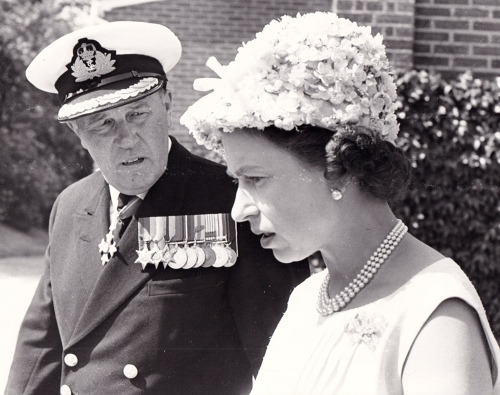
Back home, his final appointment was as Captain in Charge of H.M. Naval Base, Portland, in which post he was awarded the C.B.E., and he was placed on the Retired List in January 1959. Shortly afterwards, Lewis was selected to become Captain Superintendent of Pangbourne Nautical College, and he subsequently officiated at the Queen’s visit to the college in 1967. He also officiated over his young charges with a stern hand:
‘He had no time for ‘permissive society’, which, as far as he was concerned, was a glib excuse for idleness and slackness … He gave short shrift to the slovenly, the unpunctual, the idle and those who lacked consideration for others.’
‘Popski’, as he was known affectionately by all at Pangbourne, retired at the end of the 1960s and settled in Spain, where he died suddenly on 7 June 1971.
Sold with a quantity of copied photographs from the Queen’s visit.
Share This Page