Auction Catalogue




 Create new list
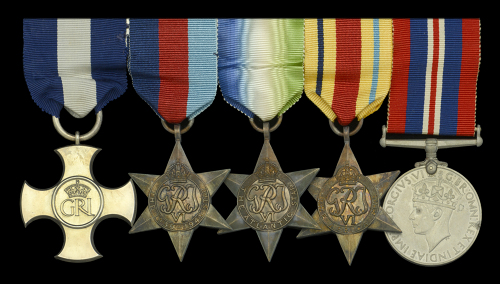
A Second War Arctic convoy D.S.C. group of five awarded to Lieutenant-Commander (E.) R. F. McArt, Royal Naval Reserve, who was decorated for his services in the escort carrier H.M.S. Avenger in PQ. 18 but was later killed in action during Operation ‘Torch’ when Avenger was torpedoed and sunk with great loss
Distinguished Service Cross, G.VI.R., reverse officially dated ‘1942’ and additionally inscribed ‘Engr. Lt. Comdr. R. F. McArt, R.N.R., H.M.S. “Avenger” Russian Convoy’; 1939-45 Star; Atlantic Star; Africa Star; War Medal 1939-45, extremely fine (5) £1,200-£1,600
D.S.C. London Gazette 1 December 1942:
‘For gallantry, skill and resolution in H.M. ships escorting an important convoy to North Russia in the face of relentless attack by enemy aircraft and submarines.’
The original recommendation states:
‘This officer showed great skill and devotion to duty in maintaining the efficiency of the main engines and other machinery during the passage of a Russian convoy and particularly during action on the 13th, 14th and 15th September 1942.’
Robert Frederick McArt was born in West Derby, Lancashire on 15 October 1900 and likely forged a career in the merchant service prior to the outbreak of hostilities. More certain is the fact he was appointed to the temporary rank of Lieutenant-Commander in the Royal Naval Reserve in August 1940.
So, too, the fact his subsequent award of the D.S.C. stemmed from his services in the escort carrier H.M.S. Avenger during the associated convoys PQ. 18 and QP. 14 which, in the wake of the disastrous PQ. 17, must rank as one of the most important Arctic operations of the war. With 92 torpedo-bombers and 133 assorted long-range aircraft based in Northern Norway, the Luftwaffe had no doubts about the outcome of this courageous effort to ‘turn the tide’ in favour of future mercy-missions to Russia. Avenger, carrying elements of 802, 825 and 883 Naval Air Squadrons (Sea Hurricanes and Swordfish), joined the outgoing convoy en route to Archangel on 9 September 1942.
And the first enemy aircraft assault arrived in the afternoon of 13 September, ineffectual efforts at bombing being followed up by a ‘flight of locusts’ in the form of 40 torpedo-bombers. In spite of the intense barrage put up by the naval escort, and D.E.M.S. gunners aboard the assorted merchantmen, no less than eight ships were lost within the ten-minute duration of this attack. Just five of the enemy’s aircraft were downed and two more ‘dangerous attacks’ followed later that evening. Here, then, the first date on which McArt 'showed great skill and devotion to duty in maintaining the efficiency of the main engines and other machinery’ in Avenger, deeds that he was to re-enact under similar circumstances on the 14th and 15th, for the convoy now came under relentless attack. And the role played by Avenger proved crucial to its survival, her Fleet Air Arm pilots breaking up and inflicting heavy losses on numerous Luftwaffe formations.
Tragically, the gallant McArt was among those lost in the Avenger on 15 November 1942, following her participation in Operation ‘Torch’, when she was torpedoed by the U-155 west of Gibraltar. Hit abreast her bomb room, which exploded, she went down inside five minutes, just 17 men surviving out of a normal complement of 545 officers and ratings.
Aged 42, McArt left a widow, Catherine, of Great Cosby, Liverpool. She received his D.S.C. at a Buckingham Palace investiture, accompanied by their 10-year-old son.
Sold with related Admiralty condolence slip in the name of ‘Temporary Lieutenant Commander (E.) Robert Frederick McArt, R.N.R.’, together with his Buckingham Palace Memorial Scroll in the name of ‘Lieut.-Cdr. (E.) R. F. McArt, D.S.C., Royal Naval Reserve’.
Share This Page