Auction Catalogue





 Create new list
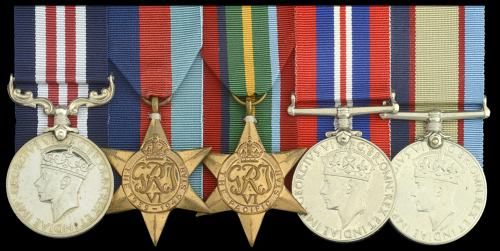
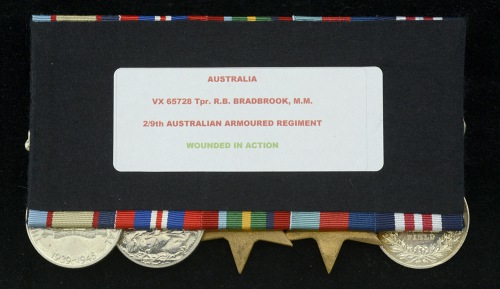
A very fine Second War ‘Malayasia campaign’ M.M. group of five awarded to Trooper R. B. Bradbrook, 2/9th Australian Armoured Regiment, who was decorated for his gallantry as a tank driver in an attack on the ‘Crater Feature’ on Labuan Island, 16 June 1945. During the latter he suffered shrapnel wounds to his back and shoulders as a consequence of a ‘suicide attack’ on his tank
Military Medal, G.VI.R. (VX.65728 Tpr. R. B. Bradbrook. A. Mil. F.); 1939-45 Star; Pacific Star; War Medal 1939-45; Australia Service Medal, campaign awards all officially impressed ‘VX65728 R. B. Bradbrook’, mounted for display, light contact marks overall, generally nearly very fine or better (5) £1,200-£1,600
M.M. London Gazette 6 March 1947.
The original recommendation states:
‘On 16 June 1945, Trooper Bradbrook was the driver of a tank supporting a series of assaults by 2/28th Australian Infantry Battalion on the inner ridges of the Crater Feature, Labuan Island, Borneo. His vehicle went into action at 0900 hours that morning and, after six and a half hours continuous fighting, withdrew for replenishment of ammunition at 1530 hours.
At about 1600 hours his vehicle again went into action supporting a platoon attack on the eastern ridge of the central position. On reaching the northern end of the ridge, he was ordered by his crew commander to proceed through a thick patch of jungle with a view to reaching a fire position on the southern side, but on entering the jungle it was found to be heavily mined with suspended aerial bombs and trip mines. By the time the mines were discovered the crew realised that they had lost contact with their supporting infantry, who had detoured to the left, but it being considered too dangerous to attempt to turn the tank in the mined area, they decided to push on. By Trooper Bradbrook’s skilful driving the area was safely negotiated and the fire position reached, from where the tank was able to give most valuable support to the attacking infantry, now partly visible in a gully to the left of its position.
At about 1830 hours, when ammunition was almost expended, the crew commander, knowing that the tank was in an isolated position, ordered their withdrawal, but as the driver manoeuvred his vehicle to commence the return journey, enemy appeared nearby and made a suicide attack on the tank with a large bomb or mine which, exploding on the left sponson plates, jammed the turret, caused damage to the top hull plates, half opened the driver’s sliding hatch cover, destroyed a vital starting motor fuze box, and badly wounded the driver in the back and shoulder with shrapnel splash.
Disregarding his injuries, Trooper Bradbrook kept the engines of his now crippled vehicle running successfully and drove back through the mined area to our lines, where it was found that the tank motors, once stopped, could not be started again. Had he allowed the engines to fail during the suicide attack, or had he stalled the tank during the drive back, the vehicle and its crew would have inevitably been lost.
His cool driving and determination throughout the action were an inspiration to his crew, and enabled them to materially assist the infantry assault. His resolute actions and disregard of personal injuries after the enemy attack at close quarters undoubtedly saved the tank and its personnel from certain destruction at the hands of our enemies.’
Ronald Bertram Bradbrook was born in Thornbury, Victoria on 9 August 1920 and enlisted in the Australian Army in November 1941. Drafted to the 2/9th Australian Armoured Regiment, he was embarked for Borneo in April 1945, where he was awarded the M.M. for the above cited deeds in an attack on the Crater Feature on Lambuan Island on 16 June 1945.
He received his award from the Governor-General at Parliament House, Melbourne on 15 March 1949 and died at Port Fairy, Victoria, in June 2008.
Sold with photographic image of the recipient.
Share This Page