Special Collections




 Create new list
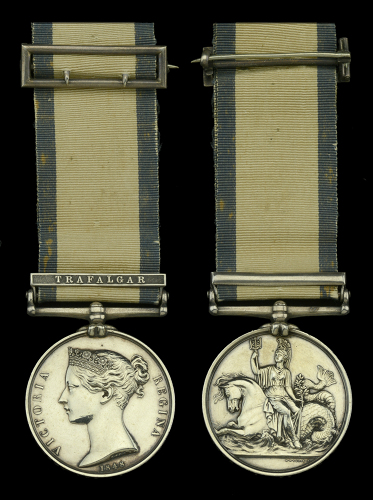
The Naval General Service medal awarded to Surgeon Henry Towsey, Royal Navy, for his services on board the Royal Sovereign at the battle of Trafalgar, one of only eighteen medical officers to survive to claim the medal, he would have been busier than most with the heavy casualties suffered by this ship
Naval General Service 1793-1840, 1 clasp, Trafalgar (H. Towsey, Asst. Surgeon, R.N.) fitted with silver ribbon buckle and original ribbon, nearly extremely fine £12,000-£16,000
This lot was sold as part of a special collection, Naval Medals from the Collection of the Late Jason Pilalas.

View
Collection
88 clasps for Trafalgar issued to H.M.S. Royal Sovereign.
Royal Sovereign carried the flag of the second-in-command, Vice-Admiral Cuthbert Collingwood, with Edward Rotherham as Captain, and led the lee column at Trafalgar, on 21 October 1805. In the actual fighting there was no ship which covered herself with greater distinction.
For a time she was engaged single-handed with several of the enemy's ships, before tackling Alava's flagship, the Santa-Ana. Her losses on this occasion amounted to 144, including I4 officers killed and wounded. Her injuries were very severe.
Her main and mizen masts and fore-topsail-yard were shot away, and her fore-mast, having been shot in several places and stripped of nearly the whole of its rigging, was left in a tottering state. By the time the Spanish three-decker Santa-Ana struck to her, the Royal Sovereign was almost unmanageable; and at 6 p.m. Admiral Collingwood, who had succeeded the dead hero as Commander-in-Chief, was compelled to shift his flag into the Euryalus, frigate, by which, and afterwards by the Neptune, she was taken in tow (The Trafalgar Roll by R. H. Mackenzie refers).
Henry Towsey was appointed Assistant Surgeon aboard the Royal Sovereign on 14 September 1805, and served in that ship at Trafalgar. With casualties of 47 killed and 94 wounded, the Royal Sovereign suffered more than most in the battle. Towsey moved to the Formidable in January 1806, and was promoted to Surgeon in December 1810. He was appointed to the Dromedary store-ship in March 1816 and placed on half-pay later that same year. In June 1824 he was appointed to the Nieman on the Cape station but was again placed on half-pay in June 1827. He was finally declared unfit for sea service in December 1839 and went to live in Devon, where he died at Lympstone on 31 March 1860.
Share This Page