Special Collections




 Create new list
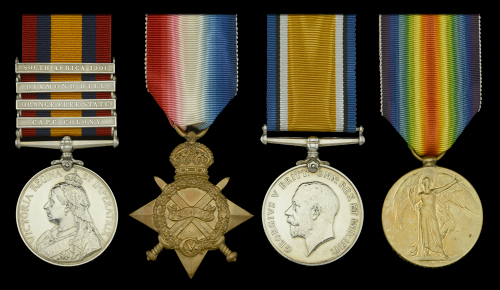
Four: Corporal T. A. Champernowne, 27th (Devon) Company, Imperial Yeomanry, later Natal Carbineers and Lieutenant, Royal Scots
Queen’s South Africa 1899-1902, 4 clasps, Cape Colony, Orange Free State, Diamond Hill, South Africa 1901, unofficial rivets between clasps (6508 Cpl. T. A. Champernowne. 27th Coy. 7th Imp: Yeo:); 1914-15 Star (Cpl. T. A. Champernowne. 1st M.R.); British War and Victory Medals (Lieut. T. A. Champernowne.) about extremely fine (4) £240-£280
This lot was sold as part of a special collection, Medals from the Collection of Peter and Dee Helmore.

View
Collection
Thomas Arthur Champernowne was born in Dartington, near Totnes, Devon in 1868, the fourth son of the Rector of Dartington. Educated at Newton College, Wolborough, Newton Abbot he was indentured apprentice Merchant Navy for three years in London on 8 May 1886 and gained his Certificate of Competency as Second Mate No 21833 from the Board of Trade dated 5 December 1889. He embarked from London on SS Himalaya bound for Sydney, Australia on 13 February 1896.
Following outbreak of the war in South Africa Champernowne returned home and volunteered attesting at Exeter for one year with the colours for the Imperial Yeomanry on 15 January 1900. His attestation papers stating he had previous service with 1st Devon Yeomanry Cavalry and giving his occupation as Cattle Breeder previously residing in Australia. Posted 6508 Private to the 27th (Devon) Company 7th Battalion Imperial Yeomanry at Topsham Barracks, Exeter, he embarked with the 1st Contingent of the 27th Company for South Africa on 1 March 1900 and took part in various actions including those at Constantia Farm, Pretoria, Diamond Hill and Nooitgedacht when the 27th Company suffered 2 men killed and 11 officers and men injured. Whilst in South Africa he was attached to the Provisional Transvaal Constabulary from June to October 1900. Having completed their one year term of service the 1st Contingent 27th Company returned home arriving by special train at Exeter on 25 June 1901 and were discharged the following day.
Returning to South Africa after the end of the war Champernowne joined the Transvaal Colonial Civil Service and was appointed Beacon Inspector in the Department of Mines, Transvaal, on 14 March 1903, serving at Pilgrim’s Rest, Barberton and Pietersburg. Transferred to the Union of South Africa Civil Service he was appointed Claims Inspector with the Deputy Commissioner of Mines in Natal in 1914 with an address in Vryheid. Following the outbreak of the Great War he enrolled as Corporal in the 1st Natal Carbineers on 12 October 1914 and was posted to the 1st Mounted Rifles Regimental No. Z95 No. 2 Troop. The 1st Mounted Rifles (Natal Carbineers) embarked at Cape Town on Galway Castle in December 1914 and disembarked at Luderitzbucht, German South West Africa and commenced a forced march across 200 miles of desert from Aus to Gibeon in 12 days. Arriving on 26 April 1915, they then completed a successful charge on horseback at Gibeon, compelling the Germans to retire on 27 April 1915. Appointed Signaller on 1 May 1915 he was admitted to hospital at Windhuk suffering from ‘Field Sores’ on 25 June 1915. The 1st Natal Carbineers returned to Cape Town via Luderitzbucht and Corporal Champernowne was discharged "Paid off before being handed over" on 23 July 1915.
Paying for his own passage from Natal Champernowne disembarked from RMS Balmoral Castle at Plymouth on 2 March 1916 and enlisted in London for General Service on 5 May 1916. Commissioned Temporary Lieutenant he was appointed Regimental Transport Officer, 13th Battalion, Royal Scots on 10 May 1916 then serving in France. Returning home from France on several occasion on medical grounds he continued to serve with the Royal Scots in France until finally returned home to be released from Service on 5 April 1919 aged 51. Returning home to Devon he married Gertrude France-Hayhurst, the widow of Commander C. H. France-Hayhurst, in June 1919. His 1915 Star was issued by the South African authority 27 November 1920 and his British War and Victory Medals by the War Office 13 August 1923. Retiring to live at The Vineyard, Dartington he died there on 19 July 1944, aged 75, and is buried in Dartington Churchyard.
Sold with extensive copied research.
Share This Page