Special Collections




 Create new list
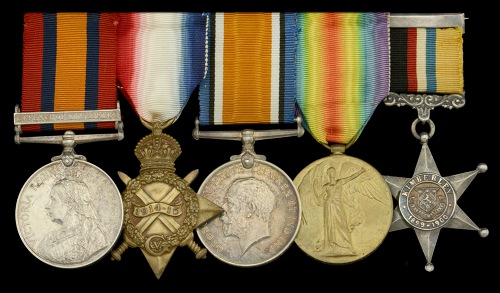
Five: Lance-Corporal E. H. Solomon, 3rd Regiment, South African Infantry, late Rand Rifles and Kimberley Town Guard, who fought at the Siege of Kimberley and was later captured and taken Prisoner of War at Delville Wood on 19 July 1916
Queen’s South Africa 1899-1902, 1 clasp, Defence of Kimberley (Pte. E. Solomon. Kimberley Town Gd:); 1914-15 Star (Pte. E. H. Solomon Rand Rfls.); British War and Bilingual Victory Medals (L/Cpl. E. H. Solomon, 3rd S.A.I.); Mayor of Kimberley’s Star 1899-1900, reverse hallmark with date letter ‘a’, unnamed as issued, with integral top riband bar, traces of adhesive to reverse of all, good very fine and better (5) £500-£700
This lot was sold as part of a special collection, The Bernard Harris Collection of Medals to the 3rd Regiment, South African Infantry.

View
Collection
Ernest Heitzman Solomon, a solicitor, was born in the Cape Province on 9 November 1880, and served as a Private in the Kimberley Town Guard during the Siege of Kimberley from 14 October 1899 to 15 February 1900. Initially ill-prepared for encirclement by Boer forces, the defenders of the diamond mining town organised an energetic and effective resistance which resulted in 42 killed and 135 wounded from a total strength of approximately 1600 men.
Attesting for the Rand Rifles at the start of the Great War, Solomon initially served 288 days in German South West Africa on operations to prevent the German Navy from using her colony’s ports and having a base for a number a long range radio transmitters. Although short in duration, the campaign was marked by a series of manoeuvres fought in extremely harsh conditions exacerbated by the extremes of the Namib desert. Solomon subsequently returned home to South Africa upon the enemy surrender on 9 July 1915, and promptly joined the 3rd Regiment, South African Infantry. Posted to “A” Company, he embarked for England on 7 October 1915 and was captured at Delville Wood on 19 July 1916 during the Battle of the Somme. Detained at Dulmen and Friedrichsfeld camps, he arrived in Holland for internment 12 October 1918, and crossed the Channel a week after the Armistice. Discharged at Maitland in 1919, his medical notes give an indication as to the ferocity of the Battle which he witnessed on the Somme: ‘dislocation of the nervous system, aggravated by captivity in Germany. Weakness of sight since returned to England.’
Sold with copied service records.
Share This Page