Special Collections



 Create new list
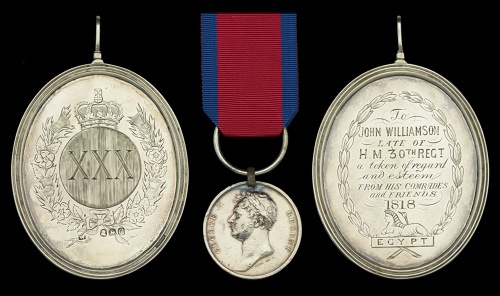
An unusual Waterloo pair awarded to Quarter-Master John Williamson, 2nd Battalion, 30th Foot
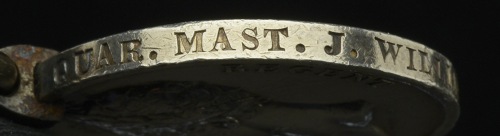
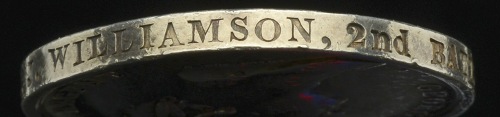
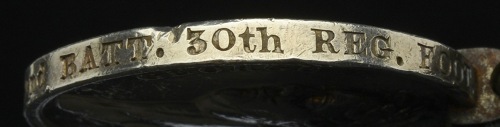
Waterloo 1815 ((Quar. Mast. J. Williamson, 2nd Batt. 30th Reg. Foot.) fitted with original steel clip and ring suspension; 30th Foot Regimental Medal (Balmer R283), silver, oval, 79mm x 64mm., hallmarked London 1818, obverse: ‘XXX’ on a crowned circle, within a wreath of roses and thistles; reverse: ‘To John Williamson late of H.M. 30th Regt. a token of regard and esteem from his comrades and friends 1818’ enclosed within a wreath over a Sphinx and ‘Egypt’, fitted with loop for suspension, the first with edge bruising and contact marks, otherwise very fine, the second good very fine (2) £1,800-£2,200
This lot was sold as part of a special collection, Medals from the Collection of Paul and Margaret Faber.

View
Collection
Waterloo, Payne Collection 1911; Mackenzie Collection, June 1934; E. Gale Hawkes Collection 1994; Dix Noonan Webb, December 2000.
John Williamson first appears in the muster rolls for the 2/30th Regiment, as Corporal in September 1803, his rank suggesting previous service, probably with the Militia. Promoted to Sergeant, 25 November 1803, and to Quarter-Master Sergeant, 24 September 1809, whilst stationed at Gibraltar. In May 1810 he embarked for Cadiz and afterwards served in Portugal and Spain until December 1812. Following further service on the Isle of Wight and in Jersey, he embarked with his battalion to Holland in January 1814 and was commissioned as Quarter-Master on 27 October 1814.
An anecdote relative to this officer is given in the United Service Journal for 1838. ‘Colonel A. Hamilton, of this regiment [30th], had a very valuable charger at Waterloo, and knowing that if it was shot in the battle he would only get the Government price, viz., £20 for another charger, he exchanged horses, before going into action at Quatre-Bras, with his steady old Quarter-Master, who, being a non-combatant, was to remain in the rear. The Quarter-Master’s horse was what is called a “safe convenience,” but the Colonel’s charger was high-spirited and fresh. Unaccustomed to the quietude of his position in the rear of the Army, he fretted and fumed at being kept back from the excitement going on in front. His rider had a bad time of it, and was a source of much amusement to the idlers and “non-effectives” in the rearward.
The narrator of this incident says that on the evening of the 16th June, 1815, Sir W. Ponsonby sent his A.D.C. to buy Hamilton’s fine charger [his owner (sic) being wounded], but the bargain hung fire in some way, and the gallant Ponsonby lost his life on the 18th June, from being badly mounted.’
Williamson was placed on half-pay on 25 June 1817.
Share This Page