Special Collections



 Create new list
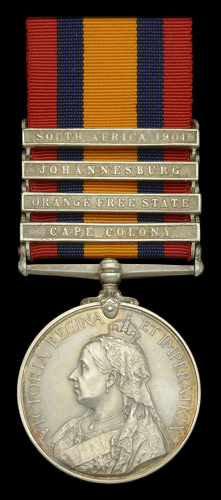
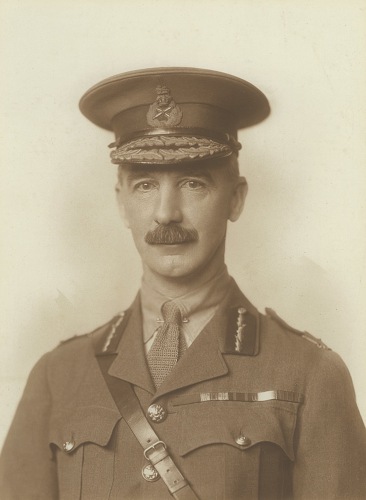
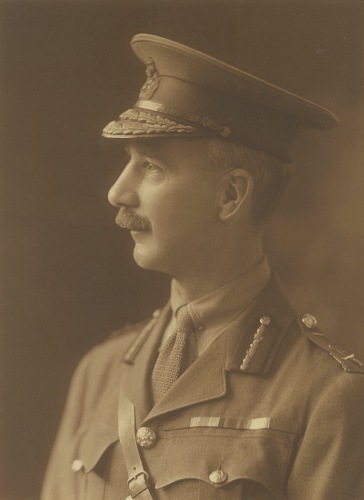
The Queen’s South Africa medal awarded to Brigadier General H. G. Casson, C.B., C.M.G., South Wales Borderers, who was M.I.D. for his services with the 1st Battalion during the Second Boer War, and subsequently commanded the 2nd Battalion during the Great War - including when they landed at Lao Shan Bay for operations against the German territory of Tsingtao in September 1914, and during their landing at Cape Helles, Gallipoli, 25 April 1915. Casson commanded the 87th Infantry Brigade as part of the 52nd Lowland Division in Gallipoli - including during the Battle of Krithia
Queen’s South Africa 1899-1902, 4 clasps, Cape Colony, Orange Free State, Johannesburg, South Africa 1901 (Capt. H. G. Casson. S. Wales. Bord.) good very fine £400-£500
This lot was sold as part of a special collection, The Luard and Casson Family Medals.

View
Collection
By Order of a direct descendant who kindly provided the images.
C.B. London Gazette 1 January 1918.
C.M.G. London Gazette 16 March 1915.
Hugh Gilbert Casson was born in January 1866, and was the son of the Reverend George Casson. He was commissioned Second Lieutenant in the South Wales Borderers in August 1886. Casson served with the 1st Battalion in South Africa, April 1900 - October 1901 (M.I.D. London Gazette 10 September 1901). He advanced to Captain in November 1892, to Major in June 1904, and to Colonel in June 1915.
Casson, ‘died recently [February 1951] in North Wales, at the house of his brother, was little known to the present generation of the 24th, but to those who served with the 1st Battalion from 1886-1912 and with the 2nd Battalion between 1912 and 1914 he represented above all other things the “Spirit of the 24th”; to him the 24th came first and the rest did not matter....
He was, I know, a very good Rugby player, a good Polo player and a brilliant gymnast. He was a pupil of Eugene Sandow in physical culture, weight lifting, etc. Many will remember the feats of strength he showed in the Mess in Quetta in 1909, and I well remember him showing a class in the gymnasium how to do exercises on the horizontal bar dressed in his uniform with his boots and gaiters on.
It was, however, not only in feats of sports and strength that he excelled, because he was selected as Adjutant of the 1st Battalion as a young subaltern, and this in the days when the appointment of Adjutant was looked upon as the “plum” of all appointments.
In 1900 the 1st Battalion went to India and immediately made a name for itself in polo throughout the whole of India, winning practically every cup it went in for. Casson often played as a member of the team, which contained such well-known players as Melville, Cooke, Gray and Smith.
Whatever he did he paid the greatest attention to all details of organisation. Everyone who served with him will remember the way the training of polo ponies was organised, the way he taught others to make polo sticks, the way Regimental “At Homes” were organised, the organisation of the Officer’s Mess. All bore the hall-mark of his meticulous attention to detail...
In 1910 Casson went home with the 1st Battalion and later proceeded to South Africa to take over Command of the 2nd Battalion. Though he had not served with the 2nd Battalion since the South African War, from now onwards he threw himself whole heartedly into the life of his new battalion.... he put all his energies into his new battalion, which had just started its foreign service, and he did a great deal to foster that spirit of comradeship which has since existed between the Officers and Other Ranks of both Battalions.
In 1912 he took us to China.... Then came Tsingtao and our first baptism of fire in September 1914, and we could not have started on Active Service under a better Regimental leader. Gallipoli followed and it was now that I could really see and feel what the Regiment meant to him and what he meant to the Regiment. He thought only of the Regiment and how he could produce it fighting fit and oraganised for one of the hardest tasks it had ever been called upon to perform, the landing at Helles.
The Battalion had a great deal to thank the Commanding Officer for in the early days of the campaign and it was mainly due to his minute attention to every detail of organisation that our casualties compared to others were so light.
Within a few weeks of the landing, Casson was selected to command a Brigade in the 52nd Lowland Division; but it was most difficult for Corps H.Q. to persuade him to give up his beloved Battalion. It was only by direct order of the Corps Commander that he left the 24th after 29 years Regimental soldiering....
He was an exceedingly good trainer and organiser. In Action he was calm and collected and afraid of nothing. He was an excellent Regimental leader, always helpful and understanding, particularly to his junior officers, who knew that they could always go to him with their troubles. But the one characteristic which stood out for all to see and appreciate was his admiration and love of the 24th, and wherever his name is mentioned this will always be remembered by those who served with him.
He would want no better epitaph than this: “One of the 24th.” (Obituary included in The Journal of The South Wales Borderers and The Monmouthshire Regiment, No. 39, May 1951 refers)
Casson lead his Battalion when they landed at Lao Shan Bay for operations against the German territory of Tsingtao. He also commanded them during their landing at Cape Helles, Gallipoli, 25 April 1915, and shortly after was made Temporary Brigadier General and appointed to the command of the 87th Brigade as part of the 52nd Lowland Division - including during the Battle of Krithia. After Gallipoli, he served as G.O.C. Delta (Egypt) and Western Force from 1916 to 1918. He retired in 1919 (M.I.D. and Serbian Order of Karageorge).
Casson in command at attack and capture of Modderfontein by the Boers in January 1901
‘At Modderfontein Nek, where the road from Krugersdorp, 22 miles distant, climbs up into the range, isolated and well-nigh forgotten in the close neighbourhood of this dangerous concentration, stood a small British post of 109 South Wales Borderers, under Captain Casson, which served no useful purpose and offered a tempting prize to the enemy.
In order to explain the error which allowed this post to be overwhelmed it is necessary for a moment to widen our horizon. Not only in the Western Transvaal but in every part of the field of war, the month of January was one of emergency and strain. Botha and Vijoen, as we shall see presently, had produced an intolerable situation in the Eastern Transvaal; Cape Colony was aflame, and de Wet was preparing a fresh invasion. In the process of meeting these emergencies French was withdrawn from his district on the 17th and directed against Botha; Colonel Haig, his capable staff officer, had been ordered away to Cape Colony; Hart, who knew the district well, and had worked it very successfully, was relieved at Krugersdorp on the 29th by Colonel Grove and was sent into the Free State; while Clements, as we have recorded, had been given the command at Pretoria. Thus most of the men who knew the district best had been almost simultaneously withdrawn.
At 4 A.M. on January 29 a convoy bearing a month's supplies left Krugersdorp for Modderfontein under an escort of 108 men commanded by Captain H. Magniac of the Oxfordshire Yeomanry. The mistake which had caused the loss of the convoy at Buffelspoort was repeated here; for, although Boers in force were known to be in the Gatsrand, the convoy was despatched without any warning to the officer commanding the garrison and without any regard for the general situation. Casson, commanding at Modderfontein, learnt only at 9 A.M. that the convoy was approaching, and at once sent all the men he could spare to secure its safe arrival. This covering party under Lieutenant Crawley effected its junction with Magniac, and the two officers succeeded in bringing the convoy into camp, but only with the utmost difficulty and under repeated assaults from Breytenbach, who was the first to appear upon the scene. Crawley himself was severely wounded.
The Boers now invested and attacked Modderfontein, Smuts and Liebenberg were summoned, and by midday on the 30th a large force with two guns was besieging the little post, now held by about 200 men. Here, again, the almost unlimited possibilities of fortification had been neglected. Tools had been lacking. The sangars and trenches were inadequate in themselves and gave little mutual support.
Magniac's men had to build their own under fire. All through the day and night of the 30th firing continued. One determined assault was repulsed, but at 1.30 A.M. on the 31st, in heavy rain and black darkness, the enemy began to storm the advanced posts. There was no regular surrender. The troops were simply overborne by numbers. Resistance ceased at 4.30 A.M. after a fight of 43 hours, during which the garrison lost 26 killed and wounded.’ (The Times History of the War in South Africa, refers). Casson was mentioned in despatches for this action.
Sold with the following copies of original and very descriptive correspondence from Captain H. G. Casson:
a) Captain Casson’s account of the action at Modderfontein 29-30 January 1901 (14pp) and through to 9 February 1901 (22pp), the originals of which are held by the National Army Museum.
b) Lieutenant-Colonel Casson’s letter to his brother, H. A. Casson, C.S.I., on his return from Tsingtao, 22 November 1914 (on board P&O SS Delta, en route to Hong Kong) giving a full account of the proceedings at Tsingtao from 19 September 1914 (4pp).
c) Lieutenant-Colonel Casson’s letter to his brother, H. A. Casson, C.S.I., from Gallipoli, 15 June 1915 (12pp).
d) Lieutenant-Colonel Casson’s letter to his brother, H. A. Casson, C.S.I., on board the Hospital Ship S.S. Dunlice Castle, 8 September 1915, whilst recovering from a wound caused by a sniper (4pp).
e) Lieutenant-Colonel Casson’s letter to his brother, H. A. Casson, C.S.I., 13 March 1916, describing events following the withdrawal from Helles on night of 8/9th January (12pp).
f) Brigadier-General Casson’s letter to his sister-in-law, Gertrude Casson, 14 June 1916, following the death of her father (8pp).
Share This Page