Special Collections




 Create new list
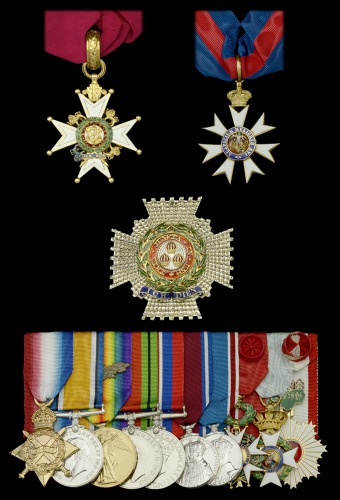
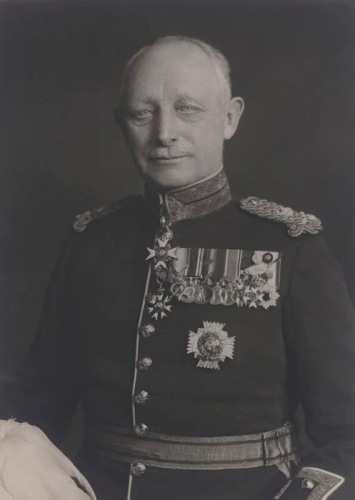
The K.C.B., C.M.G. group of twelve awarded to General Sir William Godfrey, Adjutant-General of the Royal Marines
The Most Honourable Order of the Bath, K.C.B. (Military) Knight Commander’s set of insignia comprising neck badge and breast star, silver-gilt and enamels, complete with neck cravat in its Garrard & Co. Ltd. case of issue; The Most Distinguished Order of St. Michael and St. George, C.M.G., Companion’s neck badge, silver-gilt and enamels, complete with neck cravat in its Garrard & Co. Ltd. case of issue; 1914-15 Star (Maj. W. Godfrey, R.M.L.I.); British War and Victory Medals, with M.I.D. oak leaves (Lt. Col. W. Godfrey. R.M.L.I.); Defence and War Medals 1939-45; Jubilee 1935; Coronation 1937; France, Third Republic, Legion of Honour, Officer’s breast badge, gold and enamels; Greece, Kingdom, Order of the Redeemer, Officer’s breast badge, gold and enamels; Japan, Order of the Rising Sun, 4th Class breast badge, silver-gilt and enamels with central cabachon, these ten mounted court-style, good very fine or better (13) £2,600-£3,000
This lot was sold as part of a special collection, The Collection of the late James C. Risk, C.V.O., F.S.A..

View
Collection
K.C.B. London Gazette 2 January 1939 (C.B. 1932).
C.M.G. London Gazette 1 January 1916.
M.I.D. London Gazette 16 August 1915, 14 March 1916, and 11 April 1917.
William Wellington Godfrey was born on 2 April 2 1880, the son of Mr. George Godfrey, of Courtral, Belgium. He entered the Royal Marine Light Infantry in 1898. Among the ships in which he served as a junior officer were the Juno and her sister-ship the Venus. He was promoted to Captain in April 1907, while serving as adjutant of the Chatham Division, and in 1910 was appointed to the Vanguard. Two years before war broke out in 1914 he had been one of the three Marine officers selected to join the first course in staff duties held on the introduction of the staff system in the Navy, and on passing out he joined the staff of Rear-Admiral E. C. T. Troubridge, commanding the 1st Cruiser Squadron, Mediterranean Fleet, in the Defence. After the return home of the Rear-Admiral and the transfer of the Defence to the Atlantic, he joined the staff of Rear-Admiral S. H. Carden in the battle cruiser Indefatigable at the Dardanelles. In that cruiser he was present at the blockade of the Dardanelles until joining Inflexible in January 1915 and was present at the bombardment of Forts and various minor operations. In Queen Elizabeth he was present at the bombardment of the defences of the ‘Narrows,’ 18 March 1915, and at the landing at Gallipoli, 24 April. Joining the Lord Nelson in May 1915, he was present at the landing at Suvla Bay, 7-8 August. He landed on numerous occasions at Helles, Anzac, and Suvla Bay, and was present at the evacuation of Suvla and Anzac in December 1915, and at the evacuation of Helles in January 1916. Mr. Churchill, then First Lord, afterwards referred in The World Crisis to Captain Godfrey as "a very able officer." He later served on the staffs of Admirals de Robeck and Thursby until the evacuation of Gallipoli.
Godfrey was afterwards present at the blockade of the Bulgarian and Turkish coasts. He acted as Assistant Secretary at the Conference of Allied Admirals at Malta in March 1916. He was promoted to Lieutenant-Colonel by brevet in May 1917, and three months later appointed
G.S.O.l and temporary Lieutenant-Colonel for duty as staff officer to the Admiral of Patrols, Malta, for convoy and anti-submarine work.
In August, 1918, he was appointed to the staff of Vice-Admiral Sir Roger Keyes in the Dover Patrol, with which he served until the patrol was demobilized in 1919.
After the end of the 1914-18 war Godfrey was selected for the staff of the R.N Staff College at Greenwich, and served there until 1924. He then worked in the Plans Division at the Admiralty until 1927. For the next three years he was on Corps duties at Chatham and Deal. He was appointed Assistant Adjutant-General, Royal Marines, in 1930, and while there was promoted to Colonel Second Commandant in 1931. In 1933 he received his promotion to Colonel Commandant, and was appointed in command of the Portsmouth Division of the Corps. This command he held until promoted Major-General in 1935, having served as Royal Marine A.D.C. to the King from 1934 until his promotion. He became Adjutant-General of the Corps in succession to General Sir Richard Foster in 1936; he was promoted Lieutenant-General in 1937 and General on 1 April 1939.
He was still serving as Adjutant-General, Royal Marines - a post of which the title was later changed to General Officer Commanding - on the outbreak of war, but having had to relinquish duty in order to undergo an operation in August 1939, he was relieved, at his own request, and placed on the retired list. In the following summer, however, his successor in office, Major-General Alan Bourne, was seconded for duty as the first Director of Combined Operations - becoming Deputy Director when Sir Roger Keyes was put in over his head; and during Major-General Bourne's absence General Godfrey was recalled from retirement to his old post until Bourne's return at the end of 1940. Godfrey then reverted permanently to the retired list. He died at Tavistock, Devon, on 18 May 1952.
Sold with a quantity of research including original statements of service.
Share This Page