Special Collections



 Create new list
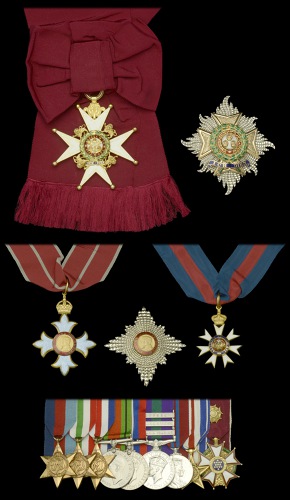
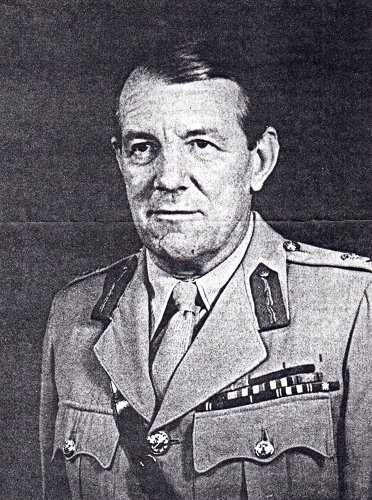
The important G.C.B., K.B.E. C.M.G. group of twelve awarded to General The Lord Bourne of Atherstone, late Royal Artillery, the remarkable ‘one armed General’ who was Chief of Staff of the First British Airborne Corps at the Crossing of the Rhine and later Colonel of 10th Battalion The Parachute Regiment
The Most Honourable Order of the Bath, G.C.B. (Military) Knight Grand Cross set of insignia, comprising sash badge, silver-gilt and enamels, and breast star, silver-gilt, gold and enamels, reverse with gold pin for wearing, complete with full dress sash in its Garrard & Co. Ltd. case of issue; The Most Excellent Order of the British Empire, K.B.E. (Military) Knight Commander’s 2nd type set of insignia, comprising neck badge and breast star, silver-gilt and enamels, complete with neck cravat in its Garrard & Co. Ltd. case of issue; The Most Distinguished Order of St. Michael and St. George, C.M.G., Companion’s neck badge, silver-gilt and enamels, complete with neck cravat in its Garrard & Co. Ltd. case of issue; 1939-45 Star; Italy Star; France and Germany Star; Defence and War Medals 1939-45; General Service 1918-62, 3 clasps, S.E. Asia 1945-46, Malaya, Cyprus (Maj. Gen. G. K. Bourne. Staff.); Coronation 1953; United States of America, Silver Star, officially numbered ‘40127’; Legion of Merit, Officer (Geoffrey K. Bourne), the last nine mounted court-style, generally good very fine (14) £6,000-£8,000
This lot was sold as part of a special collection, The Collection of the late James C. Risk, C.V.O., F.S.A..

View
Collection
G.C.B. (Military) London Gazette 1 January 1960 (K.C.B. 1957; C.B. 1949).
K.B.E. (Military) London Gazette 1 June 1954 (C.B.E. 1947).
C.M.G. London Gazette 1 January 1942.
U.S.A. Silver Star Medal London Gazette 23 July 1948. The recommendation states:
‘Brigadier Geoffrey K Bourne, OBE, British Army for gallantry in action in connection with military operations against an armed enemy of the United States on 24 March 1945. Brigadier Bourne, Headquarters, 1st British Airborne Corps, landed by glider in the hostile area on the east side of the Rhine with the airborne assault wave at 11.00 hours on 24 March 1945. Proceeding under constant enemy machine gun and small arms fire, he made a complete evaluation of the friendly and enemy situation. This vitally essential information he carried to the west bank of the Rhine, travelling through the enemy held Diersfordt Woods in order to reach his destination. Brigadier Bourne’s personal courage, gallantry and determination in the face of the enemy reflect the highest military traditions, and his actions were a material contribution to the successful airborne operation north east of Wesel.’
U.S.A. Legion of Merit, Degree of Officer London Gazette 17 October 1946. The recommendation states:
‘Brigadier Geoffrey K. Bourne, British Army, serving as Chief of Staff of the First British Airborne Corps from January to May 1945, was responsible for the joint planning of the American and British Airborne Units of the First Airborne Army. The rare judgment and unusual ability shown by Brigadier Bourne in co-ordinating the planning and execution of the joint Airborne operations contributed materially to the success achieved.’
Geoffrey Kemp Bourne was born on 5 October 1902, son of Colonel W. K. Bourne, of Sway, Hampshire. Educated at Rugby and R.M.A. Woolwich, he was commissioned into the Royal Artillery in 1923 and served overseas in Hong Kong, the Far East, and the Mediterranean during which period he lost an arm in a bob-sleigh accident as a subaltern, and retired from the Army, only to return to regimental duty a year later. Despite this handicap he passed through Staff College in 1936.
During World War II he served primarily as a staff officer including postings to the Joint Planning Staff (War Office), 1939-41, and the Joint Staff Mission, Washington D.C. U.S.A., in 1942. After serving as Commander, 152 Field Artillery Force (Ayrshire Yeomanry), in Italy (1944), he went on to serve as Chief of Staff, 1st British Airborne Corps, from January to May 1945. In this post he was responsible for the joint planning of the American and British Airborne units of the First Airborne Army, for which he was subsequently awarded the Legion of Merit (Degree of Officer). His actions on Operation Varsity, the 17th Airborne Division's first combat air assault and the last major airborne operation of World War II, to establish a bridgehead across the river Rhine, were recognised in 1948 with a US Silver Star.
After a further staff post with 21 Army Group he went on to become Commander Royal Artillery (CRA) 5 Indian Division, Java, Indonesia 1945-46, and later became Head of British Mission to Burma 1947-48, followed by General Officer Commanding, British Sector, Berlin, Germany, when he played a decisive part in setting up the Berlin Airlift.
He returned to the Airborne Forces fold in 1951 when he became Commander of 16 Airborne Division (TA), a post which he held until 1953, when he took over Eastern Command. He went on to succeed Field Marshal Templer as General Officer Commanding Malaya until 1956 and was mainly instrumental in bringing the terrorist campaign there to a close. Perhaps even more important, he set up the inter-communal security organisation which eased the path to Malaya’s independence; he had also formed the Malayan Army.
He then became Commander-in-Chief, Middle East Land Forces in 1957. His final post was as Commandant, Imperial Defence College 1958-59 before retirement to the Army Reserve of Officers in 1960. In that year he became Director General of the Aluminium Federation and Chairman of the National Building Agency fro 1967-73.
Other posts held include Colonel Commandant, Royal Artillery 1954-67; Honorary Colonel of the 10th Battalion The Parachute Regiment (TA) 1960-65, and Aide-de-Camp to the Queen. He was created a life Peer in 1964 as The Lord Bourne of Atherstone in the County of Warwickshire. General The Lord Bourne died on 26 June 1982
Share This Page