Special Collections




 Create new list
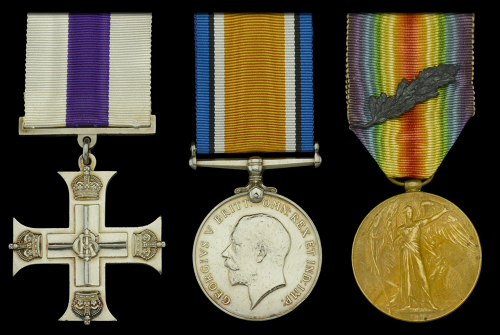
A Great War ‘Western Front’ M.C. group of three awarded to Lieutenant A. Otterburn, 2/5th Battalion, Gloucestershire Regiment, who was awarded the Military Cross for his gallantry near Fleurbaix on 30 September 1918; and was also Mentioned in Despatches
Military Cross, G.V.R., unnamed as issued; British War and Victory Medals, with M.I.D. oak leaves (2. Lieut. A. Otterburn) very fine (3) £800-£1,000
This lot was sold as part of a special collection, The Jack Russell Collection of Medals to the Gloucestershire Regiment.

View
Collection
R.A. Lynes Collection, Christie’s, November 1990; Dix Noonan Webb, October 1997.
M.C. London Gazette 1 February 1919:
‘For gallantry and devotion to duty South West of Fleurbaix on 30 September 1918. He commanded his platoon and subsequently his company with great skill and gallantry. When he reached his objective he found himself unsupported and being surrounded, he withdrew from the enemy lines after capturing twelve prisoners and inflicting casualties and clearing up an orchard, which was holding up the troop on his flank. He displayed great gallantry under fire, and by his coolness and fine leadership, extricated his platoon from a dangerous position with slight casualties.’
M.I.D. London Gazette 27 December 1918.
Alfred Otterburn attested initially for the 20th (Blackheath and Woolwich) Battalion, London Regiment, before being commissioned Second Lieutenant in the Gloucestershire Regiment on 30 October 1917. He served with the 2/5th Battalion during the Great War on the Western Front, being awarded the Military Cross for his gallantry near Fleurbaix on 30 September 1918.
The Battalion War Diary gives the following account: ‘The Battalion attacked at 5:45 a.m. Leading companies occupied Junction Post but were held up at the copse on left of it. One platoon of the right reached the road but were forced back. The line was reinforced and the copse was taken by working round it. Enemy counter attacked strongly at the cope and Junction Post and drove us out of the former. A second counter attack against Junction Post was also repelled. The copse was attacked at 2:30 p.m. and completely occupied by us. Trench running south west from Junction Post is held by us. The enemy put up a stout resistance and fought had. Area was covered with old trenches and enemy carried out a number of bombing attacks. A great deal of fire came from the south and east while the operation was taking place. Seventeen prisoners were taken and a trench mortar and six machine guns. Total casualties during the attack were 17 killed in action; 2 missing; and 53 wounded.’
Otterburn was Mentioned in Despatches by Sir Douglas Haig in 1918, and was promoted Lieutenant on 1 May 1919.
Sold with copied research.
Share This Page