Special Collections




 Create new list
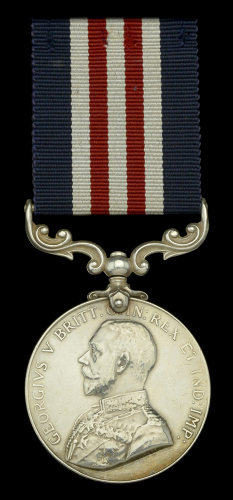
A Great War ‘1918 Battle of Festubert’ M.M. awarded to Private G. Newport, 1st Battalion, Gloucestershire Regiment, who was awarded the Military Medal for his gallantry during the action at Festubert on 18 April 1918, when the Battalion held their position when desperately attacked from front and rear by four enemy Regiments – for their gallantry that day the Regiment was subsequently awarded the ‘large size’ Back Badge, and received no fewer than 25 Military Medals, the most M.M.s awarded to a single Regiment for a single action during the Great War
Military Medal, G.V.R. (29454 Pte. G. Newport. 1/Glouc: R.) minor edge bruising, lightly polished, nearly very fine £300-£400
This lot was sold as part of a special collection, The Jack Russell Collection of Medals to the Gloucestershire Regiment.

View
Collection
Dix Noonan Webb, October 1997.
One of 25 Military Medals awarded to the Gloucestershire Regiment for their action at Festubert on 18 April 1918, the most M.M.s awarded to a single Regiment for a single action during the Great War.
M.M. London Gazette 6 August 1918.
Graham Newport attested for the Gloucestershire Regiment and served with the 1st Battalion during the Great War on the Western Front, being present during the Battalion’s epic action at Festubert, during the Battle of Bethune, on 18 April 1918.
At 6:30 a.m. enemy artillery opened up on the Glosters line and at 8.15 a.m. German machine-gunners led the advance over the rising ground 500 yards north of Festubert and were repeatedly repelled by “B” and “D” Companies of the Glosters, who by the end of the action had suffered only 29 casualties. But although the enemy were held on the main front, they were able to create one gap which had been widened by shellfire. Reinforcements were sent for by runner, but every soldier was already engaged and the sole reinforcements available were 12 men from Battalion HQ, who comprise cooks, batmen, and drivesrs. They were sent forward to join the battle just as the enemy attacked the Regiment front and rear. It was a most desperate battle. The Germans tried in every way to annihilate the Glosters, placing snipers in the ruined housed and bringing up field guns to open fire at point blank range. Still the Glosters held on until very gradually the Germans started to to withdraw, discarding all arms and equipment. By mid-afternoon the line was reformed on its original position.
The following signal was sent by the Brigade Commander to the 1st Battalion after the action:
‘I wish to express my admiration for the gallant defence put up by your Battalion yesterday. The tenacity with which they held their position when attacked from front and rear by four Regiments has earned the praise of Commanders of all grades. Under the peculiar circumstances of the sector, it was fortunate that a Battalion which had fought under similar conditions, have been in the line. All ranks fought as though mindful of the emblem [the Back Badge] they wear, and fully justify the wearing of it.’
For their gallantry on this occasion the Regiment was subsequently awarded the ‘large size’ Back Badge. Numerous individual gallantry awards were given for the action, including a Distinguished Service Order; 4 Military Crosses; 3 Distinguished Conduct Medals and no fewer than 25 Military Medals (23 M.M.s and 2 Second Award Bars), the most M.M.s awarded to a single Regiment for a single action during the Great War.
Sold with copied research.
Share This Page