Special Collections




 Create new list
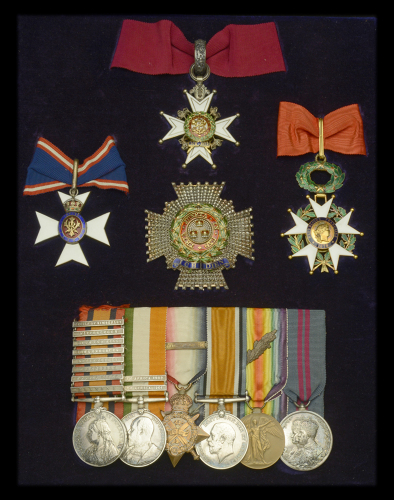
The important Boer War and Great War K.C.B., C.V.O. group of nine awarded to Lieutenant-General Sir M. F. Rimington, 6th Inniskilling Dragoons, the notorious Commandant of Rimington’s Guides during the Boer War, he commanded the Escort at the 1911 Delhi Durbar, and commanded the Indian Cavalry Corps in France 1914-16
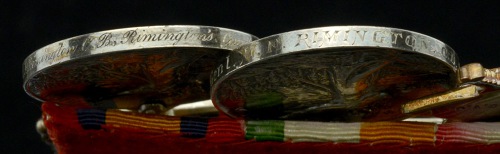
The Most Honourable Order of the Bath, K.C.B. (Military) Knight Commander’s, set of insignia, comprising neck badge in silver-gilt and enamels, and breast star in silver with appliqué centre in gold and enamels, fitted with gold pin for wearing; The Royal Victorian Order, C.V.O., Commander’s neck badge, silver-gilt and enamels, the reverse officially numbered ‘C520’; Queen’s South Africa 1899-1902, 8 clasps, Belmont, Modder River, Paardeberg, Driefontein, Johannesburg, Diamond Hill, Wittebergen, Relief of Kimberley (Major & Lt: Col: M. F. Rimington C.B., Rimmington’s Guides, Inniskilling Dgns.); King’s South Africa 1901-02, 2 clasps, South Africa 1901, South Africa 1902 (Brig: Genl. M. F. Rimington, C.B. Innis. Dgns.); 1914 Star, with clasp (Maj: Gen: M. F. Rimington. C.B. C.V.O.); British War and Victory Medals, with M.I.D. oak leaves (Lt. Gen. M. F. Rimington.); Delhi Durbar 1911, silver, unnamed as issued, the last six on contemporary court-style mounting as worn; France, Third Republic, Legion of Honour, Commander’s neck badge, gold and enamels, generally good very fine or better (10) £6,000-£8,000
This lot was sold as part of a special collection, A Fine Collection of Queen's South Africa Medals to Scout Units.

View
Collection
LIEUT.-GENERAL SIR M. F. RIMINGTON.
A FINE CAVALRY LEADER.
Lieutenant-General Sir M. F Rimington, whose death at the age of 70 is announced on another page, was a notable cavalry leader, the organizer of the famous corps of scouts, known as Rimington's Guides, in the South African War. All over the Empire the death of "Mike" Rimington will be received with real sorrow, for men of all kinds of units, regular and irregular, had served under him and know his remarkable personality and powers of leadership.
The son of Mr. Michael Rimington, of Tynefield, Penrith, Michael Frederic Rimington was born on May 23, 1858, and went to Highgate School and then to Keble College, Oxford. After taking his degree, be passed into the Army as a university candidate, and was gazetted to a lieutenancy in the 6th (Inniskilling) Dragoons in October, 1881, joining them in Natal where they were then quartered on the conclusion of the Boer War of that year in which the regiment had taken part.
For many years before this war the Government of the Transvaal bad been endeavouring to gain possession of Bechuanaland, and now these attempts were renewed until in 1882, in direct breach of the Pretoria Convention, the Dutch established in Bechuanaland the republics of Stellaland and Goshen. It seemed likely that the whole of Bechuanaland might be permanently lost, while German territory
on the west might readily be extended to join with that of the Boers. Indignant protests against the action of the Transveal were raised both in South Africa and in England, and Major-General Sir Charles Warren was sent with an expeditionary force to remove the Boer filibusters who had entered the country, to bring about peace, and to hold Bechuanaland until further measures had been decided upon.
This force contained some 4,000 men, and included in it was the 6th Dragoons. Young Rimington accompanied the column, which, without firing a shot, broke up the newly created republics and formally took the whole country under British protection. Some years later, in 1888, Dinizulu, a Zulu chief, rebelled against the British Government, which in the year before had annexed Zululand, and there was a sharp campaign in June, July, and August in which the Inniskillings were employed, and which ended with the surrender of the chief in November. Rimington had been adjutant of his regiment from August 1886 to October 1888, and had been promoted captain in October, 1887.
The 6th Dragoons now came home from South Africa. Rimington was promoted major in the spring of 1897, and in September was appointed staff captain on the Remount Establishment, a post which he held until the end of June, 1899. By this time relations with the
Dutch Republics had become strained, and Rimington went out to the Cape as a special service officer, the date of his appointment
being July 1.
The South African War had scarcely begun when Major Rimington was commissioned to raise a corps competent to act as guides in any part of the sub-continent. Its official title was “Rimington’s Guides,” but it was better known as the campaign progressed as “Rimington’s Tigers,” in allusion to the strip of wild-cat skin with which the headdresses of the men were adorned. It became a very well-known , hard-fighting body of men, and developed into a corps of scouts supplying guides to the Army. For the successful command of such a corps personality counted far more than did a “p.s.c.,” and Rimington proved himself an admirable leader of light irregular horse; his men were veterans of the many South African wars - Zulu, Basuto, Kaffir, Boer, or Matabele; they bad been carefully, even individually, selected, and
trained on novel and unofficial lines; and they would have followed their major anywhere. Here is what one of his men wrote of him:-
"He ought to have lived 500 years ago and dressed in chain-mail, and led out his lances to plunder and foray. Picturesque is the word
that best describes him. He makes every one else look hopelessly commonplace. His men admire him immensely, like him a good deal. Generals in command sometimes find him, I fancy, a bit of a handful, that is, if their policy is at all a backward one. He is essentially a man who means business, who believes that the Army is here to fight, and it is especially in action that he makes his value felt. In all scouting operations in our frequent long patrols he shows the same mixture of prudence and daring: he has never got trapped or cut off; he has an
extraordinarily good eye for country."
With a commando that devoutly believed in him, Rimington joined Methuen’s column and fought at Enslin and Modder River, and
either with his "Tigers," or with his own regiment, to the command of which he was gazetted in September, 1900, or in command of very mobile columns, he served all over the three Colonies in the operations round Colesberg, the relief of Kimberley, at Paardeberg, Driefontein, Johannesburg, Diamond Hill, and in the Wittebergen, and for his services was five times mentioned in dispatches, was made
C.B., and given a brevet lieutenant-colonelcy and ten clasps to the two war medals.
Colonel Rimington commanded his regiment for the full period, becoming a substantive colonel in January, 1903, and in the same month was appointed to command the 3rd Cavalry Brigade at home with the rank of Brigadier-General. Four sears later he was appointed to command the Secunderabad Cavalry Brigade, and in March, 1911, being now a major-general, he was selected for the post of Inspector of Cavalry in Indía, He was holding this appointment when the Great War broke out, and he followed the infantry of the Indian Contingent to France as commander of the Indian Cavalry Corps, serving during that first terrible winter, and until the Indians were withdrawn from the European theatre of war and there was no longer any scope for a cavalry corps commander.
For his services in the War he was twice mentioned in dispatches, and was appointed a Commander of the Legion of Honour.
From April, 1916, to January, 1918, Major-General Rimington was commander of a Reserve Centre. He was appointed colonel of his old regiment (now the 5th Inniskilling Dragoon Guards) in June, 1912, was given a distinguished service reward in August, 1919, and was promoted K.C.B. in 1921. He retired in July, 1919, with the rank of lieutenant-general.’ (The Times Obituary, 20 December 1928 refers).
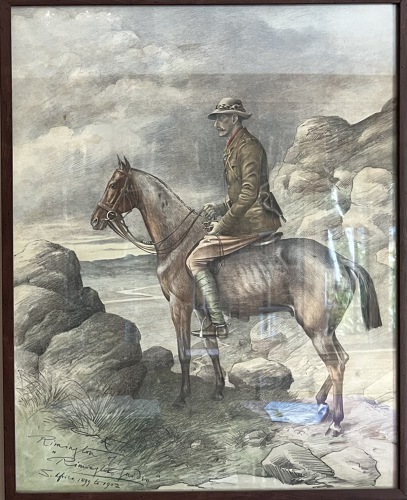
Sold with several original documents including Royal Military College Half Yearly Report of Gentleman Cadet Rimington (December 1880 - Exemplary); R.M.C. vellum Certificate of proficiency in Military Topography and Riding (August 1881); two Horse Guards, War Office letters relating to his Lieutenancy in the 6th Dragoons (October 1881); and a copy of the Special Order of the Day upon giving up the Command of the Indian Cavalry Corps (4th March 1916); together with four Boer War period photographs, a large print of Rimington on horseback titled ‘Rimington of Rimington’s Guides, S. Africa 1899 to 1902’, and another print from the I.L.N. or similar.
Share This Page