Auction Catalogue




 Create new list
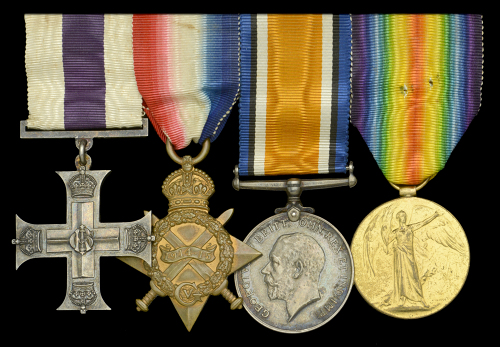
A fine Great War ‘Salonika operations’ M.C. group of four awarded to Captain J. W. McKill, Royal Welsh Fusiliers, who was decorated for his leadership during the raid on the Mitrailleuses in February 1917
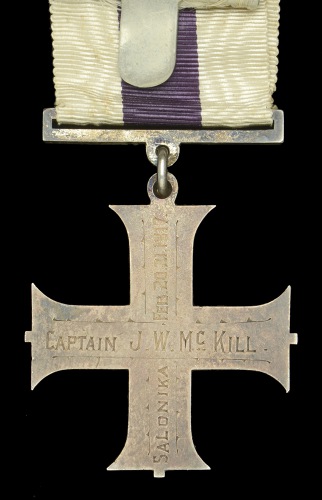
Military Cross, G.V.R., reverse privately engraved ‘Captain J. W. McKill. Salonika, Feb. 20. 21. 1917.’; 1914-15 Star (Capt. J. W. Mc.Kill. R.W. Fus:); British War and Victory Medals (Capt. J. W. Mc.Kill.) mounted as worn, good very fine (4) £600-£800
M.C. London Gazette 15 June 1917:
‘For conspicuous gallantry and and devotion to duty when in command of a raiding party. He led his men in the most gallant manner and showed marked ability and coolness throughout, not only during the raid but in subsequent operations.’
John William McKill was born at Wardleworth, Rochdale, on 16 December 1880, the second son of tailor and draper William McKill. Educated at Rossall School and Victoria University (United Kingdom), he took employment as a land agent before applying for a commission in the British Army in August 1914. Appointed Temporary Second Lieutenant (Infantry) on 2 October 1914, McKill was initially posted to the 4th Battalion, Royal Welsh Fusiliers. Transferred to the 11th (Service) Battalion at the time of his marriage in March 1915, he disembarked at Le Havre as Temporary Captain on 6 September 1915, part of 67th Brigade, 22nd Division.
McKill arrived in France at a time when many battalions of the Royal Welsh Fusiliers were licking their wounds after being ‘badly cut up at Festubert’ and were struggling to regain strength (The Records of the Royal Welch Fusiliers, refers). Detrained at Amiens and Longueau, the 11th Battalion went to Vignacourt and on to Rainneville on 9 September, taking their place in the line on the left of X Corps. Transferred to the Bois de Tailles and then south to the Somme, the troops spent 25 September 1915 relieving the 9th Border Regiment at Framerville; a fortuitous deployment given the high losses sustained by the Royal Welsh Fusiliers that morning at Loos when clouds of chlorine gas released along the British front line were wafted back on our own men by a changeable breeze.
Remaining in the Somme Department for the next month, the Royal Welsh Fusiliers were soon pleased to hear news of a move to an unknown destination on 20 October 1915. Relieved by the 6th French Division, the 11th Battalion entrained at Villers Bretonneux for Marseilles and embarked per Huntsend for Salonika on 30 October 1915. Six days later they were setting up camp on the right bank of the Galiko River, north of the Salonika-Uskub Railway, preparing to stabilise an increasingly precarious situation:
‘The Serbs were being hard-pressed by a horde of Germans and Austrians descending from the north, and from the east by Bulgaria... By the 30th November Serbian Headquarters were at Scutari, and their Army, reduced from 400,000 to a half-starved 150,000 men, was retiring on the Albanian coast, for the time being out of the War’ (The War with Bulgaria: Salonika, refers).
Deployed in a continuous line from the sea to Lake Vardar, the British gradually managed to regain control. The situation was markedly improved by the arrival of 60th Division in December 1915 and a good deal of driving snow which effectively brought the battlefield to a stalemate for a few precious weeks.
The Raid on the Mitrailleuses
Towards the end of January 1916 it was suspected that the German 59th Regiment had been relieved by Bulgars, and the Commander-in-Chief ordered the 67th Brigade to secure prisoners and confirm the report. A scheme for a surprise raid was devised, with a three day preliminary bombardment on the Mitrailleuses, Dorsal and the Nose, to soften up the enemy. The Records of the Royal Welch Fusiliers, continues:
‘Some 200 men took part in the raid, which was under the command of Captain J. W. McGill. The raiding party started at 9 p.m. Captain McGill says: “The searchlights and very lights were very troublesome. All the way through Macukovo we had a lot of rifle fire on us and could see shells falling to the Y Ravine end of the village. Shells fell about the yellow house and to the west after we had passed. We were all right from the white house. Our total casualties were 3 officers and 16 other ranks wounded. The prisoners were all of the 59th German Regiment.”’
Awarded the Military Cross, McKill remained in Salonika until July 1917 when he was invalided home to England suffering from neurasthenia and general exhaustion; his medical records note that ‘he was too weak to carry on his duties’ and had developed a mitral systolic murmur. Transferred to the General List and briefly posted to duty with the Inland Water Transport, he was invalided from further military service on 28 January 1918. Returned to Wrexham, he resumed employment as a local land agent and died in 1953.
Sold with copied research.
Share This Page