Auction Catalogue




 Create new list
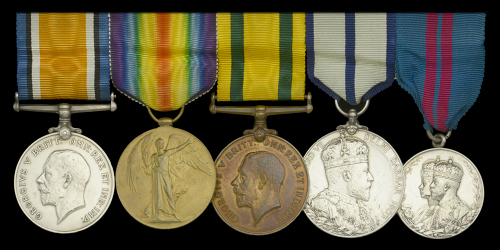
Five: Lieutenant-Colonel E. Crawshay-Williams, Royal Horse Artillery and Royal Field Artillery, who served as Liberal Member of Parliament for Leicester from 1910-13 and as Parliamentary Private Secretary to David Lloyd George
British War and Victory Medals (Major E. Crawshay-Williams.); Territorial Force War Medal 1914-19 (Major E. Crawshay-Williams. R.A.); Delhi Durbar 1903, silver, unnamed as issued, Lacking integral top riband buckle; Coronation 1911, unnamed as issued, mounted as worn, minor contact marks to Delhi Durbar and Coronation medals, otherwise good very fine and better (5) £400-£500
Eliot Crawshay-Williams was born on 4 September 1879, the elder son of barrister and politician Arthur John Williams of Coed-y-Mwstwr, Glamorgan. Educated at Eton and Trinity College, Oxford, he served under Winston Churchill at the Colonial Office from 1906-08 and was successfully elected as a Member of Parliament in the January 1910 General Election. Appointed Parliamentary Private Secretary to Lloyd George who was at that time Chancellor of the Exchequer, he likely assisted with the National Insurance Act of 1911 and other measures which led to the establishment of the modern welfare state. With his superior embroiled in the Marconi scandal of 1913, Crawshay-Williams himself saw his name flashed across the contemporary press after being exposed in a divorce case brought by fellow Liberal Hubert Carr-Gomm, M.P. for Rotherhithe; according to the recipient’s autobiography, the publicity spelt ‘the death blow of my career’ and he was forced to resign from politics in 1913.
Appointed Temporary Major in the 1/1st Leicestershire Royal Horse Artillery in 1914, Crawshay-Williams saw active service in France with the 110th Battery, Royal Field Artillery, from 26 February 1916. Initially posted overseas as Captain, he was advanced Major and was later appointed Lieutenant Colonel in 1919. A short while later he made an application for his Great War medals whilst serving at Northern Command, York. Returned to civilian life, Crawshay-Williams spent the inter-war years attempting to forge a living as an author of fiction and political texts; he wrote numerous novels, short stories, pieces of poetry, plays and film scripts, his work including the screenplay Service for Ladies (1932), the play Fascination (1931) and the Night in the Hotel (1931). As a staunch believer in appeasement, he later wrote to his former boss, now Prime Minister, Winston Churchill, pleading that the latter should use our ‘nuisance value while we have one to get the best peace terms possible...’
Churchill’s reply was bitingly brief: “I am ashamed of you for writing such a letter. I return it to you - to burn and forget.”
Crawshay-Williams later served from 1941-43 as a Civil Defence Officer at Treforest Trading Estate in Pontypridd, South Wales. He retired to Deal in Kent and died in 1962.
Sold with copied research.
Share This Page