Auction Catalogue




 Create new list
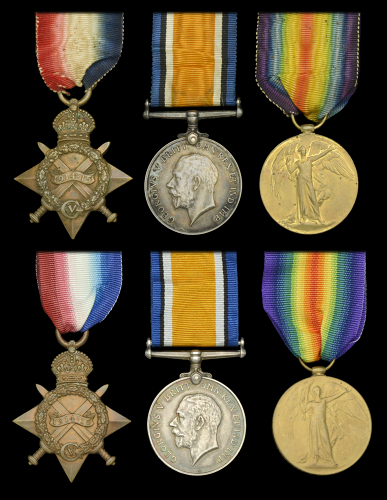
Three: Private J. E. Hewitt, Royal Welsh Fusiliers, who died of wounds on 17 March 1918
1914-15 Star (25417 Pte. J. E. Hewitt. R.W. Fus:); British War and Victory Medals (25417 Pte. J. E. Hewitt. R.W. Fus.) good very fine
Three: Private F. Spencer, Royal Welsh Fusiliers, later Army Ordnance Corps, who was severely wounded in action by shellfire in February 1916
1914-15 Star (15648 Pte. F. Spencer. R.W. Fus.); British War and Victory Medals (15648 Pte. F. Spencer. R.W. Fus.) good very fine (6) £120-£160
James Edward Hewitt, a shoemaker, was born in West Derby, Lancashire, and enlisted in the 17th Battalion, Royal Welsh Fusiliers at Caernarvon on 20 February 1915. Disembarked in France 5 December 1915, he served on the Western Front as part of 128th Brigade, 43rd Division, the Battalion being heavily engaged at Pilckem Ridge on 31 July 1917. The Battalion War Diary, adds:
‘The advance of our 17th Battalion from positions held on Iron Cross Ridge to the Steenbeek was the hardest of the day. Most of the houses along the road on top of the ridge and beyond contained concrete machine-gun shelters, and casualties were heavy. But though these points held up the troops facing them, others on the flanks pushed forward and one by one the houses were taken.’
Severely wounded in action at some point in the autumn or winter of 1917-18, Hewitt died just days before the German Spring Offensive. The husband of Mrs. A. B. Hewitt of 14, Raby Street, Grosvenor Road, Liverpool, he is buried at Erquinghem-Lys Churchyard Extension.
Sold with copied research.
Frederick Spencer, a carpenter, was born in Bristol and enlisted in the Royal Welsh Fusiliers on 31 August 1914. He served in France with the 10th Battalion from 27 September 1915 and suffered multiple shrapnel wounds to the knee, back and toes on 16 February 1916. Evacuated home to England for medical attention, he was discharged on 16 September 1916, his intended place of residence listed as ‘570 Neath Road, Molliston, near Swansea.’
Share This Page