Auction Catalogue




 Create new list
Family Group:
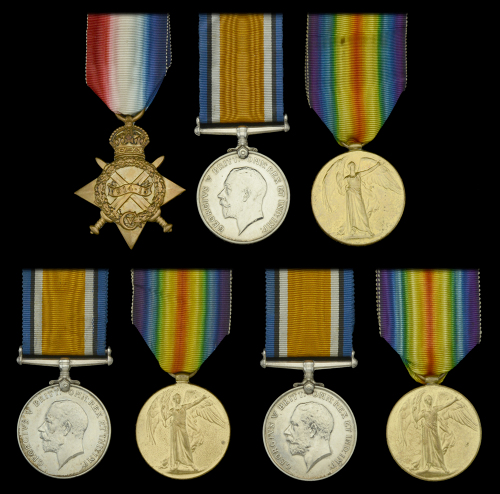
Three: Private J. E. Knight, Royal Welsh Fusiliers, who was killed in action at Gallipoli on 7 January 1916, just two days before the completed evacuation of the peninsula
1914-15 Star (31606 Pte. J. E. Knight. R.W. Fus:); British War and Victory Medals (31606 Pte. J. E. Knight. R.W. Fus.) Star lacquered to obverse, nearly extremely fine
Pair: Private J. M. Knight, Royal Marines
British War and Victory Medals (Deal 12108 -S- Pte. J. M. Knight. R.M.) nearly extremely fine
Pair: Private G. Knight, Royal Inniskilling Fusiliers, who was killed in action on the first day of the Battle of Langemarck, 16 August 1917
British War and Victory Medals (41014 Pte. G. Knight. R. Innis. Fus.) nearly extremely fine (7) £200-£240
John Edmund Knight was born in Wellingborough, Northamptonshire, in 1892, the son of Julian Morris Knight. He attested for the Royal Welsh Fusiliers at Marylebone on 31 August 1914, and served with the 8th Battalion at Gallipoli from 7 November 1915. Acting as Pioneers as part of 13th (Western) Division, the men of the 8th Battalion endured harsh conditions, notably floods and extremes of temperature, and were constant targets for Turkish sniper and artillery fire as they attempted to maintain the trench defences and supply routes, often built into the precipitous cliff edges at Helles. They also bore responsibility for maintaining the illusion that all was normal, so as not to give the Turks and Germans any indication of withdrawal.
On 7 January 1916, German General Liman von Sanders ordered the 12th Turkish Division to mount one final attack on the British at Gully Spur. According to the Records of the Royal Welch Fusiliers, it coincided with the 8th Battalion ‘packing up’:
‘So far as our battalion was concerned, the length of line they held was heavily bombarded from midday until 4.30 p.m. Then the rifle fire broke out and bayonets could be seen over the Turkish trenches, while Turkish officers moved rapidly along the line apparently urging the men to advance. On the left of our battalion, on the 39th Brigade front, the Turks did leave their trenches, but were easily repulsed. At Fusilier Bluff two mines were fired by the Turks, but their efforts were half-hearted and they gained nothing... Our battalion had about 30 casualties, and the parapets and communication trenches were considerably knocked about.’
Aged 24 years, Knight is commemorated upon the Helles Memorial.
Sold with copied Army Service Record.
Julian Morris Knight was born in Fotherby, South Lincolnshire, on 19 March 1869, the son of farm labourer John Fox Knight. Recorded in 1881 as a farm boy, he later worked as a general labourer in Willesden Green, Middlesex. He joined the Royal Marines on 31 May 1917 and is recorded in 1939 as a retired general labourer living with his incapacitated wife at 28 Sandringham Road, Willesden Green.
George Knight was born in Willesden around 1898, the son of Julian Morris Knight and younger brother of John Edmund Knight. Listed in 1911 as a school boy, Knight enlisted at Mill Hill and served in France with the 8th Battalion, Royal Inniskilling Fusiliers. Killed near Borry Farm, his battalion suffered devastating casualties from German machine-gun fire after becoming bogged down in deep, clogging mud.
Aged 19 years, Knight is commemorated upon the Tyne Cot Memorial.
Sold with copied research.
Share This Page