Auction Catalogue






 Create new list
‘After fighting for over six hours against overwhelming odds, a British submarine, still raked by devastating fire of enemy fighters, seaplanes and bombers, had all but reached her last gasp. The bridge a shambles of wounded men, blood and empty cartridge cases, powerless to dive or to steer, she was sunk by her own crew just as two enemy ships began to tow her away as a prize … ’
A newspaper report concerning the loss of H.M. submarine Shark off Norway in July 1940, refers.
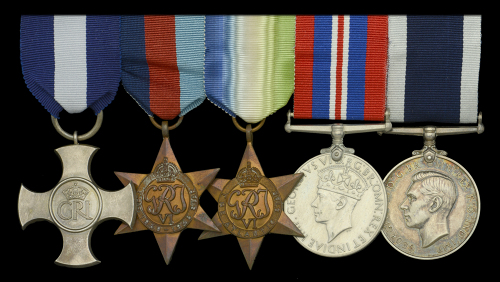
A fine Second War Norway 1940 operations D.S.C. group of five awarded to Lieutenant (E.) C. C. Loder, Royal Navy, who was decorated for his gallantry in H.M. submarine Shark, when she was damaged and scuttled after a protracted engagement and her survivors being taken prisoner
Distinguished Service Cross, G.VI.R., the reverse dated officially dated ‘1945’; 1939-45 Star; Atlantic Star; War Medal 1939-45; Naval L.S. and G.C. Medal, G.VI.R., 1st issue (M.36120 C. C. Loder. E.R.A. 1 H.M.S. Dolphin., good very fine (5) £3,000-£3,600
Sotheby’s, December 1998.
D.S.C. London Gazette 21 August 1945: ‘For conduct when the submarine was sunk by enemy action on 6 July 1940.’
The original recommendation states:
‘For devotion to duty as Engineer Officer of H.M.S. Shark during the action on the night of 5-6 July 1940. His zeal and energy were an inspiring example to the Engine Room Staff in their efforts to keep the engines running under extremely difficult conditions. The success of his efforts was responsible for the fact the submarine was able to present a more difficult target to the enemy bombers.’
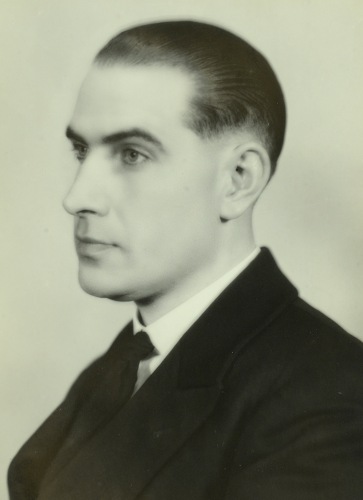
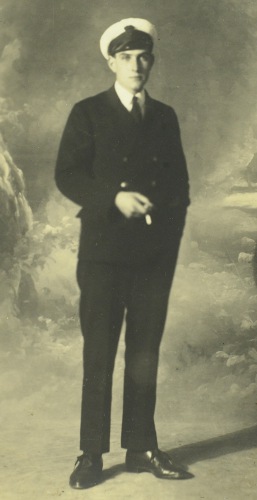
Cyril Coltman Loder was born in Portsmouth, Hampshire on 2 November 1905, and joined the Royal Navy as an Engine Room Artificer Apprentice in January 1921. Volunteering for submarines in the mid-1920s, he was awarded his L.S. & G.C. Medal in October 1938 and advanced to Acting Warrant Engineer in the summer of 1939, in which rank he was awarded the D.S.C. for his services in H.M. submarine Shark in the following year.
On patrol off Bergen, Norway on 6 July 1940, Shark was caught recharging her batteries on the surface, and so commenced a spirited action, as reported in post-war newspaper articles:
‘The Shark had surfaced to recharge her batteries and was sighted by a German seaplane. Though she dived immediately, she could not escape attack. The after hydroplanes - which control the angle at which a submarine lies when submerged - were jammed in the ‘hard arise’ position, and the boat rushed to the surface again. As soon as the bow appeared above the sea we heard a hail of machine-gun bullets on the hull,’ continued Commander Buckley, ‘and bombs dropped around us. For a time, we couldn’t get her down at all, and when she started to dive once more she went down rapidly. Then, for a second time, we rose to the surface. We came up at an incredible angle, and I knew that we would not be able to dive again …
After three hours fighting against tremendous odds, the Shark was listing heavily to starboard. Water was rising in the engine-room - yet, despite the choking atmosphere, the mechanics kept the engines running. ‘It was obvious to me that the end was now in sight,’ said Commander Buckley, ‘although everyone stuck to his post in a magnificent manner until wounded or killed outright.’ Two Germans from a seaplane (which subsequently sank, one float having been holed by the submarine’s fire) boarded the submarine, and the wounded and other members of the crew were taken on board German trawlers. Two of the trawlers attempted to tow the Shark away. ‘Measures had already been taken by the submarine’s crew to prevent this,’ said Commander Buckley. ‘No sooner had the trawlers started towing than the Shark sank. She went down vertically stern first, and her last action was to damage the propeller of one of the trawlers.’
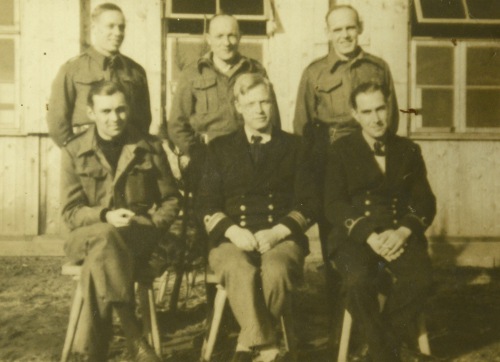
Loder spent the rest of the war as a P.O.W. in Germany, at Oflag IXA at Spangenburg Bei Kassel and Marlag und Milag Nord at Westertimke. From the latter camp he and his comrades endured a forced march, in which some of them were killed by an Allied aircraft attack and others succumbed to illness and hunger.
Loder’s description of the first sight of advance British troops at Lubeck gives only a hint of the privations endured up until then: ‘Four years, nine months and some days I had waited for this moment, and now my throat was dry with emotion.’
Following his repatriation, he resumed his career and retired as a Lieutenant (E.) in 1955.
Sold with a substantial archive of original documentation and photographs, including:
(i) The recipient’s Certificate of Baptism, together with a letter of recommendation from the Junior Technical School, dated 22 December 1920, and his final school report: ‘A very keen and loyal lad’.
(ii) His R.N. Certificate of Service, together with Naval Pay and Identity Book, Garrard & Co. case of issue for D.S.C., miniature dress medals and ribbon bar.
(iii) An impressive accumulation of P.O.W. documentation, from photographs and censored postcards sent home to his Y.M.C.A. P.O.W.’s exercise book containing a 35-page diary for April-May 1945, when he and thousands of others were herded ahead of the advancing Allies; with related typescript.
(iv) Admiralty letter of notification for the award of his D.S.C., dated 25 August 1945 and Buckingham Palace forwarding letter.
(v) Assorted newspaper reports concerning Shark’s final action, as published at the war’s end, when her story was revealed by her returning P.O.W.s.
(vi) A large quantity of photographs, covering the recipient’s life and times, from childhood, via the Navy, to retirement.
(vii) Service papers and documentation relating to Loder’s father and brother, the former a Master Gunner in the Royal Navy who saw service in the Egypt Campaign of 1882, the latter a submarine E.R.A. who was killed in an accident in Malta in 1935.
Share This Page