Auction Catalogue




 Create new list
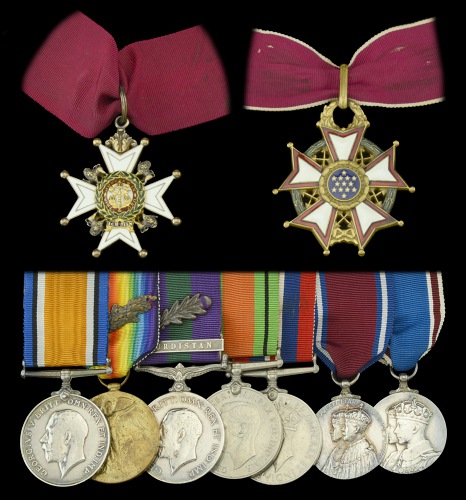
A good Second World War C.B. group of nine awarded to Air Vice Marshal R. P. Willock, Royal Air Force, late Oxfordshire and Buckinghamshire Light Infantry and Royal Flying Corps, who flew operationally with 14 Squadron (a.k.a. ‘X’ Flight) in support of Lawrence of Arabia’s desert army in Egypt and Palestine in 1916, where he was wounded in combat. Willock was mentioned in despatches for his command of No. 4 Armoured Car Company in Kurdistan in 1924, and was later a Vimy pilot on the Cairo to Baghdad Mail Run - featuring in Air Chief Marshal Sir Roderic Hill’s book on the subject. He held a number of posts during the Second World War, including AOC Iraq and Persia in 1943 and serving as Deputy Head of the RAF Delegation, Washington in 1944
The Most Honourable Order of the Bath, C.B. (Military) Companion’s neck badge, silver-gilt and enamel; British War and Victory Medals, M.I.D. oak leaf (Major R. P. Willock, R.A.F.); General Service 1918-62, 1 clasp, Kurdistan, M.I.D. oak leaf (S./L. R. P. Willock, R.A.F.); Defence and War Medals 1939-45; Jubilee 1935; Coronation 1937; United States of America, Legion of Merit, Commander’s neck badge, in gilt and enamel, breast awards mounted for wear, light contact marks, therefore generally very fine or better (9) £2,400-£2,800
Tom Baugh Collection, Dix Noonan Webb, March 2011
C.B. London Gazette 1 January 1943.
M.I.D. London Gazette 14 June 1918.
M.I.D. London Gazette 11 June 1924.
Poland, Order of Polonia Restituta London Gazette 12 June 1945. The original recommendation states:
‘As Air Officer Commanding the 21st Group where the Polish Schools were organised and carried out their duties, and also where Polish personnel were trained in R.A.F. schools, he greatly through his achievements brought the training of Polish pilots to a higher level. Through his knowledge and understanding it was possible to rapidly form Polish School Units.’
U.S.A. Legion of Merit London Gazette 24 January 1947. The original recommendation states:
‘Air Vice-Marshal Robert Peel Willock, C.B., Royal Air Force, served as Deputy Head of the R.A.F’s Delegation in the United States from March 1944 to April 1946. Air Vice-Marshal Willock served as Senior R.A.F. representative of the Combined Munitions Assignment Board, the Aviation Petroleum Products Allocation Committee and Joint Aircraft Committee. His membership on these committees made it possible for him to help carry out the provisions and spirit of the Lend-Lease Act in the best interests of both the British and American Governments. His broad knowledge and fine spirit of co-operation achieved outstanding results in the planning of Combined Allied Air Operations.’
Robert Peel Willock was born in Salford in December 1893 and was educated at Marlborough College. Commissioned in the Oxfordshire and Buckinghamshire Light Infantry in November 1914, he remained employed in the U.K. until transferring to the Royal Flying Corps, and qualified as a pilot at Castle Bromwich in October 1915. Subsequently posted to the Middle East, he joined 14 Squadron, 5th Wing (Egypt and Palestine), and went into action in the summer of 1916. Otherwise known as ‘X’ Flight, 14 Squadron was given the task of directly assisting Lawrence of Arabia’s forces, operating out of advanced landing grounds in the desert and, as illustrated by the following combat report, its pilots had their fair share of air-to-air encounters with the enemy:
‘On 23 July 1916, Lieutenant Willock, pilot, and Lieutenant West, Observer, in a de Havilland fighter, were patrolling over Romani at 6,000 feet. They observed ground signals at Romani indicating the presence of hostile aircraft. Following the direction of the arrow, they came upon the enemy machine, an Aviatik, and attacked him. He was decidedly superior in climbing power and speed. In addition to the Observer’s machine-gun, the machine was fitted with interrupter gear. His tactics, which he repeated several times, consisted in withdrawing a distance of over 20 miles over his own territory, and, when our machine lost him and was returning home, reappearing above him. Both pilot and Observer were wounded in this engagement, but although both wounded they pursued the enemy from Oghratina to Bir El Abd (a distance of 10 miles) at which point they finally lost him, flying well below them. Our machine was severely damaged. Several tracer bullets were observed to hit the enemy’s fuselage, and it is thought that he was returning in a damaged condition.’
Willock was admitted to hospital, but discharged and returned to his unit in mid-September and, a few days later, fought another combat:
‘On 28 September 1916, Lieutenant Willock, pilot, and Lieutenant Gottier, Observer, in a de Havilland over El Arish, engaged a hostile machine flying 500 feet below. Captain Minchin, in a Martinsyde, joined in the engagement. Lieutenant Willock reports that his Observer got in some good shooting. The two B.E. 2Cs which were photographing and reconnoitring had by this time completed their reconnaissance without interference and the de Havilland and Martinsyde thereupon escorted them home. A Fokker was over the Aviatik but did not attempt to engage.’
Though these were relatively early days in terms of Lawrence’s desert campaign, the great man was quick to appreciate the value of ‘X’ Flight’s activities, the following extract from Seven Pillars of Wisdom describing other operations undertaken in 1916:
‘We could also prick the Turks into discomfort by asking General Salmond for his promised long-distance air raid on Maan. As it was difficult, Salmond had chosen Stent, with other tried pilots of Rabegh or Wejh, and told them to do their best. They had experience of forced landing on desert surfaces and could pick out an unknown destination across unmapped hills: Stent spoke Arabic perfectly. The flight had to be air-contained, but its commander was full of resource and display, like other bundles of nerves, who, to punish themselves, did outrageous things. On this occasion he ordered low flying, to make sure the aim; and profited by reaching Maan, and dropping thirty-two bombs in and about the unprepared station. Two bombs into the barracks killed thirty-five men and wounded fifty. Eight struck the engine-shed, heavily damaging the plant and stock. A bomb in the General’s kitchen finished his cook and his breakfast. Four fell on the aerodrome. Despite the shrapnel our pilots and engines returned safely to their temporary landing ground at Kuntilla above Akaba. That afternoon they patched the machines, and after dark slept under their wings. In the following dawn they were off once more, three of them this time, to Aba el Lissan, where the sight of the great camp had made Stent’s mouth water. They bombed the horse lines and stampeded the animals, visited the tents and scattered the Turks. As on the day before, they flew low and were much hit, but not fatally. Long before noon they were back in Kuntilla.’
Willock advanced to Major in April 1918, and appears to have remained in the Middle East for the remainder of the war. In May 1920 he was at the School of Technical Training at Manston and in November assumed command of No 4 ACC at Hiniadi, seeing action in Kurdistan when he was Mentioned-in-Despatches. In November 1924 Willock joined 216 Squadron at Heliopolis flying the Vimy, task including carrying out the Cairo – Baghdad Mail Run. The latter was recounted by Air Chief Marshal Sir Roderic Hill, in his book The Baghdad Air Mail:
‘I woke up with the false dawn, that vision of amber over the eastern hills. As the upper sky brightened to lightest violet, the amber faded; and the sun rose in glory and lit “Valkyrie” to silver. Searle came and brought me my cup of coffee as I lay in bed. About 10am the two Vimys came and Squadron Leader D’Albiac in a D.H.9a from Amman. We had watched the Vimys’ progress on the wireless. Squadron Leader Willock and Sergeant Bennett, who bought the engine, came in the Vimys.
Of that day, the grime, the sweat, the afternoon heat and the thirst, I cannot record the details. It is a confused memory, with a few details standing out clearly. Willock standing up in his Vimy consuming a large bottle of beer, the silver undersurface of the planes reflecting white light all over him; the struggles with the sheerlegs; the beam that bent in a sickly manner as we tried to lift the engine off the Vimy; how we nearly dropped the engine as we were getting it off and on to the petrol drums in the back of the armoured car; the finding of the crack induction pipe to the Duplex carburettor; meals taken sitting on valises and trunks; working into the darkness with the light from a wandering lead and the armoured car’s head-lamp shining on the engine and the faintly lit figures of the tired workers, tools being lost and found, strolling around talking over many things with Willock....’
Willock was the station commander at Kenley for two years before attending the Army Staff College in January 1930. After two years at HQ Fighting Area, he became the Air Attaché in Shanghai in January 1934. After attending IDC, Willock served in the Air Ministry and in June 1940 was AOC 21 (Training) Group at Cranwell. Amongst his flying stations were those training Polish aircrew. In 1943 he was AOC Iraq and Persia and in 1944 became Deputy Head of the RAF Delegation in Washington. Willock retired in August 1946 when he became the Civil Attaché to the British Embassy in Washington. A year later he was the overseas representative at the Ministry of Civil Aviation and in 1949 the Civil Air Advisor to the High Commission in Australia. Air Vice Marshal Willock retired in 1959, and died in Sussex in March 1973.
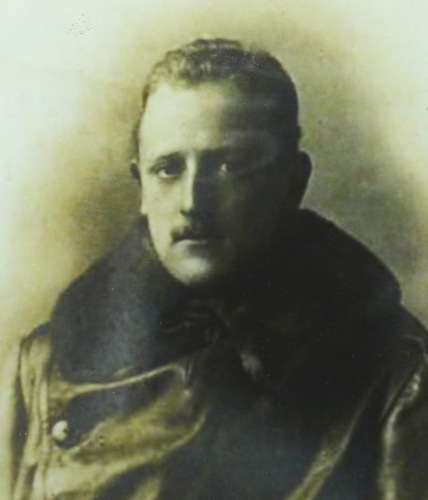
Sold with photographic images of recipient in uniform, and extensive copied research.
Share This Page