Auction Catalogue




 Create new list
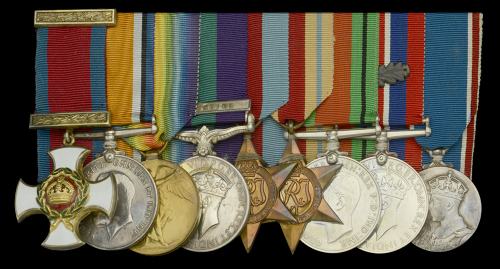
The particularly fine Second World War 1941 ‘Western Desert’ D.S.O. group of nine awarded to Brigadier J. Moubray, Coldstream Guards, who was wounded in action on the Western Front during the Great War, served in pre-war Palestine, and commanded the 3rd Battalion, Coldstream Guards with distinction in North Africa, November 1939 - March 1942. His battalion’s noble deeds are ably recorded in the regimental history No Dishonourable Name by D. C. Quilter, in which Moubray wrote the chapter called The Desert, July 1940 - April 1942
Distinguished Service Order, G.VI.R., silver-gilt and enamel, reverse officially dated ‘1941’, with integral top riband bar; British War and Victory Medals (2. Lieut. J. Moubray.); General Service 1918-62, 1 clasp, Palestine (Major J. Moubray C. Gds.); 1939-45 Star; Africa Star; Defence and War Medals 1939-45, with M.I.D. oak leaf; Coronation 1937, unnamed as issued, mounted as originally worn by Spink & Son Ltd, King Street, lightly polished, otherwise generally very fine or better (9) £2,600-£3,000
D.S.O. London Gazette 30 December 1941:
‘In recognition of distinguished services in the Middle East (including Egypt, East Africa, The Western Desert, The Sudan, Greece, Crete, Syria and Tobruk) during the period February 1941 to July 1941.’
The original recommendation states:
‘Lt. Col. Moubray has been commanding his Battalion during the period under review. On the 15/16th April he organised and led a most successful raid in the Sollum area, killing and capturing some 60 or 70 of the enemy.
On the 15th May he commanded his Battalion which was in reserve during the attack on Capuzzo, being ordered on the 16th May to hold the Halfaya Pass position. His Battalion was heavily shelled on the 25th May and afterwards attacked on the 26th May. Lt. Col. Moubray successfully extricated his Battalion which was in danger of being surrounded.
In all the above operations under review Lt. Col. Moubray has shown power of leadership and calm and reasoned judgement to a marked degree and I strongly recommend him for the award of the Distinguished Service Order.’
M.I.D. London Gazette 1 April 1941, 8 July 1941 and 15 December 1942.
John Moubray was born in May 1898, and commissioned into the Coldstream Guards from the Royal Military Academy in August 1916. He served with the Regiment on the Western Front, 2 July 1917 - 11 November 1918 (wounded). Moubray advanced to Lieutenant in November 1917, and to Captain in January 1926. He served as A.D.C. to G.O. C.-in-C. Western Command, October 1923 - June 1924, and as A.D.C. to the G.O.C. Rhine Army June 1924 - August 1927.
Moubray advanced to Major in August 1934, and served as Acting Lieutenant Colonel with the 3rd Battalion, 28 November 1939 - 27 February 1940 and Temporary Lieutenant Colonel, 28 February 1940 - 27 September 1941. Moubray advanced to Lieutenant Colonel, 28 September 1941, and his service with the Battalion during the Second World War is illustrated in the regimental history No Dishonourable Name by D. C. Quilter, in which Moubray wrote the chapter called The Desert, July 1940 - April 1942.
The following extracts give a flavour of his service:
‘The declaration of war in September 1939 found the 3rd Battalion in Egypt nearing the end of the two year tour of foreign service which was normal for battalions of the Brigade of Guards during the period between the two world wars. The time had passed pleasantly in Alexandria, except for the Munich flap in the autumn of 1938 and the subsequent six months’ hunt for rebels in Palestine; although even these evils had their compensations in that they formed good training in adaptability and the mobile rôle. And now the battalion - bronzed, fit, and all comparatively old soldiers - looked forward with a certain justifiable confidence to taking part in stirring events in the near future....
The task of keeping a fighting team together seemed well nigh insuperable at times: but at last, in June 1940 [Moubray was appointed to the command of the 3rd Battalion in November 1939], after the agony of listening to Dunkirk on the wireless, came relief through one of the major miscalculations in history; the Italians, joining what they thought to be the winning side, opened their war by bombing Alexandria....
After carefully storing the remaining peacetime kit and after final mobilization measures had been taken, the battalion entrained at Sidi Gabr station late in the evening of the 26th July [1940] and travelled through the night along the coastal desert railway to Mersah Matruh... The battalion bivouacked in an area near the coast, about three miles west of the town, and was put to work on the defences.
Digging anti-tank ditches and bathing was to be our lot for the next three weeks while the numerous and rather ineffectual air raids passed us by. We were now in the 22nd Infantry Brigade of the 6th Infantry Division. The latter was commanded by Major-General Dick O’Connor, under whose fearless leadership we had served in Palestine, and he now visited us with the exciting news that wer were to become motorized in order to lend a hand on the frontier. These were followed by two weeks of feverish re-equipping....
On the 16th August the battalion covered by road, for the first but by no means for the last time, the 110 miles to Buq-Buq and took over on the following evening from the 2nd Battalion Rifle Brigade on the escarpment above Sollum and Halfaya Pass. Only by the roads at these two places in this area could MT negotiate the steep 600-foot rise from the coastal plain to the plateau beyond the escarpment.... The battalion was now attached to the Support Group of the 7th Armoured Division... Our front was only some seven miles in extent along the edge of the escarpment, and the battalion task was to “observe and report on the enemy”...
To many people who have not experienced desert warfare, much of the early fighting must have appeared innocuous, because it savoured of the tip-and-run variety. This, if one reasoned it out, had to be the method adopted, due to the general lack of cover and obstacles and the fact that not until much later in the war could a closed flank be even temporarily obtained by the laying of mines. A helpful analogy is to regard a motor battalion in a forward area as a flotilla of destroyers in a naval engagement: for the battalion to try and stand its ground and fight it out in order to stop the enemy would be on a par with our destroyers anchoring on the Dogger Bank in order to stop the German High Seas Fleet gaining the Channel.... The three motor companies of the battalion were ably supported by an MMG company of the 1st Battalion Northumberland Fusiliers....’
This style of warfare continued until their positions were attacked by 3 Divisions of Italians, 13 September 1940. Moubray’s men were forced to retreat to positions at Buq-Buq, and then on to Alam el Hamid, Sidi Barrani and ultimately Matruh. Nothing further of note occurred for the next 2 and half months, with the exception of being subjected to frequent heavy air raids. They were then engaged in the Battle of Sidi Barrani, 10-11 December 1940, when the battalion suffered casualties of 13 other ranks killed, and one officer and 18 other ranks wounded.
The 3rd Battalion, Coldstream Guards were withdrawn for a rest, and posted to to Kasr el Nil Barracks in Cairo at the end of January 1941. Moubray and his men returned to Matruh, 7 April 1941. With the Germans rapid advance, they were rushed back into action:
‘Though tired, we were therefore glad when warned to take the same road back early next day to defend Sidi Barrani. Having assumed our dispositions there, we were then ordered to report to Brigadier Gott at the foot at Halfaya, ten miles from our starting-point, where we arrived at 4am., having covered approximately 280 miles in forty-eight hours...
On the 15th [See D.S.O. citation above] the battalion was briefed to attack a company or more of Germans which was reported by the D.L.I. to be holding the Egyptian barracks above Sollum. Although we were to have the support of one of Jock Campbell’s batteries, it was a hazardous night task involving difficulties over transport, a rocky and unknown approach, changes of direction with no recognizable landmark and a start from a purely imaginary line. The order of batting was for No. 2 Company to lead and make a silent attack on an isolated enemy post on the edge of the escarpment; then for No. 1 Company (now commanded by Douglas Home) and No. 4 Company to carry out a supported attack on the barracks. Finally, Battalion Headquarters and a platoon of No. 3 Company (Tony Hay) were to follow up, and the latter was to be left to man an OP near the barracks. There was to be fifteen minutes’ intensive artillery fire on the barracks to help Nos. 1 and 4 Companies in the final approach.
All went fairly well, but the difficult ground over a distance of some eight mules put us behind time; No. 2 Company was put out of the running when it struck a wrong spur in the labyrinth of wadis at the edge of the escarpment; and the artillery bombardment started before we required it because, although the signal had not been given, it was past the expected time for it. After these slight setbacks, Nos. 1 and 4 Companies made hard for the barracks, but they were unlucky enough to find an entire German battalion “stood to” in its positions some distance short of the objective. This encounter soon developed into a good old roughhouse which raged furiously for a considerable time. Our force rallied in Sollum about dawn, since the enemy were still too thick on the ground to allow an OP party to be left out. After a hard struggle our casualties in the two companies were heavy and depressing - one officer and seventeen other ranks killed or taken prisoner; and one officer and eighteen other ranks wounded.... As far as the enemy were concerned, this was the first real taste of hand-to-hand fighting the members of the Afrika Korps received in Libya, and it was evident that they did not like it. Their casualties were conservatively estimated at well over seventy.’ (Ibid)
The advent of May saw a continuation of action for Moubray’s battalion, as evidenced by his D.S.O. citation and in the regimental history:
‘Just after midnight on the 15th [May] the Brigade started a forty-five mile night advance, supported by “I” tanks, to attack the area Sollum-Fort Capuzzo at dawn. The battalion was in reserve, so we could watch the armour and Scots Guards take the Germans completely by surprise at the top of Halfaya Pass... Five hundred prisoners were taken, and the DLI seized Fort Capuzzo. The 2nd Battalion Rifle Brigade was still attacking the Germans who were holding out at the foot of the Pass, and here the battalion provided some telling mortar support which eventually made them pack in. We also helped mop up a number of prisoners....
That night the remainder of the Brigade withdrew to the foot of the Halfaya Pass, while the battalion was ordered to hold the summit. The next evening the remainder of the Brigade withdrew right back to the Sidi Barrani area, and we resumed much the same position at the top and bottom of the Pass as we had held ten months previously. For the next nine days the Germans were constantly probing our positions with their armour. At one time our gunners and tanks (one battery of the 31st Field Regiment under Major “Tubby” Renton and a squadron of 4 RTR under Major Miles) had at least eight German tanks disabled in front of our position...
By the 25th [May] the enemy were seen to be bringing up reinforcements and were ranging with 105mm guns. By the next afternoon the shelling had begun in earnest, and an attack by twelve tanks and four hundred captured Pt. 190, one of our vital OPs at the top of the Pass. A counter-attack just before dark by a platoon of No. 3 Company under Sgt. Masterman, supported by all available tanks and artillery, failed to recapture it. Only two out of seven of our tanks were now effective at the top of the Pass. In the course of the afternoon Jack Younger, the battalion carrier officer, was wounded by a shell at Battalion Headquarters.
The hopeless nature of the situation - the enemy reinforcing and the battalion extended over a four-mile front which was completely overlooked, with its left flank in the air - was reported during that night, but the reply came back that we were to hold on.... At 6am on the 27th the attack opened again with redoubled vigour - as it was quite evident it would. A force of sixty to seventy large German tanks, supported by several infantry columns, started to converge and outflank No. 1 Company’s position at the top of the Pass. The company and their supporting forward gunners were literally being blasted off the face of the rock; but they held on nobly for an hour, the section of the 31st Field Regiment and some guns of the 260th Anti-Tank Battery (Norfolk Yeomanry) doing great execution until they themselves were knocked out.
After an hour Douglas Home received the order to withdraw, and the remnants of his force had to scramble down the steep slopes on foot. A troop of the 3rd Hussars and two “I” tanks out of seven were the only vehicles to get down. The heavy shelling on the rocky ground had caused all line communication to go, including the line to the demolition on the Pass; therefore it can be understood that, taking into account the shortage of transport and the complete domination of our remaining positions by the enemy’s tanks and guns, the orders to withdraw which were now received from Brigade were not easy to implement.
Before 8am the enemy were swarming down the Pass and Nos. 2 and 4 Companies at the bottom were having a bad time while trying to get clear. Guy McLaren, temporarily commanding No. 4 Company while Buster Luard was on leave, was wounded and taken prisoner, Buster once again living up to his nickname of “Lucky Luard”. CSM Marchant, also of No. 4 , an indomitable soldier... was killed. In No. 2 Company, nearer the coast, a gallant young officer in the person of Tony Magniac, who had only been with the battalion two months, was last seen surrounding himself with loaded weapons and preparing to fight it out. We discovered later that he was fatally wounded and died shortly afterwards in German hands, in spite of medical attention. It was his first battle, and he set the finest of examples.
A section of the battalion carriers under Sgt. Wright (later V.C.) was sent forward to help in the extrication of Nos. 2 and 4 Companies, and the German account of the battle, which was captured later, gave great credit to this “dashing action of the armoured cars”. This praise was well merited... As it was, the force had over one hundred casualties. The battalion withdrew during the day to what was now becoming our spiritual home in the desert - namely, the area on the coast at Km. 103 on the Matruh road. Here we stayed awhile to recuperate.’
Moubray continued to command the 3rd Battalion until 8 March 1942. Having commanded the battalion for nearly two and half years, he was posted to command a sub-area in the Canal Zone. Moubray called it ‘the saddest day in a regimental officer’s life’.
Moubray served as G.S.O, 1, Home Forces, November 1942 - May 1944. He advanced to Temporary Colonel, and then served as Acting Brigadier, South East London, Sub-District Commander, August 1944 - February 1945. Another Regimental History records:
‘The Sollum Club, which gets its name from the Egyptian Village close to the Libyan frontier in the Western Desert, was formed by Lt. Col. J. Moubray D.S.O. in 1947. Membership was limited to a number of officers chosen by him who served in the 3rd Bn. between the outbreak of war and the fall of Tobruk, which is roughly the period over which he commanded the Bn.
The Club, which dines once a year at Boodles, on the Tuesday before the Eton and Harrow match, has no rules, but Lt. Col. W. D. C. Forbes, C.B.E. always presides.’
Moubray retired as Honorary Colonel in December 1948, and died in December 1951.
Sold with copied research.
Share This Page