Auction Catalogue




 Create new list
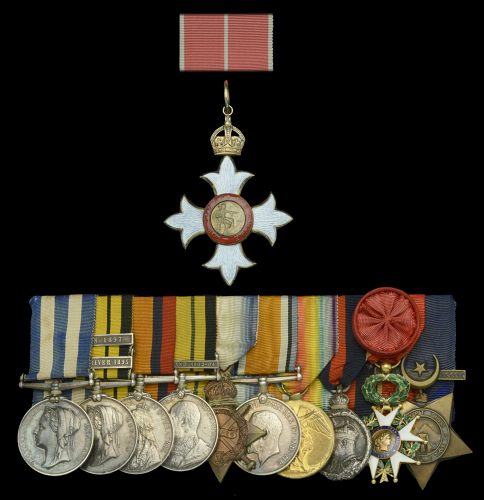
The Great War C.B.E. group of eleven awarded to Vice-Admiral M. R. Hill, Royal Navy, who came under special notice on six occasions for his extensive services as a bluejacket on the African coast in the period 1893-1901
The Most Excellent Order of the British Empire, C.B.E. (Military) Commander’s 1st type neck badge, silver-gilt and enamels; Egypt and Sudan 1882-89, dated reverse, no clasp (M. R. Hill. Nav: Cad: R.N. H.M.S. Achilles); East and West Africa 1887-1900, for Mwele 1895, 2 clasps, Brass River 1895, Benin 1897 (Lieut. M. R. Hill R.N., H.M.S. Barrosa); Queen’s South Africa 1899-1902, no clasp (Lieut. M. R. Hill R.N., H.M.S. Redbreast); Africa General Service 1902-56, 1 clasp, Somaliland 1902-04 (Commr. M. R. Hill, R.N., H.M.S. Perseus); 1914-15 Star (Capt. M. R. Hill, R.N.); British War and Victory Medals (R. Adml. M. R. Hill.); Coronation 1902, silver; France, Third Republic, Legion of Honour, Officer’s breast badge, gold and enamels, with rosette; Khedive’s Star, dated 1882, unnamed as issued, the last ten mounted court-style as worn, good very fine (11) £3,600-£4,400
C.B.E. London Gazette 10 July 1919.
Marcus Rowley Hill was born at Paddington, London on 18 March 1867, the son of the Bishop of Sodar & Man, Isle of Man, and a grandson of the 4th Baronet of Brook Hall, Londonderry.
Entering the Royal Navy as a Cadet in Britannia in July 1880, young Hill quickly witnessed active service off Egypt and the Sudan in H.M.S. Achilles as Navigating Cadet, and was appointed a Midshipman in January 1883; at just 15 years of age, he was amongst the youngest to receive the Egypt Medal.
Returning home to continue his studies, he was appointed a Sub-Lieutenant in April 1887 and served for a year or two on the North America station. In the summer of 1890, he served briefly in the royal yacht Victoria & Albert and was advanced to Lieutenant, following which he joined the Racoon on the West Coast of Africa in April 1891.
And it was in that capacity that he went on to witness active service as a bluejacket on several occasions. Hence, in October 1893, his part in the successful reconnaissance of the Witu Protectorate, for which he was mentioned in Commander F. H. Henderson’s despatch as being with Captain Marx when he rushed the gate at Punwani which was held to the last. He also took part in the operations at M’wele against Sheik Mburuk, in which he was praised by Captain T. MacGill, in addition to receiving a favourable mention from Commander Startin in his report of proceedings in dislodging rebels at Pongwe. Finally, before removing to the Barrosa, he received the thanks of the French government for assistance rendered to the gunboat Ardent, when ashore at Abo, 129 miles up the River Niger. Following his joining the Barrosa, Hill saw yet further service ashore with the Naval Brigade in the expeditions to Brass River in 1895 and to Benin in 1897. In the latter, he was favourably mentioned in Rear-Admiral H. Rawson’s despatch.
Back home, he received his first command, the Ariel, and was likewise appointed to the Redbreast on the East Indies station in March 1900. He was subsequently actively employed off South Africa in early 1901 and received the thanks of the Foreign Office for services rendered in running despatches during the Colonel Seman’s expedition from Kismayu in the same year.
Promoted to Commander in June 1901, Hill commanded the Roebuck during the Fleet Review in 1902, and he returned to the East Indies station with command of the Perseus. Here, then, his part in the Somaliland operations in 1903-04, for which Their Lordships expressed their appreciation of services rendered ‘in connection with the 1904 Expedition against the Mullah’.
Having then been advanced to Captain, Hill was serving in command of the cruiser Leviathan on the outbreak of hostilities in August 1914. And he remained likewise employed until the summer of 1918, latterly as Chief of Staff to Vice-Admiral Sir George Patsey, K.C.M.G., K.C.V.O., Commander-in-Chief of the North America and West Indies stations. Next borne on the books of President, for service with the Admiral Commanding Reserves and Coast Guard, he became Captain of the Scottish District Coast Guard with an office in Edinburgh. His final wartime appointment occurred in May 1918, when he was posted for special service, in the rank of Commodore 2nd Class, as Senior Naval Officer, Simonstown, South Africa.
Awarded the C.B.E. and appointed an Officer of the French Legion of Honour, Hill was placed on the Retired List as a Rear-Admiral. He was subsequently promoted to Vice-Admiral (Retd.) in November 1923 and died in February 1925.
Sold with copied record of service and other research.
Share This Page