Auction Catalogue




 Create new list
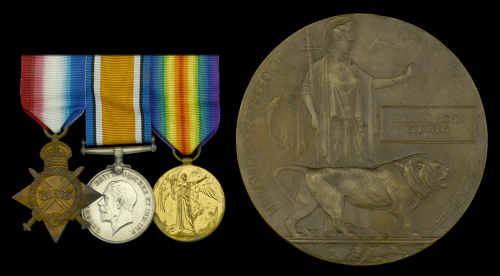
Three: Stoker 2nd Class W. J. Stevens, Royal Navy, who was killed in action in H.M.S. Monmouth at the Battle of the Coronel on 1 November 1914
1914-15 Star (K. 22032, W. J. Stevens, Sto.II, R.N.); British War and Victory Medals (K. 22032 W. J. Stevens. Sto. 2. R.N.), together with Memorial Plaque (William John Stevens) extremely fine (4) £200-£240
Spink, September 2001.
William John Stevens was born at Penzance, Cornwall, on 26 July 1895, and entered the Royal Navy as a Stoker 2nd Class in February 1914. Subsequently drafted to the cruiser H.M.S. Monmouth, he was killed in action at the Battle of the Coronel on 1 November 1914, when Vice-Admiral Graf von Spee overpowered a squadron under Rear-Admiral Sir Christopher Cradock, R.N., sinking the Monmouth and the Good Hope with heavy loss of life.
Early in August 1914, a force comprising the old, armoured cruisers Good Hope and Monmouth, the light cruiser Glasgow and the armed merchant cruiser Otranto, all under the command of Rear-Admiral Sir Christopher Cradock, R.N., was sent to protect the southern trade routes and to intercept German cruisers operating on the high seas.
In October 1914 the squadron was reinforced by the addition of the old battleship Canopus but reports of the ship’s lack of speed led Cradock to leave her behind as he searched for the German East Asiatic Squadron. The German squadron, commanded by Admiral Graf von Spee comprised the armoured cruisers Scharnhorst and Gneisenau, and the light cruisers Leipzig, Nurnberg and Dresden. Both admirals became aware of the proximity of the other on 31 October.
At 6.40 p.m. on 1 November the squadrons made contact off the Coronel, Chile and at 7.04 p.m. the battle opened at a range of 11,500 yards. As the German ships had a greater number of heavier guns, Cradock’s tactics were to close the range to allow his ships’ more numerous smaller calibre guns to come into play; this however was partly negated by the rough seas and high speeds which prevented many of the British armoured cruisers’ casement guns being brought into action. The British armoured cruisers were repeatedly hit as the range was reduced to 5,500 yards, the Good Hope being set on fire in several places and in a bad way. Endeavouring to reduce the range even further, so as to be able to fire torpedoes in a last ditch attempt to do damage to his adversary, the ship was repeatedly hit by heavy calibre shells and at 7.53 Good Hope blew up, taking the Admiral and all hands with her. At about 9.30 the Monmouth too was hunted down and sunk with the loss of her entire complement of 678; the Glasgow and Otranto were able to make their escape under the cover of darkness.
Aged 19, Stevens was the son of William and Annie Stevens of 5 Park Corner, Penzance, and is commemorated on the Plymouth Naval Memorial.
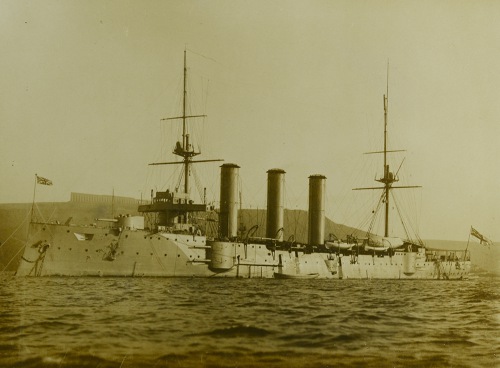
Sold with a quantity of original documents and photographs, the former including Admiralty forwarding letters for his campaign medals, dated 11 March 1922, and the recipient’s death certificate, dated 18 January 1915, and the latter a portrait photograph of him in uniform and another of H.M.S. Monmouth at anchor.
Share This Page