Auction Catalogue




 Create new list
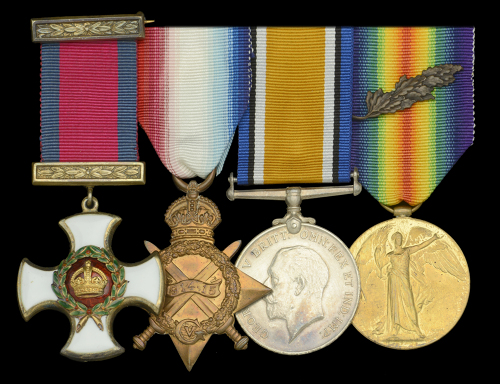
A notable Great War D.S.O. group of four awarded to Major S. H. Foot, Royal Engineers and Tank Corps, a prominent figure in the development of tank warfare whose career is vividly recounted in the pages of his published wartime memoir Three Lives
Distinguished Service Order, G.V.R., silver-gilt and enamel, with integral top riband bar; 1914-15 Star (Lieut: S. H. Foot. R.E.) officially re-impressed naming; British War and Victory Medals, with M.I.D. oak leaves (Major S. H. Foot) good very fine (4) £1,800-£2,200
This lot is to be sold as part of a special collection, Medals from the Collection of Lieutenant-Colonel Edward De Santis.

View
Collection
D.S.O. London Gazette 1 January 1918.
Stephen Henry Foot was was born in Fulham, London on 6 June 1887 and was educated at Eastbourne College, Sussex, where he was member of the college’s 1st XV and shot at Bisley, and Emmanuel College, Cambridge. On graduation - and having been commissioned as a Second Lieutenant in the Royal Engineers Special Reserve in June 1909 - he joined the Shell Oil Company, in which capacity he was posted to Singapore and Malaya, latterly as a District Manager. Subsequently, in the immediate period leading up to the outbreak of war, he worked for the Corona Petroleum Company, a subsidiary of Shell, in Mexico, but was compelled to make for the Texan border on the outbreak of the Villa Revolt, in which he came under fire.
Back in the U.K. by August 1914, Foot was mobilised from the Special Reserve and joined the 10th Railway Company, R.E., at Longmore, Hampshire. It was here that he first met Major E. D. Swinton, a key player in the development of tanks and the Tank Corps. In late November 1914, Foot was embarked for France, where he first came under fire during dam building work on La Bassée Canal in late January 1915. One of his men was shot dead by his side.
In April 1915, he transferred to the 2nd Bridging Train, R.E., in which he was quickly back in action in the Second Battle of Ypres. He was also detached for entrenching duties and wrote a definitive memorandum entitled Co-operation between the R.E. and Infantry, which was subsequently published for use by all R.E. and Infantry units. He also experimented with concrete and steel bunkers.
In December 1915, following the Battle of Loos, Foot was appointed Adjutant to the Commander Royal Engineers (C.R.E.) in 21st Division, a posting that required regular inspection of our trenches in front of Armentieres. Thus ensued some close calls, including the occasion an enemy shell came through the wall behind his observation post, missing his head by inches. Likewise, a sniper’s bullet that exited a sand bag by his head.
In the battle of the Somme, 21st Division was allocated to capture the village of Fricourt, whilst Foot was charged with creating a forward dump of R.E. material. Further actions at Mametz Wood and Barentin raised the division’s casualties to the 8,000 mark, and it was taken out of the line in late July 1916. But it returned to witness further fighting on the Somme in September-October 1916. Foot was mentioned in despatches (London Gazette 4 January 1917, refers) but made himself unpopular by disregarding the chain of command in sending recommendations direct to Lloyd George, then Secretary of State for War.
Tank Corps – D.S.O.
It was time for a change of scenery, and he made a successful application to join the Tank Corps, in which he was initially posted to ‘D’ Company, Heavy Machine Gun Corps, but he was subsequently appointed Adjutant of the 2nd Brigade Central Workshops. In April of 1917, however, Foot was appointed Brigade Major of the 2nd Brigade of the Tank Corps, in which capacity he undertook preparations for the battles of Messines and Passchendaele. His brigade’s part in those operations was duly acknowledged by his seniors, who cited the ‘great gallantry and devotion to duty’ shown by its ranks. But it was in the famous tank action at Cambrai on 17 November 1917 that Foot particularly distinguished himself, accompanying 2nd Brigade’s ‘H’ Battalion in the centre of the attack in front of Beaucamp and Viller-Plouich. As he moved forward, he stopped to question the supporting infantrymen as to their opinions of his tanks, their responses ranging from “just right” to “magnificent.” He was again Mentioned in Despatches (London Gazette 11 December 1917, refers) and awarded the D.S.O.
Transferred to the War Office as a G.S.O. 2, under Major-General Sir John Capper, K.C.B., K.C.V.O., Foot worked on proposals for future policy in mechanization of the Tank Corps. And his work took him back to France, not least in the wake of the German Spring Offensive in March-April 1918. As a result, he was able to pen a significant tank warfare paper - A Mobile Army – and was invited to join the staff of General J. F. C. Fuller.
The latter appointed Foot the editor of his Weekly Tank Notes, a publication which had been prompted by an earlier conversation between the two men. The first edition appeared on 10 August 1918 and the last one in February 1920. King George V requested a copy of each edition, as did many influential figures, among them Winston Churchill. And in an indication of the high esteem in which Foot was held, he received due credit in General Fuller’s Tanks in the Great War, 1914-1918, in which he referred to him as his ‘close friend and fearless assistant’.
Fuller’s use of ‘fearless’ was entirely appropriate, Foot having gone into battle against a senior cavalry officer who lied to him about plans for the Tank Corps having been cancelled. Fuller was away at the time but defended his colleague’s robust actions. He referred to the incident in his book, Memoirs of an Unconventional Soldier: ‘Although Foot could not imagine for what purpose this wretched little man was prevaricating, I knew perfectly well. He was hand-in-glove with the G.H.Q. Cavalry Ring.’
Advanced to Major, Foot resigned his commission in March 1919 and set about penning his first book, entitled Tank Tales, using the pseudonym of ‘Tank Major’. Written in cooperation with Eric Wood, the book was dedicated to Winston Churchill.
Post-war
In May 1920, Foot returned to his alma mater Eastbourne College, and there he remained happily employed until 1934, latterly as a College Bursar and House Master. His Great War memoir, Three Lives, appeared in print in the same year, the first of a number of books he published in his retirement. A keen traveller, he died at Ealing, London in June 1966.
Share This Page