Auction Catalogue




 Create new list
Pair: Lieutenant-Colonel A. E. Prescott, D.S.O., Royal Engineers, who served on the Directorate of Roads
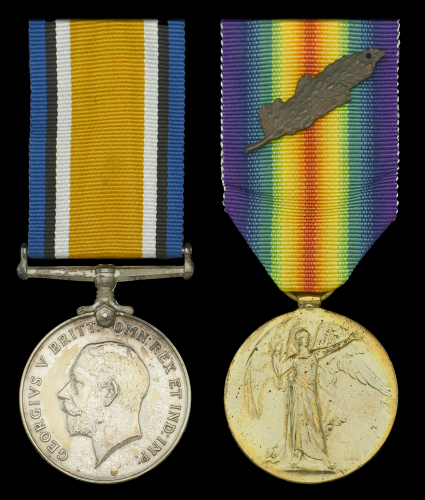
British War and Victory Medals, M.I.D. oak leaves (Lt. Col. A. E. Prescott.), together with a dress miniature D.S.O., G.V.R., silver-gilt and enamel, good very fine (2) £60-£80
This lot is to be sold as part of a special collection, Medals from the Collection of Lieutenant-Colonel Edward De Santis.

View
Collection
Albert Ernest Prescott was born in St. Helen’s, Lancashire on 3 July 1877. His father, John, was onetime jailed for larceny in Walton Gaol, Liverpool. Albert clearly studied engineering, for by 1902 he was employed as the Water Engineer for Douglas on the Isle Man, following which he was appointed a Borough Surveyor in Eastbourne, Sussex.
No doubt on account of his qualifications, he was appointed a Temporary Major in the Royal Engineers in December 1916, when he was posted to France as a Deputy Assistant Director of Roads under Brigadier-General Sir Henry Maybury. Such was the scale of their planning in 1917, that new roads built and depot areas paved with stone were the equivalent to 85 miles of 18-foot roadway, while 190 miles of road were reconstructed. And by the end of the year, Prescott’s Directorate of Roads was overseeing 1,900 miles of road in military areas and 1,200 miles elsewhere. In fact, writing in 1918, Sir Douglas Haig stated:
‘With the development of modern methods of warfare, the importance to the army of a good road service has vastly increased, while the problems of road construction and maintenance have grown enormously. That the needs of our Armies in that respect were well met, even in the most difficult days of 1918, speaks very highly for the zeal and efficiency of all ranks of the Roads Directorate.’
Prescott - who was promoted to Temporary Lieutenant-Colonel in April 1917 - was mentioned in despatches (London Gazette 7 November 1917, refers) and awarded the D.S.O. (London Gazette 1 January 1918, refers), in addition to being appointed a Chevalier of the French Legion of Honour and awarded the Croix de Guerre in October 1918. Returning to civilian life after the war, he settled in St. Albans, Hertfordshire and died there in December 1948.
Share This Page