Auction Catalogue




 Create new list
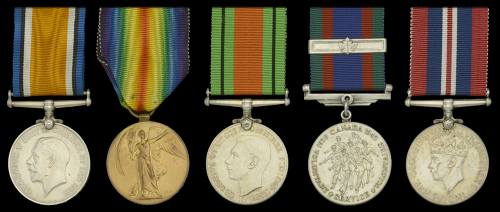
Five: Corporal A. Myke, Canadian Engineers, late Royal Canadian Artillery and Royal Canadian Army Service Corps
British War and Victory Medals (757374 Spr. A. Mike. C.E.); Defence Medal, Canadian issue in silver; Canadian Voluntary Service Medal 1939-45, with overseas clasp; War Medal 1939-45, Canadian issue in silver; together with a pair of R.C.A. football prize medals for 1924 and 1925, silver, silver-gilt, one named to ‘Gnr. A. Myke’, good very fine (5) £120-£160
This lot is to be sold as part of a special collection, Medals from the Collection of Lieutenant-Colonel Edward De Santis.

View
Collection
Alexander Myke was born in Hagersville, Ontario on 22 January 1900 and enlisted in the Canadian Expeditionary Force in December 1915, when by way of covering up his underage status, he gave his surname as ‘Myke’ and his date of birth as 22 January 1897. He was in fact just 15.
Initially drafted to the 120th (City of Hamilton) Battalion, he joined the 124th Canadian Pioneer Battalion of the Canadian Engineers on his arrival in England, in which unit he was embarked for France in March 1917. The unit quickly saw action in the Arras sector and in the Vimy Ridge operations in April, followed by the fighting around Hill 70 in August and Passchendaele in October-November 1917. In May 1918, Myke transferred to the 11th Battalion, Canadian Engineers, and he was subsequently present at the battles of Amiens and the Scarpe in August 1918.
Demobilised back in Canada, he re-enlisted in the Permanent Force of the Canadian Royal Artillery in July 1923, but he was discharged a year later over a pay dispute. Yet again, however, he re-enlisted, this time serving until April 1929, the termination of his period of service in the Royal Canadian Artillery.
In September 1939, Myke volunteered for the Canadian Army at Kingston, Ontario, and rejoined the Royal Canadian Artillery as a gunner. Embarked for England in 1 Medium Regiment, R.C.A., in January 1940, his subsequent duties included as spell a P.O.W. escort detachment, but he was re-embarked for Canada on medical grounds in December 1941. Back home, after several postings, he was re-assigned to the Royal Canadian Army Service Corps and thence to the Royal Canadian Engineers. He was finally discharged in January 1947. He appears to have lived out the remainder of his life in Kingston, where he was employed as a city bus driver and he died there in December 1972.
Sold with a quantity of original documentation and photographs (15), including his Canadian Expeditionary Force discharge certificate, dated 12 July 1919, Permanent Force parchment certificates of discharge (2), dated 31 July 1924 and 30 April 1929, and a statement of war gratuity, dated 28 January 1947.
Share This Page