Auction Catalogue




 Create new list
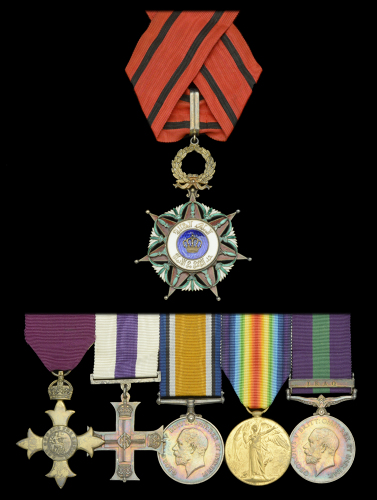
An inter-war ‘Iraq’ O.B.E., Great War ‘Western Front’ M.C. group of six awarded to Captain E. T. Caparn, Royal Engineers, who was twice wounded in action
The Most Excellent Order of the British Empire, O.B.E., (Civil) Officer’s 1st type, breast badge, silver-gilt, hallmarks for London 1934; Military Cross, G.V.R., unnamed as issued; British War and Victory Medals (Capt. E. T. Caparn.); General Service 1918-62, 1 clasp, Iraq (Capt. E. T. Caparn.); Iraq, Kingdom, Order of the Two Rivers (El Rafidain), Third Class neck Badge, 120mm including wreath x 65mm, silver-gilt and enamel, together with a mounted set of related miniature dress medals, excluding the Iraqi award, good very fine (6) £1,400-£1,800
This lot is to be sold as part of a special collection, Medals from the Collection of Lieutenant-Colonel Edward De Santis.

View
Collection
O.B.E. London Gazette 1 January 1935.
M.C. London Gazette 4 June 1917.
Eric Thomas Caparn was born in the historic market town of Petersfield, Hampshire on 2 January 1886 and was educated at Lincoln Grammar School and Finsbury Technical College. He subsequently served as an apprentice to Lawrence Scott and Company in Norwich, in which firm he rose to the position of Assistant Engineer, and having then joined the ship building firm John Brown and Company, he was elected an Associate Member of the Institution of Electrical Engineers.
Onetime a cadet in the University of London Officers’ Training Corps, he applied for a commission in the Royal Engineers in September 1915 and was appointed a Temporary Second Lieutenant in January 1916. He was subsequently posted to 106 Field Company, R.E., and was awarded his M.C. in respect of his gallantry in the battle of Messines in April 1917, and he was likewise employed when wounded on 7 June 1917.
On recovering from his wounds towards the end of the year, Caparn was appointed Second-in-Command of his company, followed by his promotion to Temporary Captain, but he was again wounded on 25 March 1918, by shellfire near Buchanan Camp. He was sent home on convalescent leave and on returning to the front in November 1918, he was assigned to the 2nd Bridging Battalion, R.E. Shortly afterwards, however, he was promoted to Temporary Major and given command of the Heavy Tank Bridging Company, R.E.
Demobilized with the rank of Captain in July 1919, Caparn took up appointment as Chief Electrical Engineer in his old firm, Lawrence Scott & Company, but in February 1920 he was remobilized for service in Iraq. That tour of active duty over, he relinquished his commission in September 1921, when he became Executive Engineer with the Public Works Department in Iraq, a position that he was to hold until 1925. He was later appointed Superintending Engineer in the Public Works Department and was also elected President of the Baghdad District Water Board.
Awarded the Order of the British Empire (Civil) for his work in Iraq, he was subsequently promoted to Chief Engineer of the Public Works Department and remained in Iraq throughout the Second War. And on his retirement in January of 1947, the Iraqi government awarded him the Order of Al Rafidhain, 3rd Class.
Upon his return to England, Caparn became the Director of Lawler Ayers and Company, and he died in Tunbridge Wells in June 1971.
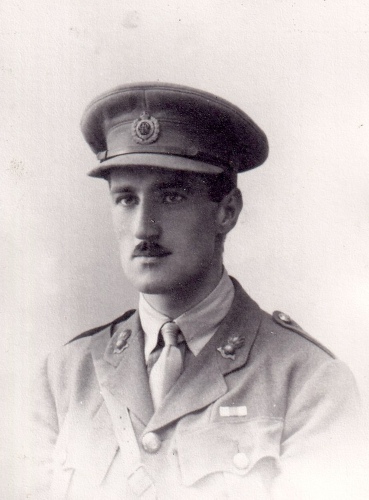
Sold with a photographic image of the recipient.
Share This Page