Auction Catalogue




 Create new list
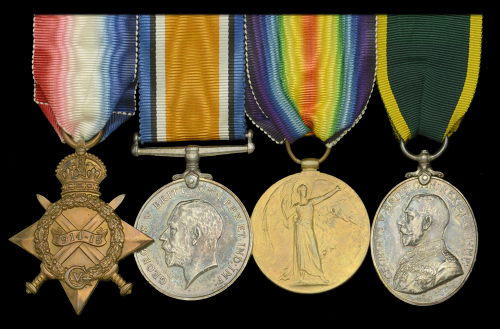
Four: Company Sergeant-Major R. H. Nuttall, Royal Engineers, who served as C.S.M. of the 42nd Division Signal Company from its mobilisation in Manchester in August 1914 until his evacuation from Gully Ravine, Gallipoli, a year later
1914-15 Star (240 C.S. Mjr. R. H. Nuttall. R.E.); British War and Victory Medals (240 W.O. Cl. 2 R. H. Nuttall. R.E.); Territorial Force Efficiency Medal, G.V.R. (426898 C.S. Mjr: R. H. Nuttall. R.E.), mounted as worn, good very fine (4) £100-£140
This lot is to be sold as part of a special collection, Medals from the Collection of Lieutenant-Colonel Edward De Santis.

View
Collection
Roland Harry Nuttall was born in Manchester, Lancashire in July 1880 and was employed as an electrician by the Hyde Park Car Works and later still as a Depot Foreman by Manchester Corporation Tramways. But he was also a keen member of the Volunteer Force, having enlisted in the 3rd Lancashire Royal Engineer Volunteers as a sapper in September 1907. In the following year the unit became part of the newly created Territorial Force and Nuttall was serving as a Sergeant in the signal company of 42nd (East Lancashire) Division on the outbreak of war.
Promoted to Company Sergeant-Major in September 1914, his unit was embarked for Egypt in September 1915, where it undertook assorted tasks in strengthening the defences of the Suez Canal. Then in early May 1915 it came ashore at Gallipoli, where it was deployed in readiness for the Krithia operations. Nuttall was subsequently wounded by shrapnel on 16 June 1915, when his unit came under heavy artillery fire, but he remained on duty. Come late August, however, he was laid low by jaundice and evacuated to Egypt via 1/3rd East Lancashire Field Ambulance on 1 September 1915. To add to his woes he also contracted rheumatic fever, thereby necessitating his evacuation by hospital ship to England in April 1916. Numerous medical boards ensued and he was only ever deemed fit enough for employment on the home establishment. He was awarded the T.F.E.M. in May 1919, shortly after being discharged.
Share This Page