Auction Catalogue




 Create new list
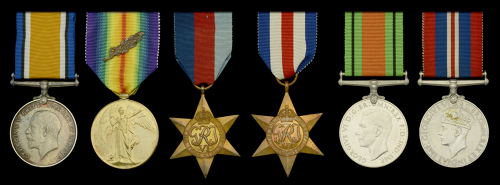
Six: Lieutenant-Colonel A. G. S. Smith, Royal Engineers, later Royal Signals, who was twice Mentioned in Despatches
British War and Victory Medals, with small M.I.D. oak leaves (Lieut. A. G. S. Smith); 1939-45 Star; France and Germany Star; Defence and War Medals 1939-45, good very fine (6) £80-£100
This lot is to be sold as part of a special collection, Medals from the Collection of Lieutenant-Colonel Edward De Santis.

View
Collection
Alan George Stewart Smith was born in Edinburgh on 2 December 1895 and was educated at the Edinburgh Academy and Edinburgh University, where he served as a cadet in the Officer Training Corps from October 1914 until April 1915. Commissioned as a Second Lieutenant in the Royal Engineers in the latter month, he joined the 35th Divisional Signal Company in France in May 1916 and quickly saw action on the ‘First Day of the Somme’; so, too, in the July 1916 operations on Bazentin Ridge.
Posted back to the U.K. later in the same year, Smith’s subsequent appointments included a tour of duty in Irish Command, in which he was Mentioned in Sir Douglas Haig’s despatch of 9 April 1917. Then in May 1918 he returned to France, where his future postings included a stint as an instructor at VI Corps Singal School. He was again Mentioned in Despatches (London Gazette 23 December 1918, refers).
Having then been demobilised in January 1919, Smith rejoined the Royal Engineers towards the end of the same year, when he was again posted to Irish Command, in which capacity he transferred to the newly formed Royal Signals in January 1921. Reverting to the Territorial Army Reserve of Officers as a Captain in April 1923, he took up work as the Assistant Manager of the Radio Communications Company in Glasgow but by the renewal of hostilities in September 1939, he was employed as the Senior Maintenance Engineer for B.B.C. North Region.
Recalled in February 1940, he was appointed a Draft Conducting Officer, in which capacity he served in the B.E.F. in France in March-June 1940, and he subsequently held assorted posts in Wales, including a stint as Chief Instructor of 2nd Signals Training Centre. Then in March 1944, as a recently promoted Lieutenant-Colonel, he joined Supreme Headquarters Allied Expeditionary Force as a G.S.O. 1 (Wireless). And it was in that capacity that he served in the North-West Europe campaign from September 1944 to V.E. Day. Released from military service back in London in August 1945, Smith rejoined the B.B.C. and retired as the corporation’s Senior Administrator in the North in 1952. He died at Newthorpe, Nottinghamshire in December 1978.
Share This Page