Auction Catalogue




 Create new list
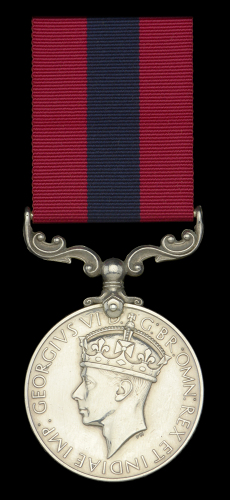
A Good Second World War North Africa ‘immediate’ D.C.M. awarded to Company Sergeant Major J. Aitken, 5th (Caithness and Sutherland) Battalion, Seaforth Highlanders, who had been M.I.D. in 1940, and further distinguished himself at Corradini during the advance to Tripoli, 21 January 1943 - only to be killed in action whilst gallantly holding the Zigzaoug Anti-Tank Ditch during the assault on the Mareth Line, 22 March 1943
Distinguished Conduct Medal, G.VI.R. (2818488 W.O. Cl. II. J. Aitken. Seaforth.) very fine £1,800-£2,200
D.C.M. London Gazette 22 April 1943. The original recommendation states:
‘This WO's Company took part in the attack on Corradini on 21 January 1943. The Company was subjected to very heavy mortar and MG fire and the Company Commander was wounded. Throughout the whole operation CSM Aitken moved freely amongst the men of his Company, encouraging and steadying them when there was a risk of them becoming disorganised as a result of the difficult country and the weight of enemy fire. He showed powers of leadership above those expected of his rank, and a complete disregard for his own safety. The success of his Company must be largely attributable to the very great example he set to his men.’
M.I.D. London Gazette 20 December 1940:
‘In recognition of services in connection with operations in the field March - June 1940.’
James Aitken was the husband of Lillian Irene Sarah Aitken, of Muswell Hill, Middlesex. He served during the Second World War with the Seaforth Highlanders. Aitken advanced to Company Sergeant Major and served with the 5th Battalion, Seaforth Highlanders as part of the 152nd Infantry Brigade, 51st Highland Division, 30 Corps in North Africa. Aitken distinguished himself during the 51st Highland Division's assault on the German defensive lines at Corradini, a few miles short of Tripoli, Libya, 21 January 1943.
Company Sergeant Major Aitken was killed in action whilst serving with ‘D’ Company at the Zigzaoug Anti-Tank Ditch, Mareth Line, 22 March 1943. The 5th Camerons and 5th Seaforth, installed to hold the ditch two days earlier, had found themselves pinned down in the Wadi and caught in tremendous fire. When they were withdrawn, under cover of smoke, at 0300hrs on 24 March they had suffered very heavy losses. The following extract from Sans Peur: The History of the 5th (Caithness and Sutherland) Battalion, The Seaforth Highlanders, 1942-1945 by A. Borthwick gives further detail:
‘Twice ‘A’ Company at the left end of the ditch reported German infantry and tanks forming up for an attack on their front; but both times the fire of our supporting guns, called down through our single wireless link with Brigade, was enough to disperse them before they came within small-arms range. If they had been close enough to shoot at, I think it might have helped. As it was, we could only lie and wait for the next shell - an event which, considering that the Boche knew exactly where we were, was seldom long in coming. Here, for example, is a snippet from one man’s day, part of an account written by Corporal Parkinson of ‘D’ Company. He was lying on a parapet, with Company H.Q. immediately behind and below him.
“I remember hearing the whine of a shell, followed by an awful crump, as one burst no more than two yards away and directly in front of me. I ducked, and in that split second another shell landed immediately behind me and right in the centre of the sloping wall of the ditch. I felt myself being lifted and carried through the air by the blast, and then I landed on top of C.S.M. Aitken and Mr. [W. D. D.] Gammie. I was dazed and startled by the suddenness of it all... blood stank in my nostrils... I grabbed the C.S.M. by the tunic and shook him, but his head dropped to one side... he must have died instantaneously.
Confusion reigned everywhere. I sat where I was, and wept... Lieutenant Gammie seemed to be trying to speak, but in less than two minutes he too was dead. Two of the stretcher-bearers were killed outright also... The third was badly hit... Four of us nearest the explosion and on the ledge were blown off by the blast, and two of us - Lance Sergeant Bert Brookes and Pat Davidson - were hit in the lung by small pieces of shrapnel. Captain Robertson was wounded in the legs... and of the sixteen men in Company H.Q. only three of us escaped.
I could scarcely credit my good fortune, and gingerly felt myself over. My pack on my back was riddled in four or five places; and, taking out my mess tins, I found two jagged holes in them. One piece of shrapnel had ended up in the middle of a bar of chocolate, and another in my cheese sandwich. My water-bottle was like a watering can. My blanket was used to cover the dead...”’
Company Sergeant Major Aitken is buried in Enfidaville War Cemetery, Tunisia.
Sold with copied research.
Share This Page