Auction Catalogue




 Create new list
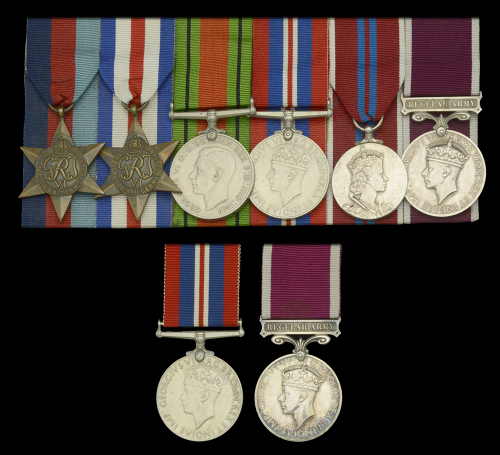
Six: Major H. A. Charlton, Royal Engineers
1939-45 Star; France and Germany Star; Defence and War Medals 1939-45; Coronation 1953, unnamed as issued; Army L.S. & G.C., G.VI.R., 1st issue, Regular Army (Lieut. (QM.) H. A. Charlton. R.E.) mounted court-style for display, good very fine
Pair: Major A. C. Jenner, Royal Engineers
War Medal 1939-45; Army L.S. & G.C., G.VI.R., 1st issue, Regular Army (1859432 Sjt. A. C. Jenner. R.E.) minor edge bruise, extremely fine (8) £100-£140
This lot was sold as part of a special collection, Medals from the Collection of Lieutenant-Colonel Edward De Santis.

View
Collection
Herbert Alfred Charlton was born in Faversham, Kent on 29 May 1906 and originally enlisted in the 4th Battalion, East Kent Regiment (Territorials) at Canterbury in November 1925. In September 1926, however, he transferred to the Regular Army as a Sapper in the Royal Engineers, his inter-war postings including 7 Field Company, R.E., and 4th Fortress Company, R.E.
Following the outbreak of war in September 1939, Charlton was embarked with 23 Field Company for service in the B.E.F., in which capacity he and his comrades would have been charged with bridge demolition duties in the withdrawal to the Escaut in May 1940. Lucky to make it back via Dunkirk, he transferred to 238 Field Company, R.E., on his return and was commissioned as a Lieutenant (Q.M.) in April 1943. Embarked for Normandy in mid-July 1944, he was attached to H.Q., 21 Army Group and remained likewise employed until V.E. Day. And he qualified for his L.S. and G.C. Medal in September 1944.
Post-war, Charlton undertook two tours of duty in the British Army on the Rhine and added the Coronation Medal to his accolades in June 1953, when serving in 26 Field Regiment, R.E. Having then been promoted to Major (Q.M.) in the same year, he was placed on the Retired List in December 1959. He settled in the West Country and died in Bristol in December 1984.
Alfred Charles Jenner was born in Karachi, India on 28 October 1905, the son of a Royal Engineer N.C.O. Himself enlisting in the corps as a boy recruit in December 1919, he remained employed on the home establishment for the duration of his long career, specialising as a lithographer. He was advanced to Sergeant in December 1935, awarded his L.S. and G.C. Medal in December 1937 and acted as editor of The Sapper in the years leading up to the outbreak of war; he later drew the maps for The History of the Corps of Royal Engineers, Volumes VIII and IX, 1939-1948, by Major-General R. P. Pakenham-Walsh, C.B., M.C.
Commissioned Second Lieutenant in May 1941, he served for the duration of the war in the Geographical Section, prior to his advancement to Major in the Territorial Army in September 1957. Latterly the second-in-command of the University of London Officer Training Corps, he was finally placed on the Retired List in August 1961 and died in Worksop, Nottinghamshire in May 1985.
Share This Page