Auction Catalogue




 Create new list
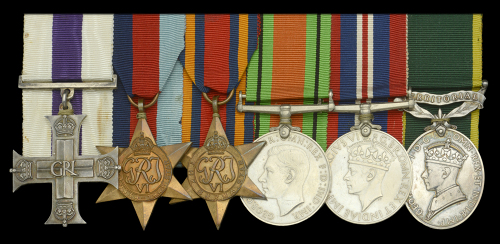
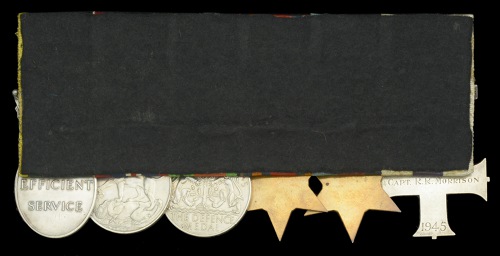
A good Second World War ‘immediate’ Burma M.C. group of six awarded to Captain R. R. Morrison, 1st Battalion, Seaforth Highlanders, for his gallantry in undertaking a remarkable daylight reconnaissance of the Japanese positions on Nippon Hill prior to its successful assault, 24 July 1944. He crept through the enemy wire and worked his way to the top of the hill, which was completely bare and devoid of cover. Morrison located all of the enemy bunkers, the gaps in the wire, and the best route for a night approach. He repeated this feat of field-craft at Harvest Hill, just three days later
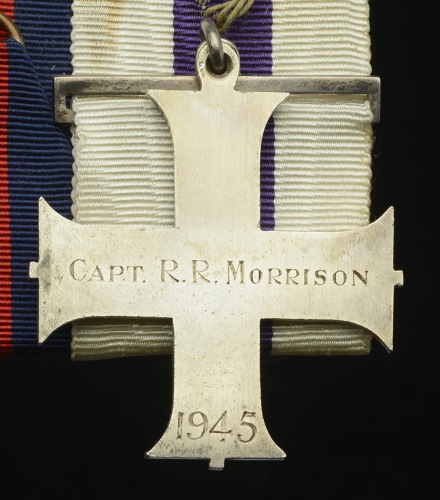
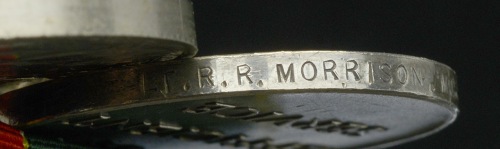
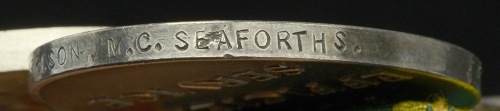
Military Cross, G.VI.R. reverse officially dated ‘1945’, and additionally engraved ‘Capt. R. R. Morrison’; 1939-45 Star; Burma Star; Defence and War Medals 1939-45; Efficiency Medal, G.VI.R., 1st issue, Territorial (Lt. R. R. Morrison. M.C. Seaforths) mounted for display, light contact marks, very fine (6) £1,800-£2,200
M.C. London Gazette 22 March 1945. The original recommendation states:
‘Before the attack on Nippon Hill on 24 July 44, it was necessary to confirm a previous report that the Jap was holding the reverse slope only. Various small recce patrols met with little success because of Jap wariness and fondness for shifting his positions overnight. It was imperative to obtain the desired information because the plan for the Bn. attack was that the leading Coy. should ascend the forward slope under cover of darkness and at first light charge the enemy on the reverse slope. On 22 July 44, Lieut. Morrison with three men set out to recce Nippon Hill which according to the latest information, was held by two platoons. Under cover of mist and by skilful use of cover afforded by the thick jungle and undergrowth, this officer was able to work his way forward into a favourable position to observe. He lay in concealment and watched, but owing to the Jap’s skilful camouflage and concealment of movement he was unable to get the desired information from the position chosen. He decided on a bold step. Carefully positioning his men to cover his entry into the position he crept in through the enemy wire, working his way right on to the top of the hill which was completely bare and devoid of cover. With patience and field-craft he located all the enemy bunkers and gaps in the wire and the best route for a night approach. This was not accomplished without his being spotted by the Jap sentry who raised the alarm, but who was promptly shot. Under a hail of fire Lieut. Morrison withdrew his patrol unscathed. This remarkable feat was accomplished in broad daylight and without doubt, but for his accurate information supplied, assured the success of the Bn. attack on 24 July 44.
A member of the patrol guided the leading Coy. up the forward slopes to the top of the hill under cover of darkness. Again during the course of this same operation, the Bn. was given as its objective, Harvest Hill on 27 July 44. It was not known whether the hill was occupied or not. Time was pressing and Lieut. Morrison was given the task of going ahead with a small recce patrol to reach the top of the hill ahead of the Bn. Lieut. Morrison making skilful use of cover, and although tired and exhausted from many days fighting and marching, reached the top with a speed which was amazing, to find it unoccupied, with the Jap in position lower down the slopes overlooking the Lokchao Bridge. Despite his exhausted condition, he got his leading platoon established on the crest above the Japs and this enabled the Bn. to occupy the whole feature causing the enemy to withdraw South. Great credit is due Lieut. Morrison for his high sense of duty, his fortitude in overcoming difficulties in terrain and weather, his determination to win through, and for the personal example he set at all times on his many successful patrols.’
Robert Rowley Morrison was a Cadet prior to being commissioned Second Lieutenant in the Seaforth Highlanders, 19 October 1940. He served during the Second World War with the 1st Battalion, Seaforth Highlanders as part of the 1st Indian Infantry Brigade, 23rd Indian Division, 4th Corps in Burma. Morrison distinguished himself at Nippon Hill, a strategic location overlooking the Tamu Road near Kohima/Manipur in July 1944.
Share This Page