Auction Catalogue




 Create new list
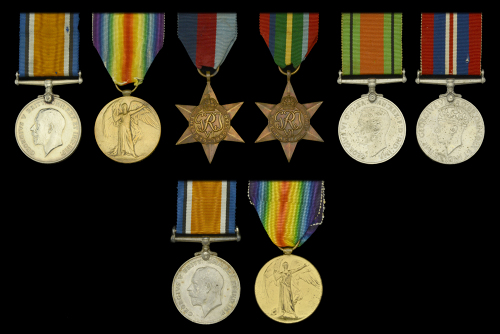
Six: Major J. H. C. Shakespear, Royal Engineers, later Indian Army Engineers
British War and Victory Medals (2-Lieut. J. H. C. Shakespear.) these both late issues claimed in 1939; 1939-45 Star; Pacific Star; Defence and War Medals 1939-45, old adhesive stains to reverses, generally very fine
Pair: Lieutenant W. A. Harwood, 2/16th Sappers and Miners, Indian Army
British War and Victory Medals (Lieut. W. A. Harwood.) good very fine (8) £120-£160
This lot is to be sold as part of a special collection, Medals from the Collection of Lieutenant-Colonel Edward De Santis.

View
Collection
John Henry Childe Shakespear was born in Mitcham, Surrey on 7 August 1898 and was educated at Holland House School, Sussex and the City and Guilds College, London University. Having then enlisted in the Royal Fusiliers in April 1917, he was commissioned in the Royal Engineers a few months later and was embarked for France in January 1918, where he joined 83 Field Company, R.E. And he quickly saw action at St. Quentin in the German Spring Offensive.
On being demobilised in February 1919, Shakespear pursued a career in civil engineering, his appointments taking him to India, Sierra Leone and Northern Rhodesia, in addition to service as a Civilian Garrison Engineer at Aldershot and Tidworth. Then in June 1939, he accepted a post in the Air Ministry Works Directorate in Singapore and Malaya, where he was charged with airfield maintenance, and by December 1941, he was serving as a Squadron Leader in the Reserve of Air Force Officers. Having then managed to escape the Japanese via Java in February 1942, he relinquished his R.A.F. commission and was appointed a Captain in the Indian Army Engineers in July 1942. And he remained employed there until returning to the U.K. in January 1945. He subsequently served at the War Office and in Wiltshire, up until his release in August 1946. He died in Bexhill, Sussex in June 1965.
William Albert Harwood was born in Blackburn, Lancashire in early 1888 and attended the School of Physics and Astronomy at Manchester University. A noted meteorologist, he was to publish numerous papers over the coming years. An early example was ‘On Recent Balloon Ascents from Manchester’, namely ascents undertaken at the university’s Kite Flying Station on Glossop Moor.
On graduating from university, he joined the Indian Meteorological Department as an Assistant Director at Agra, and he was likewise employed when commissioned as a Second Lieutenant in the Agra Volunteer Rifles in September 1915. He was subsequently attached to the 2/16th Sappers and Miners and resigned his commission in May 1920.
For much of the inter-war period he was employed at Malta’s meteorological office and come the renewal of hostilities in September 1939, he joined the Air Ministry’s meteorological office in Edinburgh as a Principal Technical Officer. A Fellow of the Royal Society of Edinburgh, he retired to Torbay in Devon, where he died in May 1975.
Share This Page