Auction Catalogue




 Create new list
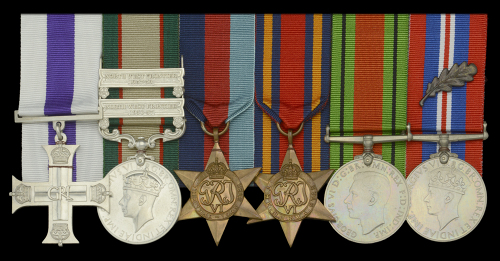
A scarce Second War ‘Burma operations’ M.C. group of six awarded to Major A. J. Bayley, Royal Armoured Corps, attached 7th Light Cavalry, Indian Armoured Corps, who received shell splinters to the legs in action around Thaunggyi, February 1945
Military Cross, G.VI.R. reverse officially dated 1946; India General Service 1936-39, 2 clasps, North West Frontier 1936-37, North West Frontier 1937-39 (7885490 Pte. A. J. Bayley. R. Tank. C.); 1939-45 Star; Burma Star; Defence and War Medals 1939-45, with M.I.D. oak leaf, mounted court-style for display, light pitting, good very fine and better (6) £2,000-£2,400
Glendining’s, December 1966 and November 1986; Dix Noonan Webb, December 2003.
M.C. London Gazette 17 January 1946:
‘In recognition of gallant and distinguished services in Burma.’
The original Recommendation states: ‘Major Bayley commanded “A” Squadron 7th Light Cavalry during the actions with 20 Indian Division in the area Thaunggyi in February 1945, in many subsequent actions in 20 Indian Division’s bridge head in February and March 1945, then during Barcol operations including the capture of Wundwi and Kume in April and finally with 4 Corps under 17 Indian Division during the advance on Rangoon in April and May 1945. In the first of these actions at Thaunggyi, Major Bayley was wounded by several shell splinters in the legs. Although he had to receive intermittent Medical attention for several weeks before all the splinters were extracted, Major Bayley remained on duty in command of his squadron. Throughout this period full of incident and action, Major Bayley has maintained the highest standard of efficiency in command. His excellent tactical sense, military knowledge and personal disregard of danger have resulted in the unbroken record of many successful actions fought by his squadron.
Major Bayley’s personal example has set a high standard for his officers and men. His energy, constant devotion to duty and the ability with which he has always exercised his command are worthy of the highest official recognition. He is a most deserving case for an award of the Military Cross.’
M.I.D. London Gazette 19 July 1945 (Burma).
Arthur John Bayley was born on 29 December 1915, and joined the Royal Tank Corps, seeing active service on the North West Frontier 1936-39. Commissioned on 22 June 1940, he was subsequently attached to the Indian Armoured Corps and served with the 7th Light Cavalry in Burma, being both Mentioned in Despatches and awarded the Military Cross.
The recipient’s own account of his service in Burma, as published in The Tank, August 1948, states:
‘During the siege of Imphal and the subsequent advance through Assam and Burma to Rangoon I was serving with the 7th Light Cavalry, Indian Armoured Corps. Early in December 1944 '”C” Squadron, 7th Light Cavalry, under the command of the 11th East African Division, crossed the Chindwin against light opposition and eventually made their way to Mutaik, where they found the Stuart tanks left behind by the 2nd Royal Tank Regiment in 1942. On examination it was found that, except for the missing breech blocks and Brownings and seized or damaged engines, the tanks were more or less complete. In this area also there were most of the other vehicles which had to be destroyed and abandoned. Apart from removing the springs from all of the “B” vehicles, everything seemed to be just as it had been left by the Burma Army in 1942.
The 7th Light Cavalry was equipped with Stuart Marks I and III tanks and was very short of spares and, quite naturally, we were more than pleased to find such a supply of spares on our very doorstep Cannibalisation started almost at once. “C” Squadron, 7th Cavalry, had been through a very trying time fighting their way down the Kabaw Valley with the 11th E.A. Division during the monsoon and by the time they reached Kalewa their tanks needed extensive repairs. The tracks and suspension were completely worn out due to cross-country work. It was found that the ex-2nd Royal Tank Regiment tank tracks were in very good shape considering they had run all the way from Rangoon. It did not take the Sikhs of “C” Squadron long to change them over. My own squadron were not in such a bad way, having had a fairly easy run from Palel to Kalewa, for the monsoon had finished and the sappers had built a road. Even so, we changed tracks where necessary and stocked up with such items as bogies, idlers, nipples, petrol pumps and several other spares which were normally not available.
It was not until Meiktila airfield was captured in April 1945 that we received spares for our Stuarts in any quantity. What we should have done without the spares we obtained from the ex-2nd Royal Tank Regiment vehicles I do not know. Although we fully realised what the feelings of the 2nd Royal Tank Regiment must have been when it became necessary for them to destroy their tanks, we were most grateful for what they left behind.’
Bayley rejoined the Royal Armoured Corps, and was advanced Major on 4 October 1950. He retired on 26 June 1958.
Sold with copied research.
Share This Page