Auction Catalogue




 Create new list
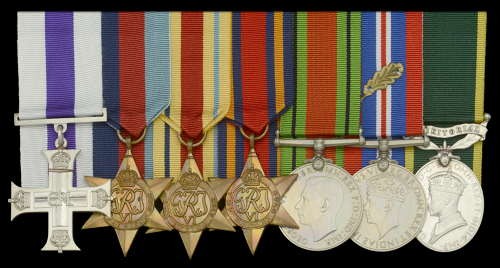
A good Second War 1942 ‘Western Desert’ M.C. group of seven awarded to Lieutenant-Colonel J. C. Barras, Royal Tank Regiment, attached 8th King’s Royal Irish Hussars. His tank was hit by a shell, and his crew evacuated as it ‘brewed up’, only to realise that the driver was still trapped inside the vehicle. Despite the heavy fire of the enemy, only 800 yards distant, Barras and one other man rushed back to the tank and extricated the seriously wounded driver
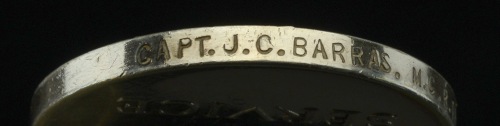
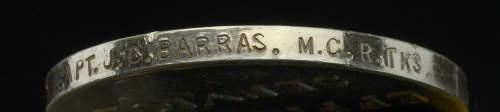
Military Cross, G.VI.R. reverse officially dated ‘1942’; 1939-45 Star; Africa Star; Burma Star; Defence and War Medals 1939-45, with M.I.D. oak leaf; Efficiency Medal, G.VI.R., 1st issue, Territorial (Capt. J. C. Barras. M.C. R. Tks.) mounted court-style for display, light pitting, nearly extremely fine (7) £1,800-£2,200
M.C. London Gazette 19 March 1942:
‘In recognition of gallant and distinguished services in the Middle East.’
The original Recommendation states: ‘On 28 November 1942 Second Lieutenant Barras was in command of a troop of four tanks from Defence Squadron, 30 Corps, and was at that time attached to 8th King’s Royal Irish Hussars. On 28 November 1942 Second Lieutenant Barras’s tank was hit by an enemy shell and appeared to be on fire. The crew dismounted and took cover, but it was then discovered that the driver of the tank was still inside. Second Lieutenant Barras, together with his gunner left their cover, and without any thought of their own safety mounted the front of the tank in full view of, and under heavy fire from the enemy, who was only 800 yards away. The driver’s cover was distorted and required considerable time to prize open, and when this was done the driver was discovered severely wounded and unable to help himself. The instrument panel had now to be removed as it was holding the wounded man down, and eventually he was lifted out and carried to another tank. This man undoubtedly owes his life to the courage and unselfishness of Second Lieutenant Barras and his gunner.
Later that day his troop sergeant’s tank was hit and abandoned, but eventually was recovered. As he had now only one serviceable tank left out of the troop of four, the third being destroyed at the same time as his own, Second Lieutenant Barras decided to utilise his troop sergeant’s tank even though the driver’s cover would not close properly, thus rendering the driver, gunner and commander vulnerable to small arms fire. He got together a crew of volunteers from the remnants of his troop, and fought with this tank on 29 November until it had been holed five more times, and was eventually towed out of action.
The officer commanding the 8th Hussars Squadron to which Second Lieutenant Barras’s troop were attached has written asking for the names of those who saved the wounded tank driver with a view to recommendation for awards, but in view of the length of time involved, and the second part of the narrative, I have the honour to submit this recommendation direct.’
M.I.D. London Gazette 13 January 1944 (Middle East).
John Cecil Barras commanded 3 Royal Tank Regiment from 1961 to 1964. He transferred to the Supernumerary List on 4 November 1964.
Withdrawn
Share This Page