Auction Catalogue




 Create new list
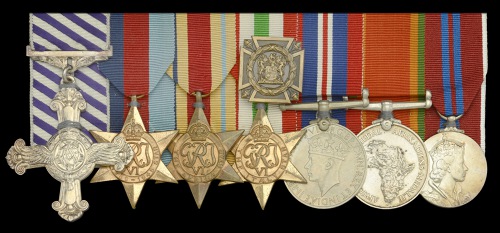
An exceptional Second War ‘Mediterranean, Aegean and Adriatic operations’ D.F.C. group of seven awarded to Major J. Louw, South African Air Force, who amassed a tally of 97 operational sorties, latterly as a Deputy Flight Commander in Beaufighters of 16 (S.A.A.F.) Squadron in the Balkan Air Force, many such sorties being captured by gun camera footage.
During this latter period, he led several spectacular strikes against enemy shipping, transport and troops, his aircraft on one occasion suffering considerable damage from flying debris. Nor did he grant the opposition any quarter, enemy personnel who abandoned their stricken boats in one attack being ‘thoroughly sprayed with cannon and M.G. fire’
Staying in the service after the war, Louw was killed when his Lockheed Ventura of 17 Squadron spun into the ground near Oudtshoorn on a night navigation exercise, 8 September 1953
Distinguished Flying Cross, G.VI.R., reverse officially dated ‘1945’; 1939-45 Star; Africa Star; Italy Star; War Medal 1939-45; Africa Service Medal, all campaign awards officially impressed ‘210601 J. Louw’; Coronation 1953, unnamed as issued, mounted for display, with related miniature awards, very fine (7) £1,200-£1,600
D.F.C. London Gazette 20 April 1945.
The original recommendation states:
‘Prior to joining the Balkan Air Force, Captain Louw completed one tour during which he flew Bisleys and Beauforts on G.R. work, eventually converting to Beaufighters.
During this time, he completed numerous shipping protection tasks and several offensive operations under G.H.Q., Eastern Mediterranean, over the Aegean and off the coast of Greece.
On these offensive operations he contributed to the sinking of one ‘F’ Boat and an 80-ton caique, the probable destruction of a 150-ton motor caique and a 100-ton caique, and damage to a 300-ton schooner.
Captain Louw usually flew No. 2 to his Flight Commander, Major Loock, though on some occasions he led a pair and did lone night intruder patrols over Aegean waters.
Since joining the Balkan Air Force, Captain Louw has led the squadron on four operations, ranging from the northern Adriatic to the east coast of Greece. During this time, he has made a large personal contribution to the success of the squadron’s operations in the Balkans.’
Johannes Louw, who was born in Wellington, Cape Province in 1922, likely commenced his first tour of duty when 16 Squadron moved to Egypt in April 1943.
Operating in rocket equipped Beaufighters, it later moved to Benghazi, Libya, and carried out a spate of operations in the eastern Mediterranean, mostly in and around Greece. In the summer of 1944, it moved to the Italian mainland, from whence it flew sorties to the Balkans in support of the partisans; spectacular gun camera footage of the squadron’s sorties may be viewed on the ‘SAAF WW2 Heritage Site’.
Of those sorties flown from the Italian mainland, the recommendation for Louw’s D.F.C. cites under a separate heading –
‘Outstanding Operations’ – the following:
25 August 1944:
Captain Louw led a successful attack on a Bulgarian barracks at Prenjasi.
28 August 1944:
This pilot flew in a formation which penetrated into Trieste harbour and sunk the S.S. Giulio Cesare. Baulked on his run in to attack the ships, Captain Louw turned his attention to a troop train of about 40 carriages drawn by two locomotives. He first flew along the entire length of the train, raking the carriages with cannon fire, then orbited and returned to destroy both locomotives with a salvo of 8 R.Ps [Rocket Projectiles}. This attack was followed by large explosions heard above the aircraft engines and flames which rose 150 feet.
September 1944:
Attack on the village of Kriz and Novoseleo marshalling yards. On this occasion, Captain Louw fired his 8 R.Ps to straddle the area between Novoseleo railway yards and the timber yard. A partisan report stated three trains - of which one was full of enemy troops - were set on fire and considerable casualties were inflicted on the Cossack troops.
12 October 1944:
Captain Louw led a formation which attacked 4 Pil Boats. When the formation left, one Pil Boat was left on fire with smoke rising to 1,000 feet (confirmed by photos). This was claimed destroyed and a second Pil Boat was down at the stern, probably destroyed. The remaining two Pil Boats were claimed as damaged. Enemy troops who jumped into the sea were thoroughly sprayed with cannon and M.G. fire.
18 October 1944:
Captain Louw led a section in a formation which attacked an enemy convoy off Atheridha Point, Greece. No R.P. hits were scored but the following damage was claimed as a result of cannon strikes: one Ems craft, one Torpedo Boat, one E-Boat and one 100-foot barge – all damaged.
22 November 1944:
Captain Louw led a formation of six aircraft to attack rolling stock at Dubica, Yugoslavia. A train was sighted and attacked by all aircraft. Captain Louw went in first, firing a salvo of 8 60lb. R.Ps. which resulted in a huge explosion from the train from which smoke rose to over 600 feet. Captain Louw’s aircraft flew through the explosion and sustained considerable damage from flying debris. In spite of this he managed to lead his formation safely back to base.
At the time of being recommended for his D.F.C., Louw had amassed over 400 hours of operational flying.
Remaining a regular in the South African Air Force after the war, he was killed when his Lockheed Ventura of 17 Squadron spun into the ground near Oudtshoorn on a night navigation exercise on 8 September 1953.
Share This Page