Auction Catalogue




 Create new list
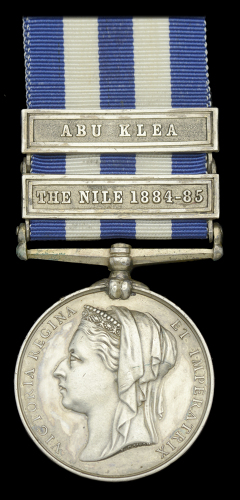
The scarce Egypt and Sudan 1882-89 Medal awarded to Private G. Thornhill, 5th Dragoon Guards, who was killed in action at Abu Klea, 17 January 1885
Egypt and Sudan 1882-89, undated reverse, 2 clasps, The Nile 1884-85, Abu Klea (1410. Pte. G. Thornhill. 5th Dgn. Gds.) remnants of lacquer, good very fine £2,000-£2,400
This lot is to be sold as part of a special collection, Medals from an Africa Collection.

View
Collection
G. Thornhill served with the 5th Dragoon Guards, and was killed in action at Abu Klea, 17 January 1885.
4 officers and 44 other ranks of the 5th Dragoon Guards served in the Heavy Cavalry Regiment on the Nile, of whom Major Atherton and 31 other ranks fought at Abu Klea. Major Atherton and 10 men were killed in action or died of wounds, mostly when the Heavy Camel Regiment section of the square was overwhelmed.
The following is given in Khartoum - The Ultimate Imperial Adventure by M. Asher:
‘The Guards were also on the right face, and the Mounted Infantry and Heavies on the left. At exactly 1000 hours on 17 January 1885, the buglers sounded the advance. The British kept up a funeral pace. Dervish sharpshooters followed them leaping from boulder to boulder. Bullets whanged and hissed into the ranks. Men staggered and fell. The deadly fire walk had now covered a mile and a half and had gone on for more than an hour. For most of the soldiers present, it was the longest hour of their lives. Stewart had been expecting an attack from the high ground on the right. For this reason he put the Heavies - the least experienced infantrymen - at the left hand corner. What followed was a sight no British soldier present would ever forget. From a hidden ravine thousands and thousands of black figures appeared. Many carried spear, swords and knives which glowed like red gold in the sunlight. The left flank, a second ago dead, was now teeming with dervishes brandishing their weapons, as numerous as swarming wasps. Stewart acting with remarkable coolness. He did not want to be caught on the low ground, and ordered the square to move thirty yards, to the top of the next ridge. It was an awkward movement, and a gap appeared at the corner of the left flank manned by the Heavies. “The sides of the square literally blazed with fire”. The British poured volley after volley into the onrushing whirlwind. For a moment Wilson was certain the attack would be broken off, he was amazed to see the dervish army wheel sharply to the right as if on manoeuvres. The front rank of the enemy rushed directly towards the Heavy Camel Regiment. The subsequent action at Abu Klea lasted only ten minutes. Lord Charles Beresford gleefully ran out the Gardner gun, thirty yards out of the ranks. When Burnaby saw Beresford’s intention, he did something unforgivable - he ordered 3 and 4 Companies of Heavy Camel regiment to wheel out of the square. The Baggara surged forwards, smashing into the Heavies No. 4 Company like a battering ram, screaming, hacking and thrusting with their ten foot spears. The Heavies rattle off a few wild shots before the enemy hit them. A moment later they were jammed face to face with the foe, so tightly that neither British nor Sudanese could use their weapons. The Heavies fell back fast facing the enemy. The front and right ranks of the square held steady. The Heavies and Sussex Regiment in the rear face had also turned to fire inwards. The British were shooting at close range with terrible accuracy. Soon there was not a single living dervish in what remained of the square. Wilson inspected the place where the square had broken. The desert was shiny with blood. Sixty-eight of the Heavy Camel Regiment had been killed or mortally wounded.’
Sold with copied research.
Share This Page