Auction Catalogue




 Create new list
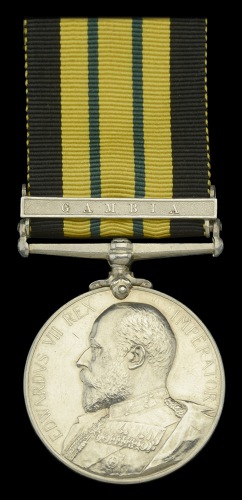
The scarce A.G.S. ‘Gambia’ awarded to Mr P. E. Wainewright, Travelling Commissioner in the Gambia, who died of Malaria on McCarthy Island, 16 May 1901
Africa General Service 1902-56, high relief bust, 1 clasp, Gambia (Comr. P. Wainewright, Gambia F.F.) good very fine £600-£800
This lot is to be sold as part of a special collection, Medals from an Africa Collection.

View
Collection
Awards to Civilians from the Collection of John Tamplin, Dix Noonan Webb, September 2003
Approximately 13 A.G.S. ‘Gambia’ clasps awarded to Civilians.
Percy Errington Wainewright was born in Plomesgate, Suffolk in 1865, and baptised at Iken, Suffolk in April of the same year. He was the son of Reverend Arnold Wainewright, and was appointed a Travelling Commissioner at South Bank, in the Gambia, 4 November 1896. Wainewright arrived in the Colony on that same day and was appointed a Justice of the Peace for the Colony two days later. At the time of the Diamond Jubilee of Queen Victoria in June 1897, Wainewright was one of the many inhabitants of the Gambia whose name appears on an Address to the Queen, published in the Gambia Special Gazette of June 1897. He attended a Levée at Government House on 21 of June, given by His Excellency the Administrator, Robert Llewelyn, C.M.G., but was unavoidably absent from a Dinner given by the Administrator three days later.
Wainewright transferred from South Bank to McCarthy’s Island District in November 1897, and an indication of what his circumstances were like is given in The Work of Samuel Budgett Balfour -Student of the University of Cambridge (the latter being record of Balfour’s travels and zoological findings, published in 1907):
‘During his stay on the Gambia, which lasted over eight months he made his headquarters at McCarthy Island some 150 miles from the mouth of the river. Here he met much kindness from officials, especially from the late Mr. P. Wainewright - Travelling Commissioenr with whom he stopped at Government House which he thus describes, “The House itself lays back from the river and near it laid two or three ruins of the barracks of former days. All is now waste and overgrown with bushes and jungle”. From time to time he accompanied Mr. Wainewright on his tours through the district under his charge, and lived under all sorts of varying conditions. Thus on 29th November 1898 he writes: “At times things were dangerous. At eleven o’clock at night a man tried to get into the hut where we slept, but stumbled over our native boy who slept at the door. Then Wainewright heard two men at the other door, which was lightly barricaded, discussing the possibility of killing the two white men. So we got our interpreter to sleep outside the hut, and we held our pistols in readiness, and passed the night in quietness”.
The frequent illness of his friend Mr. Wainewright caused him constant anxiety. On 27th May 1899, he writes “Worked in the swamp between the showers of rain. Read and wrote, Wainewright better in the evening. A herd of Elands are believed to have been seen in the distance, and I was presented with a skull taken by Mr. Wainewright from a carcass floating down the river”.
Wainewright took part in the operations in the Gambia from January to March 1901, for which he received the medal and clasp. He contracted malarial fever and died shortly afterwards, on 16 May 1901, at McCarthy Island. As Wainewright died intestate, his effects were sold by public auction at the Court House, Bathurst, 30 July 1901. He is commemorated on a plaque at St. Botolph’s Church, Iken.
Sold with copied research.
Share This Page