Auction Catalogue




 Create new list
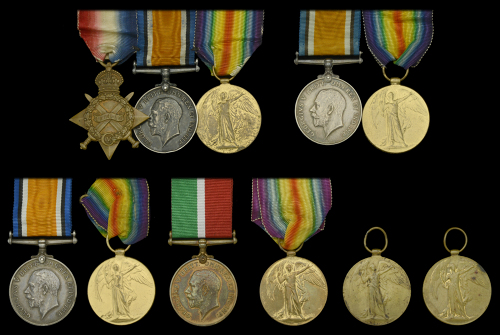
Three: Leading Seaman G. Harrison, Royal Navy, who died at the Royal Hospital Haslar in 1922
1914-15 Star (J.19548, G. Harrison, A.B., R.N.); British War and Victory Medals (J.19548 G. Harrison. L.S. R.N.) minor edge bruising, nearly very fine
Pair: Able Seaman S. Allen, Royal Navy
British War and Victory Medals (J. 73718 S. Allen. A.B. R.N.) mounted as worn, better than very fine
Pair: Able Seaman H. Roberts, Royal Naval Volunteer Reserve, who survived the torpedoing of the Q-Ship H.M.S. Zylpha in 1917
British War and Victory Medals (L.Z.3364 H. Roberts. A.B. R.N.V.R.) nearly extremely fine
Mercantile Marine War Medal 1914-18 (John Johnson); Victory Medal 1914-19 (3) (S.S.107451 J. R. Griffiths. L.Sto. R.N.; Ch.19130 Pte. A. G. Traylor. R.M.L.I.; M.Z.863 J. A. Waggett. L.S. R.N.V.R.) generally very fine and better (11) £140-£180
George Harrison, a pony driver, was born in Rawal Pindi, India, on 23 August 1895, and joined the Royal Navy as Boy 2nd Class on 31 August 1912. He spent much of the Great War stationed in Greece, before returning to Portsmouth on 10 April 1918 and serving in the destroyer H.M.S. Syren as part of the Dover Patrol from 22 July 1918 to 31 December 1918. Admitted to hospital in Gosport suffering from influenza and brocho-pneumonia, he was discharged dead on 11 January 1922.
Samuel Allen, an engine cleaner, was born in Northampton on 2 January 1897, and joined the Royal Navy as Ordinary Seaman on 13 July 1917. Posted briefly to Portsmouth, he spent the remainder of the Great War in the submarine service before being demobilised on 2 April 1919. He is later recorded in 1939 as a resident of Daventry, employed as a locomotive driver for the London and North Eastern Railway.
Herbert Roberts, a milk carrier, was born on 18 March 1897 and spent his childhood living with his mother at Lower Munlyn, Forden, Montgomeryshire. He joined the Royal Naval Volunteer Reserve on 2 October 1915 and was sent to the Q-Ship H.M.S. Zylpha under the command of Lieutenant-Commander Jock McLeod. An ex-collier built in 1894, H.M.S. Zylpha patrolled the waters of the North Atlantic and Irish Sea on the lookout for German submarines, experiencing a number of skirmishes with enemy u-boats in the spring of 1917.
Spotted by the U-72, her luck ran out on 11 June 1917 when struck by a torpedo which killed the Third Engineer. Sea Killers in Disguise by author Tony Bridgland, sets the scene:
‘Suddenly there was the almighty roar of an explosion and Zylpha seemed to leap clean out of the water in surprise. Nobody had seen the torpedo coming. It had crashed through the Q-Ship’s hull on the port side of the engine room. Almost instantly the ship’s engines were flooded and she lost way.’
McLeod ordered the ‘panic party’ away and they rowed around aimlessly, hoping to entice the submarine to the surface; unconvinced, the German Commander followed the ‘long range’ hit and run code and left the scene. Remaining afloat due to her holds being stacked full of timber, the crew waited for a second torpedo which never came. Taken in tow by H.M.S. Daffodil, the stricken Q-ship proceeded towards Bantry Bay on the Irish coast, but settled further in the water near the Great Skellig Rocks and eventually sank in a stiff squall. Her crew, including Roberts, were taken aboard the USS Warrington and returned to port in Liverpool.
John Robert Griffiths was born in Corwen, Merionethshire, on 25 July 1889, and joined the Royal Navy as Stoker 2nd Class on 16 July 1908. He served in the battlecruiser H.M.S. New Zealand from 23 November 1912 to 27 February 1918, and fought aboard her at the Battle of Jutland on 31 May 1916.
Albert George Traylor , a gardener, was born in Radnorshire on 13 October 1895 and enlisted in the Royal Marine Light Infantry at Birmingham on 15 September 1914. He served with the Royal Marine Brigade in the Dardanelles and France, and was later discharged from the Chatham Division on 15 June 1922.
John Albert Waggett, a painter, was born on 15 January 1888 and enlisted in the Royal Naval Volunteer Reserve on 27 November 1915. He served in the steam drifter H.M.S. Lavatera as part of the Auxiliary Patrol from 16 February 1918 to 5 March 1918, and was demobilised on 7 March 1919.
Sold with copied research.
Share This Page