Auction Catalogue




 Create new list
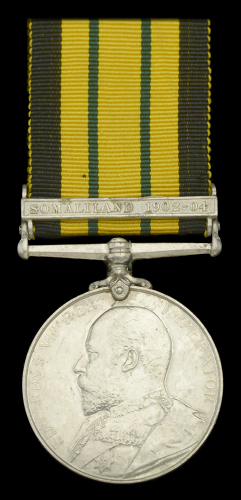
The scarce A.G.S. ‘Somaliland 1902-04’ medal awarded to Sepoy Niyaz Ali, 2nd Sikh Regiment, who was one of 50 men of the regiment who were all killed in action at Gumburu, 17 April 1903 - when a force of thousands of Dervishes led by the Mad Mullah threw themselves on an isolated square of infantry, inflicting casualties of ‘9 British officers killed, and 187 men killed and 29 wounded. There were only six unwounded survivors’. Known afterwards as the “Gumburu Disaster”, the 2nd Sikhs had formed the front face of the square and it was reported that they lay dead in an unbroken line and that their face of the square was unbroken
Africa General Service 1902-56, 1 clasp, Somaliland 1902-04 (1677 Sepoy Niyaz Ali. 52nd Sikhs.) good very fine £500-£700
This lot is to be sold as part of a special collection, Medals from an Africa Collection.

View
Collection
Niyaz Ali was killed in action at Gumburu, 17 April 1903.
The following additional detail is given about the “Gumburu Disaster” in D. J. Jardine’s The Mad Mullah of Somaliland:
‘On the following day, the 17th April, Cobbe ordered two reconnaissances. The one, which will ever be remembered in the annals of Somaliland, was to the westward and consisted of one company of the 2nd Battalion of the King’s African Rifles, under Captain H. E. Olivey, of the Suffolk Regiment. This company left camp at 4.45am. Three hours later Olivey despatched a message to Cobbe saying that he was three to four miles out, had seen no enemy, and was about to return. Twenty minutes later at 8.15am he despatched a second message to say that the Dervishes, horses and foot, were advancing; that he was retiring; and that he required reinforcements. Lieutenant Colonel A. W. V. Plunkett, of the Manchester Regiment was immediately ordered to take out another company of the 2nd Battalion King’s African Rifles, together with fifty men of the 2nd Sikhs, who had joined Cobbe’s column on the previous day, and two Maxims, and to bring in Olivey’s company. Just as Plunkett was starting, another message was received from Olivey saying that he was within a mile and a half of the camp and was not in action. It was to prove the last message received from the British officers employed on this ill-fated reconnaissance or from Plunkett’s relieving force.
Although Plunkett’s instructions had been confined to bringing Olivey in, and although the latter was within a mile and a half of the camp when the relieving force went out, the fight at Gumburu took place some seven miles from the zariba. The presumption, therefore, is that after meeting Olivey, which he should have done within a mile of the camp, Plunkett must have proceeded further and been drawn on by the enemy until he was attacked by the whole of the Mullah’s forces. As no British officer survived to tell the tale of Gumburu it is necessary to reconstruct the story from the evidence given by the Yao survivors.
It appears that after Plunkett’s force met Olivey’s they formed square, with the Sikhs in the front face, and marched some six miles further on to an open spot surrounded by thick bush, in which the enemy were mustered, commanded so it was said, by the Mullah in person, and numbering some 4,000 horse and 10,000 foot. From three sides the Dervish horsemen swooped down upon the square, firing from the saddle as they came. While the front face and flanks were thus completely engulfed in a surge of horsemen calling on Allah and hurling imprecations at the infidels, the spearmen and dismounted riflemen attacked our rear.
Again and again the Mullah’s cavalry precipitated themselves into the square which stood firm, fighting with grim determination. The Maxims at the corner of the square swept the enemy, whose dead lay in great heaps all round. One by one the British officers fell urging their men to stand. Plunkett was the first to be hit, and he also received a spear thrust. But he fought on until the last. Neither the Maxim nor the rifle fire of the square succeeded in stopping the rushes of the Dervishes, whose frenzied valour, encouraged by the shrill cries of their womenkind in the rear, impelled them to charge the square time and again, impervious to the terrible punishment that was being meted out to them. Indeed, it is difficult to know which to admire most - the dogged courage of the Sikhs, Yaos and Somalis as they stood firm in the square, hopelessly outnumbered, or the fanatical contempt for death displayed by the savage enemy. Finally when our ammunition was all but expended, Plunkett gave the order to break up the square and charge back to Cobbe\s zariba, some seven miles distant. With fixed bayonets, the survivors of the square fiercely rushed the exulting Dervishes, but, although they put up a most heroic fight, the British force was eventually worn down by sheer numbers. Our total casualties were 9 British officers killed, and 187 men killed and 29 wounded. There were only six unwounded survivors.’
The Regimental Medal Roll contained in W.O.100 shows the 2nd Sikh Regiment listed under its new Regimental title as the 52nd Sikhs. Noted against the names of the men who were killed at Gumburu is the date 17 April 1903. All fifty men of the force which accompanied Plunkett were killed - there were no survivors from the 52nd.
A British officer visiting the battlefield soon after the engagement reported that the 2nd Sikhs lay dead in an unbroken line and that their face of the square was unbroken. Indeed, the staunch behaviour of the Sikh contingent at Gumburu was universally praised; in May 1903, Lord Kitchener, C-in-C in India, commended them in a public lecture and General Manning, commanding forces in Somaliland, spoke of the universal admiration for their bravery and dedication.
Sold with copied research.
Share This Page