Auction Catalogue




 Create new list
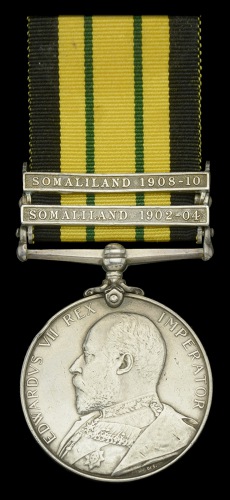
A particularly fine A.G.S. and 2 clasps awarded to Colonel F. L. Lloyd-Jones, 1/113th Infantry attached 102nd Grenadiers, who was the Commandant of Fort Sulaik when it was attacked and besieged by around 1,000 Kotaibi tribesmen, 25 - 29 October 1903. With approximately 60 men, Lloyd-Jones carried out an epic defence, and counter attack, against overwhelming odds - being severely wounded in the process.
The action was part witnessed and recorded in detail by George Wyman Bury - the British Explorer and Political Officer - in his book The Land of Uz: ‘When I got back to Salaik [sic] I was much distressed to find that the Commandant of that post severely injured with a badly shattered thigh and several flesh wounds. He had been shot down at the head of the main attack and while firing from the ground drew repeated shots from the Kotaibi positions at pistol range.’
Africa General Service 1902-56, 2 clasps, Somaliland 1902-04, Somaliland 1908-10 (Capt: F. L. Lloyd Jones 102nd P.W.O. Grendrs.) edge bruise, nearly very fine £800-£1,000
This lot is to be sold as part of a special collection, Medals from an Africa Collection.

View
Collection
M.I.D, London Gazette 17 February 1905:
‘Captain F. L. Lloyd-Jones 113th Infantry attached 102nd Grenadiers, who was in command of the Sulek [sic] Post when it was attacked by the Kotaibis from 25th to 29th October, 1903 and who was severely wounded in action of 29th October.’
M.I.D. London Gazette 12 January 1920 [Mesopotamia].
F. L. Lloyd-Jones was born in September 1867, and commissioned Second Lieutenant in February 1888. He advanced to Captain in February 1899, and served with the 113th Infantry, Indian Army. Lloyd-Jones was attached to the 102nd Grenadiers for operations in Somaliland. He was in command of the troops at Fort Sulaik when the following happened:
‘Severe Fighting in the Aden Hinterland - News comes by way of Aden that Captain Lloyd-Jones and sixty men were surrounded by 1,000 of the Kotaibi tribe at Sulaik, four miles west of Hardaba. The captain reported that he was running short of ammunition and had eight men killed. Sulaik was relieved by Colonel Scallon after a sharp fight, in which Captain Lloyd-Jones was wounded, but is doing well’ (Driffield Times, 7 November 1903 refers)
Additional details were added a few days later in the Edinburgh Evening News:
‘From some of the earliest details of the Hinterland just received here it appears that Captain Lloyd-Jones, commanding at Suleik [sic] sent out a patrol of native light infantry, which was ambushed, four men being killed and one wounded. The Kotaibees then attacked Suleik which was besieged for four days. An attack was made on the hill commanding Suleik camp by Captain Lloyd-Jones with native infantry. A determined resistance was offered, but the position was carried at the point of a bayonet. Captain Lloyd-Jones received four wounds but is doing well and is being sent down to Aden.’
The action was also recording in detail by the British Explorer and Political Officer George Wyman Bury in his book The Land of Uz (written under his Arabic pseudonym, Abdullah Mansur):
‘Meanwhile the Kotaibi tribe had been seething for some time. A stony thinly bushed expanse commanded from a low ridge on the left bank of the wadi by a defensible serai known general as Fort Salaik [sic]. The post was garrisoned by a detachment of the 102nd Bombay Grenadiers under a double company commander (the Commandant of Salaik).
A messenger got through from Salaik with a letter from the Commandant [Lloyd-Jones] reporting that the Habilein patrol had been ambuscaded from the tamarisk belt further down the wadi near the former Customs Post of the Kotaibi, presumably by the members of that tribe, who had killed seven sepoys and a havildar. Another sepoy had been wounded but got back to the fort. The post was beset. The Commandant had called for volunteers and brought in the bodies which had not been mutilated.
The column halted near the head of the pass to straighten out its tail, and as I drew rein the G.O.C. came up and with a hand on the mares neck emphasised his final instructions. “To relieve Salaik, to thrust the Kotaibi back across the wadi leaving Salaik plain clear for the arrival of the supporting column”. For Salaik must have been awaiting this development and re-opened with a fierce and strenuous rattle to enfilade that reach, and the Kotaibi skirmishers were pushed back across the wadi.
The Commandant met me in the wadi at the foot of the “col” on either eminence of which stand the village and the post respectively. I sniffed enquiries and the Commandant pausing remarked pensively. “That’s all this is left of my best havildar”. I tendered my condolences. “Come up”, he replied “and watch the men getting some of their own back”. He led the way up into a little “keep” on the crest with a guard hut annexed, all home made of undressed stone. I looked round to see what the column was doing. “They won’t want you yet a while”, observed the Commandant. “Look there go the guns”. It was a sight worth looking at. Meanwhile the Commandant showed me round the post to see the various fakements he had introduced since I was there last, for the benefit of the Kotaibi. A barbed wire fence encircled the position, with empty tin cans strung along it each containing a pebble or two. “The old Sheikh in the village”, the Commandant remarked, “told me that the Kotaibi would probably try and taint our well by emptying a tin of kerosene down it. He said it was a favourite trick”.
The preliminary step was heralded by a brisk crackle of firing which ran along the right bank of the wadi up to our “keep”. Here the Commandant and myself were attending to a sportsman who was making himself very obnoxious from two alternate positions on either side of a boulder high up on the flank of the near kopje. After several well meant efforts, we watched him fire from position number one and then sighting on position number two, fired simultaneously at his smoke. The prolonged silence that ensued from that spot aroused in us grave hopes. I thank the Commandant for his entertainment. “Good luck - take care of yourself - good people are scarce”, was his farewell. “Rather” I replied making my own way down the slope.
When I got back to Salaik I was much distressed to find that the Commandant of that post severely injured with a badly shattered thigh and several flesh wounds. He had been shot down at the head of the main attack and while firing from the ground drew repeated shots from the Kotaibi positions at pistol range.’
Lloyd-Jones ultimately returned to the 1/113th Infantry, advanced to Major in February 1906, and to Lieutenant Colonel in February 1914. He served with the regiment during the Great War in Mesopotamia (entitled to BWM and VM; M.I.D.).
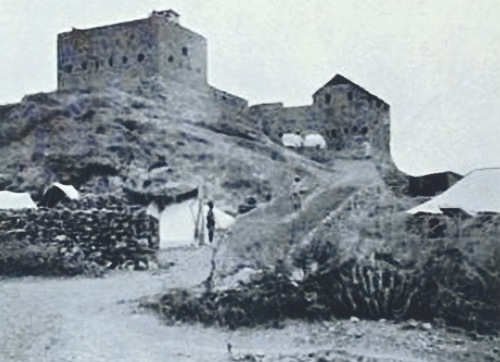
Sold with copied research, including a photographic image of Fort Sulaik - as illustrated in The Land of Uz.
Share This Page