Auction Catalogue



 Create new list
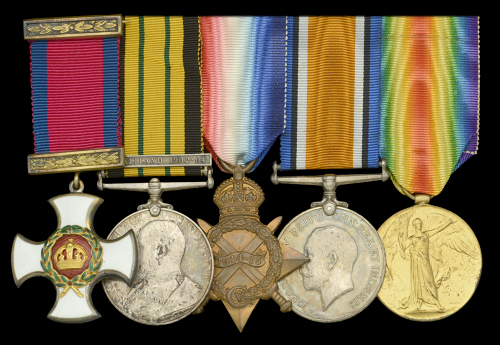
An unusual Great War D.S.O. group of five awarded to Engineer-Commander P. L. Butt, Royal Navy, for gallantry in action on board H.M.S. Partridge in December 1917, when he ensured that his ship would sink and not fall into the hands of the enemy
Distinguished Service Order, G.V.R., silver-gilt and enamels, with integral top riband bar, in its Garrard & Co case of issue; Africa General Service 1902-56, 1 clasp, Somaliland 1902-04 (Eng. Sub. Lt. P. L. Butt, H.M.S. Hyacinth.); 1914-15 Star (Eng. Lt. Cr. P. L. Butt. R.N.); British War and Victory Medals (Eng. Lt. Cr. P. L. Butt. R.N.) extremely fine (5) £1,000-£1,400
This lot is to be sold as part of a special collection, A Fine Collection of Medals, the Property of a Lady.

View
Collection
D.S.O. London Gazette 24 May 1919:
‘Butt, Percy Lovel, Engineer Lieutenant-Commander (now Engineer-Commander), Royal Navy. For gallant conduct in action on board H.M.S. Partridge on the 12th December 1917. H.M.S. Partridge, while screening a Scandinavian convoy, was attacked by a superior enemy force and put out of action. Engineer Lieutenant-Commander Butt, in order to make sure that the ship would sink and not fall into the enemy’s hands, went three times into the engine room, which was full of steam, and remained there until there was no doubt that the vessel would sink.’
A lengthy account of the attack on the Scandinavian Convoy, 11-12 December 1917, is given in Naval Operations, Vol. 5, by Henry Newbolt from which the following extract is taken:
‘Lieutenant-Commander J. R. C. Cavendish of the Pellew hoped that he would be able to gain time for the convoy by engaging the enemy closely and hotly; but the Germans were in sufficient strength to thwart his manœuvre. Three of their destroyers steered a parallel course to that of the Pellew and Partridge, and engaged them fiercely; the fourth was detached to deal with the convoy.
The British destroyers were no match for their opponents, and they were, moreover, in the leeward position. The north-west wind swept a blinding storm of spray into the faces of their gunners, and when the Partridge and Pellew were in the trough of the waves, nothing was to be seen of the enemy except their masts, and the tops of their funnels.
The Germans made admirable use of their advantage; and, as usual, their fire was extremely accurate and rapid. Although the terrible precision of the enemy's shooting meant death to most of those who saw it, the officers and men in the British destroyers watched the fall of the German salvoes with a sort of bitter admiration. From the very beginning matters went badly with the British destroyers, and both began to suffer. The Partridge, indeed, was a doomed ship.
After a few moments of firing, a shell struck her at the forward end of the engine-room, and severed the main steam-pipe. In an instant the engine-room was filled with scalding steam, and the ship came to a standstill. Everybody working at the engines was scalded to death, and, though Engineer-Commander P. L. Butt and a chief engine-room artificer attempted repeatedly to enter the engine-room and give assistance, they were always driven out by the boiling steam.
A few minutes later another shell struck the after gun, and put it out of action; almost simultaneously a torpedo struck the ship forward, and she began to settle down. The Partridge had now as little power of manœuvre or resistance as an ordinary practice target, and Lieutenant-Commander R. H. Ransome, the commanding officer, gave orders that the ship was to be abandoned; at the same time he directed the engine-room staff to do everything in their power to see to it that the ship sank rapidly.
As the crew were attempting to clear away the boats, the enemy’s destroyers came inside the firing arc of the Partridge's torpedo tubes; but in order to cause no delay in the escape of any possible survivors, Lieutenant A. A. D. Grey and Lieutenant L. J. B. Walters determined to fight the torpedo tubes by themselves. They manned the after tube, and fired a torpedo which struck one of the enemy's destroyers without exploding; they then went forward, but found that the deck beneath the other tubes was so buckled that the training gear was immovable. Soon afterwards Lieutenant Grey was wounded in the thigh; he was put, with the first lieutenant, into a boat which capsized, and threw both of them into the water: Lieutenant Grey now mustered his strength for a great effort. He saw that the first lieutenant was getting very exhausted, and helped him to swim to the nearest raft. When they reached it Lieutenant Grey found that it would carry only one more person; he refused to take the vacant place himself, but put the first lieutenant on to it, and swam away towards the nearest German destroyer. The water was intensely cold, and he was swimming in it for nearly half an hour with the blood flowing from his wound all the time; but he reached the German destroyer at last, and the German seamen hauled him on board; just before he fell down unconscious, he saw a terrific explosion in the Partridge, as she sank, struck by a third torpedo.
Note: These details were supplied, later, by Engineer-Commander Butt, on whose recommendation Lieutenant Grey was awarded the Silver Medal and Certificate of the Royal Humane Society. Equally meritorious was the action of Engineer-Commander Butt, who was awarded the D.S.O. He tried, three times, to get into the engine-room after the main steam-pipe had been severed. He finally succeeded when the ship was sinking: it was still full of steam, and pitch dark, as the dynamos had long since ceased to work; but he groped his way through the steam and darkness, and rising water, and opened the door of the starboard condenser, in order to make the ship sink more rapidly.’
For the recipient’s related miniature awards, see the following lot, Lot 2.
Share This Page