Auction Catalogue




 Create new list
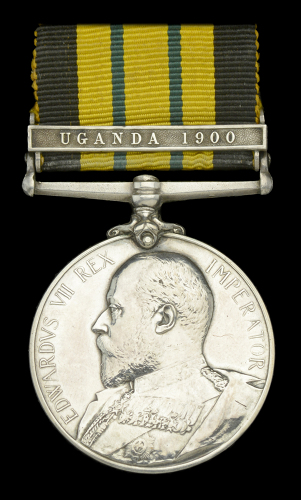
The rare A.G.S. ‘Uganda 1900’ awarded to Mr. S. Browning [C.M.G.], attached Uganda Rifles, and later Provincial Commissioner, Western Province, Uganda - a colourful character, who mixed official duties with big game ‘poaching’ as recorded in African Roses by J. R. P. Postlethwaite. The latter’s book of short stories and poems chronicled British colonial figures living and working in Africa. The book was published in 1937, but the names used were fictitious and in the case of Browning - he was represented by “Pete Pearson”. With a chapter dedicated to him, “Pearson” was described as ‘strolling along, rifle on shoulder, and the inevitable cigarette in the corner of his mouth...’
Africa General Service 1902-56, high relief bust, 1 clasp, Uganda 1900 (S. Browning. Uganda F.F.) mounted for wear, very fine £800-£1,200
This lot is to be sold as part of a special collection, Medals from an Africa Collection.

View
Collection
Sidney Browning was born in 1866, and was a native of Richmond Surrey. He was appointed Assistant Collector, British Central Africa in 1893, and served in a similar capacity in Nyasaland Protectorate the following year. Browning was employed as a 3rd Class Assistant Collector in Uganda in May 1900. He was attached to the Uganda Rifles for operations in the Nandi country, 3 July - October 1900.
Browning transferred to the Uganda Protectorate Accounts Department at Entebbe in May 1901, and was appointed the Chief Cashier the following month. After a period of leave in the UK, Browning transferred from the post of Assistant Treasurer to Assistant Collector in October 1904. He served in the latter capacity at Masaka, and was promoted to Collector in January 1905. Browning subsequently became District Commissioner and then Provincial Commissioner, Western Province in 1914.
Browning was an active big game hunter during his spare time, and his activities are described in African Roses by J. R. P. Postlethwaite. The latter being a British Colonial Administrator, whose book of short stories and poems chronicle British colonial figures living and working in Africa. The book was published in 1937, but the names used were fictitious and in the case of Browning - he was represented by ‘Pete Pearson’. In the book there is a poem dedicated to ‘Pete’, and a whole chapter detailing his poaching activities. In 1910 Parliament discussed the particularly undisciplined behaviour of certain British officers hunting elephants in Lado, as the territory changed ownership.
A flavour of Pearson/Browning’s character is given below:
‘Six weeks before this story commences, a safari left Nimule for an unknown destination. Six tough looking natives of various tribes and types, armed with more or less serviceable martinis, a string of Swahili porters carrying kit and provisions and Pete Pearson strolling along, rifle on shoulder, and the inevitable cigarette in the corner of his mouth.
All went according to plan until five weeks later, when on the return journey the hunting party were only one day’s march from the river. They had camped for the night in a rocky nullah secure, as they thought from attack. A returning body of Congo native police, however, who had been engaged on tax collecting duty not entirely free from personal commission, happened to notice the smoke of the camp fires in the distance. The scrap that followed would have made the fortune of any film company but it had a somewhat different effect on Pete’s financial resources. The askaris outnumbered the poacher’s fighting force by three rifles to one and in addition had the supreme advantage of surprise and cover in the rocky hills that overlooked the encampment.
The porters rapidly panicked and fled leaving three dead on the ground while the armed members of the party, taking what shelter they could find, proceeded to back slowly down the valley. This is not an account of the gorgeous fight that followed, which has become a saga often told by the natives of the hill villages, suffice to say that Pete and three natives reached the river and safely leaving his kit, ivory and the rest of his rifles, and ammunition in the hands of the protectors of law and order, who also paid their toll, losing two-thirds of their number dead and wounded.
A mule cantered up to the District Commissioner’s house and Willoughby [D. L. Baines] dismounted, throwing an official looking document on Pete’s knee. The paper was in French and was to the effect that a reward of two thousand francs was offered for the capture of one Pete Pearson, alleged to be a British subject, who had broke the Congo game laws and was accused of the murder of ten native policemen. Pete reflectively tossed the butt of his cigarette over the edge of the verandah. “Murder”, he said. “I like that. If I hadn’t been pretty quick with my gun the devils would have had me, it was them or me.” His grammar was not his strong point.’ (African Roses, by J. R. P. Postlethwaite)
Browning’s brushes with foreign officials seems to have had no effect on the rest of his career, and he retired in 1921 (C.M.G.). He died in October 1928.
Sold with copied research, including a small photographic image of recipient as illustrated in Europeans in British Administered East Africa: A Biographical Listing (1888-1901) by S. J. North.
Share This Page